
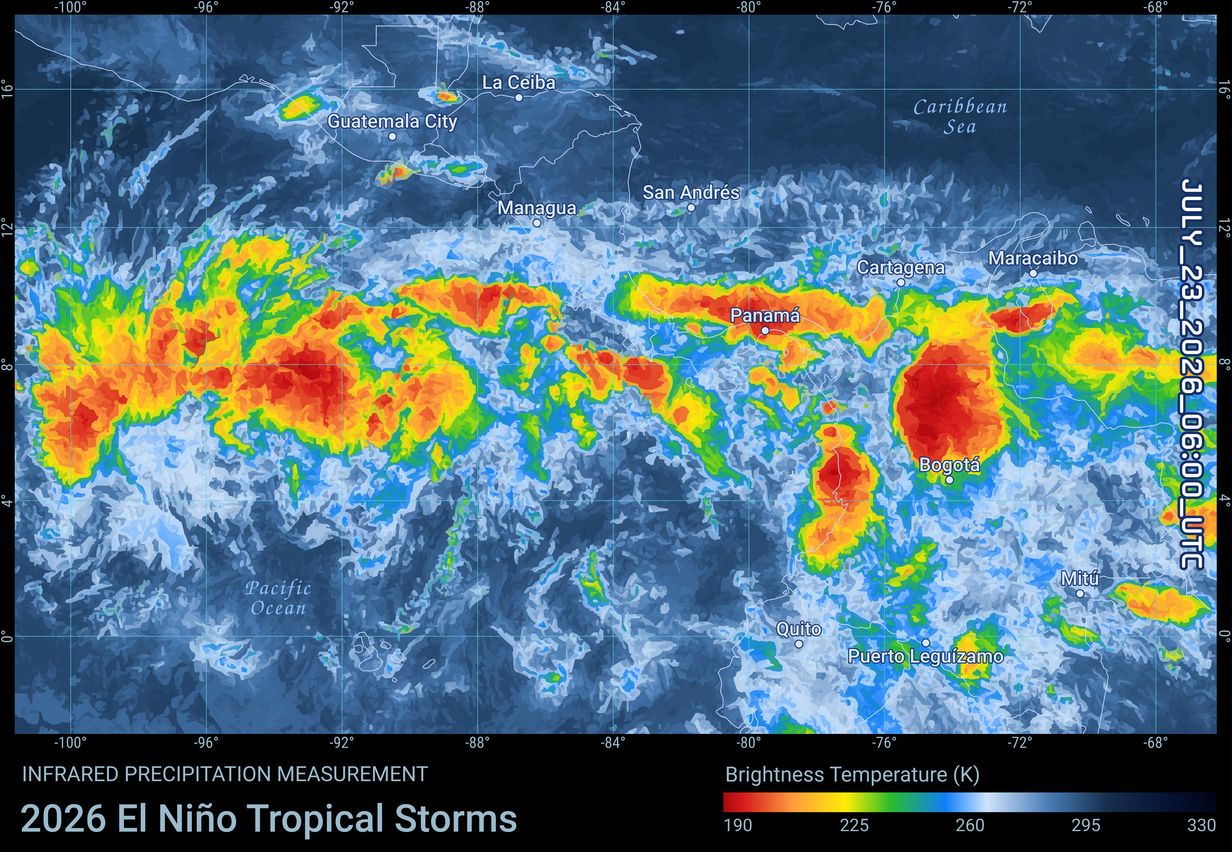
The chances that 2026 becomes the hottest year on record have nearly doubled in a month – from 12 per cent in July to 69 per cent in August – according to the latest analysis from Berkeley Earth, a nonprofit research group that tracks global temperature data. The nonprofit points to an unusually powerful El Niño, and the fallout is already showing up on three continents at once.
Crops are failing in Argentina and Indonesia, London has just sweltered through its hottest day of the year, and India’s monsoon is running well below par. Forecasters say the El Niño driving much of these weather events could yet intensify into one of the strongest on record. This year’s El Niño is expected to push global temperatures to record-breaking levels, and it is already driving crop failures across several continents.
The US Climate Prediction Center puts the odds of a stronger El Niño developing this autumn and winter at more than 90 per cent, with a 69 per cent chance that it reaches historic strength between October and November – the strongest since records began in 1950. The heat is already showing up in the data: this July was the joint second-warmest on record, with average surface air temperatures running 1.47°C hotter than the pre-industrial (1850–1900) baseline, according to Copernicus.
How it works
El Niño begins with rising sea-surface temperatures in the central and eastern tropical Pacific. That heat drives further condensation, which shifts atmospheric circulation and nudges major jet streams out of position – triggering excess rainfall and temperature swings thousands of kilometres away. It doesn’t just raise the temperature; it redistributes heat and rainfall, bringing drought to some regions and flooding to others.
In July, the World Meteorological Organization (WMO) put the odds that El Niño will shape weather patterns for the rest of the year at 90 per cent. The International Research Institute for Climate and Society recorded sea-surface temperatures at +1.55°C in June, rising to +2.1°C by mid-July.
Latin America: drought in the south, floods in the north
Southern parts of Latin America are bracing for wetter conditions, while the north faces drought and heat. Argentina, Paraguay, Uruguay and southern Brazil are all facing heightened drought risk. Peru, by contrast, faces high flood risk, and its fishing industry is already suffering as fish move to deeper, cooler waters.
Africa: drought in the south, floods in the east
Southern Africa is bracing for intensifying drought, while parts of East Africa face heavier rainfall. In 2023, El Niño brought crop failures to southern Africa and damaging floods to the east.
Asia: dry fields, a weak monsoon
In Indonesia, an unusually dry spell is hurting farmers with crop losses, even as salt producers benefit from ideal evaporation conditions.India hasn’t been spared either. The WMO forecast below-average monsoon rainfall for South Asia between June and September. As of August 11, Reuters reported India’s monsoon rainfall was running 12 per cent below average for the season, with western, southern and central regions expected to stay drier over the following fortnight.
India leans heavily on the monsoon for farmland irrigation, so a weak one risks poor harvests, higher food prices and added strain on electricity generation and drinking-water supplies. Scientists, however, caution against pinning the shortfall entirely on El Niño, as a positive Indian Ocean Dipole (IOD), a climate pattern driven by the temperature gap between the western and eastern tropical Indian Ocean, is also expected to develop this year and could amplify or offset El Niño's influence.
Europe: a heatwave with a different cause
Western Europe has just had its hottest June-July period on record, fuelling droughts and wildfires. France has endured one of its longest heatwaves on record, with temperatures hitting 37-39°C in places. The UK recorded 38.1°C at Kew Gardens in west London on 13 August – its hottest day of 2026 so far and the UK’s fifth heatwave of the year – while Spain reached 42.4°C.Notably, the WMO says El Niño isn’t entirely to blame for Europe’s heat, as persistent high-pressure systems, unusually warm seas, parched soils and broader climate change may have contributed to the unusually hot summers in Europe.
It is too early to call 2026 the hottest year on record, but the Met Office puts the probability at 86 per cent that at least one year between 2026 and 2030 will overtake 2024, the current record-holder. El Niño remains a contributing factor to that broader warming trend.
Inside the JRC’s global assessment
The JRC report is the most detailed global picture yet of what this El Niño could mean. Modelling several possible intensity scenarios, including the one it flags as unprecedented, it finds that El Niño’s climate impacts will be felt across 2026–27 across much of the world, and could persist even after the event peaks between December 2026 and February 2027.The report's findings go well beyond the weather.
Using a new tool called INFORM Warning, which combines hazard forecasts with data on conflict, food insecurity and economic conditions, the JRC finds several Central African countries – along with Sudan, Somalia, South Sudan and Chad –carry the highest humanitarian warning levels worldwide, as El Niño compounds existing conflict and displacement, while Ecuador, Venezuela and Haiti are flagged as at risk of humanitarian deterioration as drought compounds pre-existing crises.
On food prices, global durum wheat is expected to climb sharply as the event strengthens, with maize also likely to edge up, while soybean and Hard Red winter wheat prices are expected to fall across all scenarios modelled. The JRC also notes that this El Niño could be strong enough to flip Europe’s usual pattern. The World Food Programme has warned that drought and crop failure linked to a powerful El Niño could push nearly 49 million more people into acute food insecurity by the end of 2027 – a figure the JRC’s country-level modelling now helps map more precisely onto specific at-risk regions.