
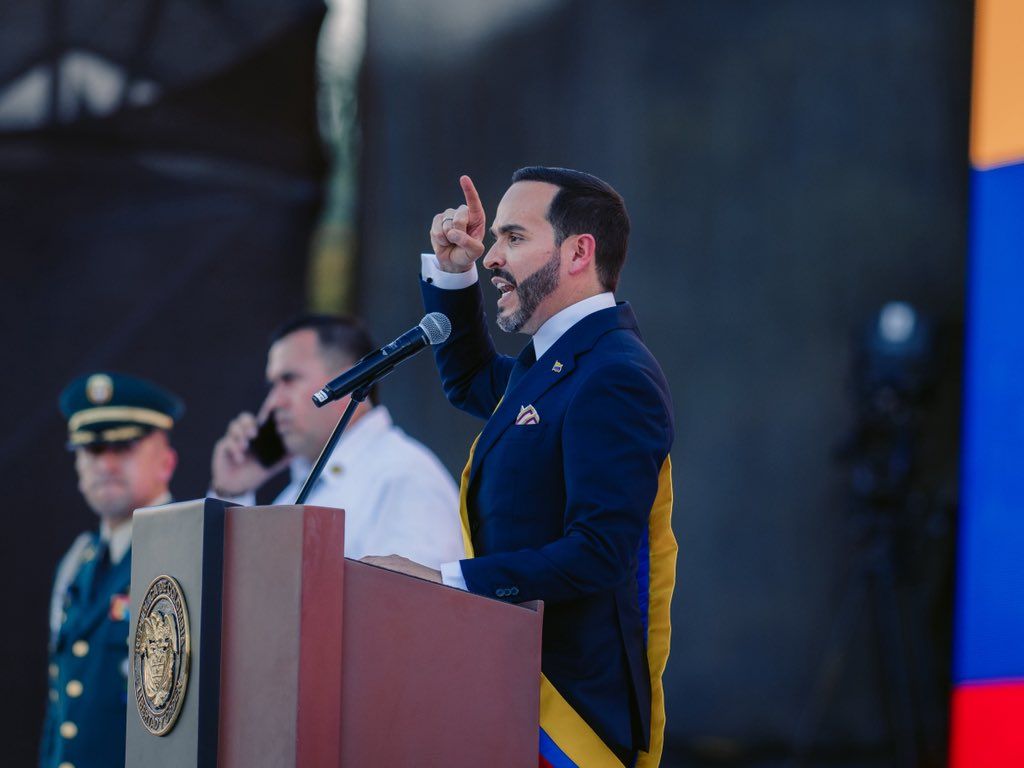
Right-wing lawyer Abelardo de la Espriella was sworn in as Colombia’s president on August 7, capping one of the country’s most tightly-fought elections and marking a sharp break from four years of friction with Washington. The vote was closely watched abroad: outgoing leftist president Gustavo Petro had been one of the Trump administration’s most vocal critics in Latin America, while his successor was openly endorsed by US President Donald Trump himself.
With the presidency now in the hands of a Trump ally, Washington has promised a revival of military and security cooperation with Bogotá.The 48-year-old Espriella, replaces Petro, whose government repeatedly clashed with the Trump administration over deportations, counternarcotics policy and US intervention in regional politics. He won a close contest on June 21 against Petro’s chosen successor, Iván Cepeda of the Pacto Histórico – a margin of under one percentage point, the narrowest in Colombia’s electoral history.
These elections also saw the country’s highest turnout in decades. Corruption, crime and the future of Petro’s negotiated “total peace” with armed groups dominated the campaign, alongside a significant question: whether Colombia would align more closely with Washington or chart a more independent course. A reboot of the military relationship is already under way. Washington and the incoming government are moving ahead with a cooperation plan covering intelligence-sharing, counternarcotics operations and extraditions.
Incoming defence minister Jorge Eduardo Mora described the plan, dubbed Plan Patriot 2.0, as marking “a new stage of cooperation, integration and joint action” that would help restore Colombia’s military capabilities, according to New York Times. The US State Department has separately said it plans to pledge $1 billion in security assistance, pending congressional approval. Colombia has long been America’s strongest military partner in Latin America.
Under the earlier “Plan Colombia”, Washington supplied millions of dollars in military aid that helped Colombian forces weaken FARC, the Marxist-Leninist guerrilla group that had waged an asymmetric war against the state since 1964. FARC signed a peace accord in 2016 and formally demobilised, transitioning into a political party.Espriella emerged as the strongest right-wing challenger to Cepeda, well ahead of Paloma Valencia of the Democratic Centre and centrist Sergio Fajardo, both of whom trailed badly in the first round.
Cepeda ran on continuity with Petro’s agenda: negotiating with armed groups and prioritising social welfare. Espriella promised the opposite – ending talks with armed groups, cracking down on drug trafficking and expanding prisons – a hard-line security platform that resonated with voters wary of rising violence. He vowed to hunt down armed-group members that he had declared military targets “like cockroaches, like rats”, promising to unleash a reckoning on them unlike anything Colombia had seen.
Espriella claimed that closer ties with Washington was an economic necessity, not just ideological affinity. He pointed to the fallout from Petro’s confrontations as proof that antagonising the US carried real costs – most visibly the January 2025 stand-off, when Trump threatened tariffs of up to 50 per cent after Petro blocked US deportation flights, a dispute that was resolved only once Bogotá backed down. Foreign direct investment languished below US$1billion per month for more than a year under Petro, while remittances from Colombia’s US diaspora overtook FDI as the country’s top source of dollar inflows for the first time in two decades.
On the campaign trail and in office, Espriella has pitched himself directly to business as the corrective, pledging to investors that Colombia would again be “a safe and profitable decision”, casting realignment with Washington as the fastest route back to market confidence. Washington, in turn, stands to gain on several fronts. A friendlier Bogotá gives the US a renewed foothold against Chinese influence in the region. China overtook the US as several South American economies' top trading partner during Petro’s term, and Colombia’s incoming government has flagged countering that influence as a priority.
Espriella has also pledged to join the US-led “Shield of the Americas” coalition, giving Washington a fresh regional security anchor and a partner willing to reopen aerial coca eradication and expand joint military operations against groups it designates as terrorist organisations – an approach Petro had resisted. Colombia also hosts the largest population of Venezuelan migrants of any country, and a Espriella government gives Washington a more cooperative partner on regional Venezuela policy at a moment when the US has sharply escalated its own involvement there.
With Colombia’s coca cultivation at record highs and the country designated by Trump as having “failed demonstrably” on counternarcotics obligations, closer cooperation also lets Washington claim progress on a politically salient issue at home. On the other hand, Espriella’s push to revive oil, gas and mining investment – paused under Petro – will likely open the door wider for American firms.