
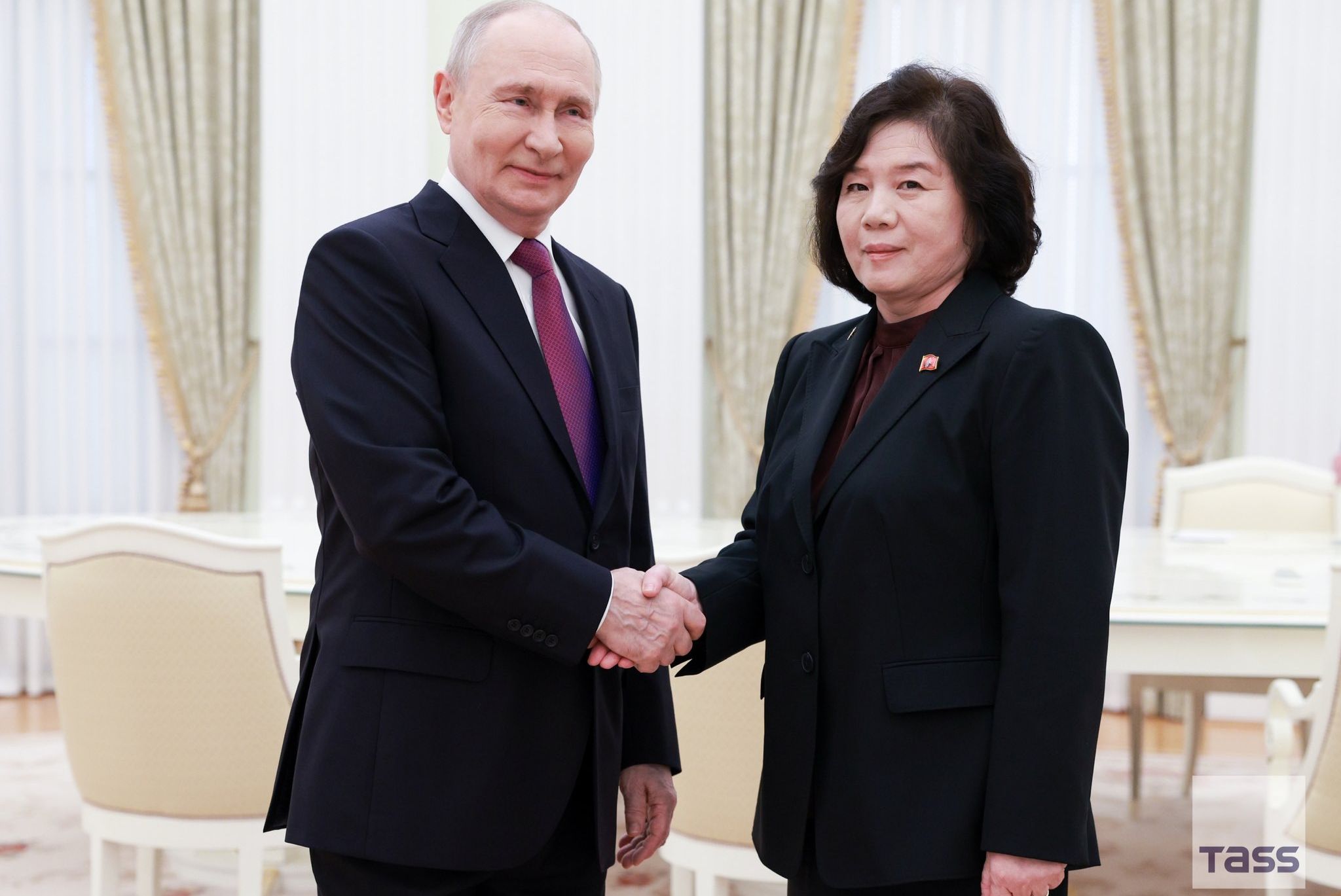
North Korean Foreign Minister Choe Son Hui travelled to Moscow on Sunday (July 19) at the invitation of her Russian counterpart, Sergey Lavrov – a visit notable less for what was said than for when it happened. There is no multilateral summit, treaty anniversary or other obvious occasion to explain the timing.
Lavrov has yet to comment publicly on the visit’s purpose. The trip comes just days after Chinese People’s Political Consultative Conference Chairman Wang Huning met North Korean leader Kim Jong Un on July 17, placing Pyongyang at the centre of high-level diplomacy with both of its major patrons within the same week.
A relationship built on wartime necessity
Putin and Kim have met twice on Russian soil, in 2019 and 2023, and again in June 2024 in Hanoi, where the two leaders signed a mutual defence pact pledging aid should either country face aggression – an agreement widely regarded as the strongest bilateral partnership either country has forged since the Cold War.
That partnership has since moved well beyond symbolism. When Russia needed to repel a major Ukrainian incursion into its western Kursk region in 2024, North Korea deployed 14,000 soldiers in support. In return, Moscow has supplied Pyongyang with fuel, food, economic assistance and military technology, including fighter jets and short-range missile systems. According to Russia's Tass news agency, Putin praised the strength of bilateral ties during his meeting with Choe at the Kremlin, reiterating his “gratitude to the North Korean leadership and people” for their support of Russia’s military campaign in Ukraine. Choe, for her part, told Putin that Kim remains committed to the “comprehensive development” of relations with Moscow. It was her second visit to the Russian capital in under a year; she last met Putin there in October 2025 to discuss deepening cooperation.
South Korea’s Unification Ministry, which handles North Korea policy, has declined to speculate on the substance of the talks. Spokesperson Yoon Min-ho said the ministry would not assess whether Moscow and Pyongyang were discussing a further summit between Putin and Kim.
Pyongyang’s two-track strategy
Kim has increasingly prioritised Russia in his foreign policy, while simultaneously courting closer ties with Beijing – he hosted Chinese President Xi Jinping for a summit in Pyongyang in June. The near-simultaneous engagement with senior officials from both powers this month indicates that North Korea is deliberately deepening relationships with its two principal benefactors in tandem, rather than favouring one over the other.
Why the region is on edge
The prospect of North Korea gaining broader access to advanced missile, satellite, air defence and submarine technology – the likely long-term payoff of its military support for Russia – is a growing concern for South Korea, according to a NATO Defense College analysis. Japan shares that unease, already contending with frequent North Korean missile tests alongside rising Chinese military activity in the East China Sea.
Senior US military officials have said the deepening coordination among Russia, China and North Korea is forcing Washington to prepare for the possibility of simultaneous crises across multiple regions, according to reports on US-Japan military planning. That assessment is reinforcing an argument that NATO has made for some time: that its expanded cooperation with Indo-Pacific partners – South Korea, Japan, Australia and New Zealand – is justified precisely by the tightening links between Russia, North Korea and China.
Choe’s Moscow visit, however modest in its public output so far, fits a pattern the alliance has been pointing to for months rather than an isolated diplomatic gesture.