
Bastar, Chhattisgarh, India: Fourteen-year-old Sundarlal Wadde sways his head to a tinny Bollywood beat spilling from his earphones. Dressed in shorts and a faded sleeveless T-shirt, the boy digs holes with intense concentration, planting bamboo poles for the refreshment shop that he dreams of opening. He is the lone surviving child of his parents in Baleveda, a village tucked inside the Abujhmad Hills in the central Indian state of Chhattisgarh.
His elder brother was killed by the police after he joined the ranks of the Communist Party of India (Maoist), popularly known as the Maoists. Another was executed by the Maoists after being branded a police informer. Though most of the families fled the village, Sundarlal and his parents stayed. Now the family is rebuilding, albeit slowly, like many others in this part of Chhattisgarh. The acrid stench of gunpowder may have finally given way to the sweet, heady fragrance of mahua flowers in the forests of Bastar, a culturally rich and forested region in southern Chhattisgarh.

According to the Ministry of Home Affairs data, more than 6.5 crore people were caught in the Police-Maoist crossfire for decades in the region, which was once called the Red Corridor, stretching from southern India's tribal heartlands to Nepal's porous borders. The long period of extreme Left rule appears to be ending. What has followed are the hesitant footsteps of returning villagers and unheard sounds of school bells.
Around 20 families, including the new sarpanch's, have trickled back to Baleveda after years of exile in Narayanpur town, nearly 100 kilometres away. They are patching up homes eaten by rain and time. Just three months ago, this was still part of the so-called "liberated zone", where Maoist kangaroo courts flourished. The Jantana Sarkar, the parallel administration run by the Maoists, sometimes even ordered death warrants, according to some locals.

The returning villagers speak in hushed voices. Rajuram is critical of the Maoists and feels he and others lost freedom under the Maoists' watch. "If they come back," he says quietly, "we will not run again." Most are still unsure how they will earn a living. Yet they are strangely confident they will not starve. Nature here is generous in its own raw way: grains from shifting cultivation, fruits and fuelwood from the jungle, fish from the river and fresh liquor from the salfi tree. Baleveda is an open supermarket of the forest.
An eight-kilometre trek through dense jungle trails and knee-deep river crossings brings you to Khader village. A few dozen families are returning. Brick houses funded by the Prime Minister's Housing Scheme are rising amid the thatch and mud. At one site, 18-year-old Sonaruram Usendi mixes mortar with quiet resolve. "They branded several of us informers and shot three of my friends in public," he recalls. "I ran before they could catch me." His voice carries exhaustion.
Stories like his are not isolated. Across Abujhmad, long considered a Maoist stronghold since the 1980s, the conflict entered its most violent phase as security forces pushed deeper into the once-inaccessible region. Panic set in among the cadres, triggering random brandings, executions and fierce encounters, the locals recalled. Civilians paid a heavy price in the crossfire between the security forces and the Maoists.
South Asia Terrorism Portal data shows that more than 12,000 people have been killed in Maoist-related violence since 2000, including over 4,000 civilians, around 2,700 security personnel and nearly 5,000 insurgents. According to Chhattisgarh government records, 243 schools closed in Bastar for more than 16 years due to the Naxal threat. In this region alone, over 20 teachers were killed in recent years, while hundreds of schools were either destroyed or forced to shut down. All the schools are now reopened.

Yet, interactions with residents show that the hunger for education never died. In Pedhakorma village in Bijapur, once home to a Maoist school that also imparted their core ideology, children now sit on fresh mats reciting the alphabet. The school bell rings again. Young volunteers like Vikesh Kodam walk from hut to hut, coaxing reluctant parents to send their children. In the last few years, 263 schools have been reopened or built in former Maoist strongholds in the Bastar region, including Pedhakorma, Bharti Munda, Tugwal and Gudiyapur. Over 9,000 children have started attending these schools. Besides, 100 more school buildings are under construction.

The Abujhmad Hills span over 4,000 square kilometres, larger than Goa, across Narayanpur, Bijapur and Dantewada in Chhattisgarh and Gadchiroli in Maharashtra, and remained beyond the reach of the Indian state for decades. District magistrates were abducted; roads did not exist; electricity, water, schools, and hospitals were distant rumours. Maoist commanders like Raju, Bhupati, Devji, Gudsa Usendi and Kosa wielded tremendous influence in these hills and over the lives of people.
Today, Narayanpur district magistrate (DM) Namrata Jain hops on a motorcycle and rides fearlessly through these out-of-bounds villages. Sushasan Shivirs, the good governance camps, are being held deep inside the forests. Officials sit in makeshift tents, helping tribal residents apply for Aadhaar cards, ration cards, and other essential documents. They are applying for these documents for the first time. "Our aim is that no resident should be left without these essential papers," the DM told reporters during one such camp in what was, until recently, the Maoist capital.
The roads that security forces have carved through the jungle tell their own story. DSP Ashish Natem, who helped set up 35 new camps deep in the Abujhmad, points to a fresh mud track: "This didn't exist three months ago. We cleared the jungle ourselves." His gunman, Manish Usendi from Gadchiroli, says he lost his own brother to the Maoists for wanting to join the police. Today, Manish serves in the District Reserve Guard. Years later, he was part of the team that, after a 50-hour gunfight on May 21, 2025, eliminated CPI (Maoist) general secretary Nambala Keshava Rao alias Basavaraju. His death triggered a cascade. Around 300 rebels surrendered in the following weeks.
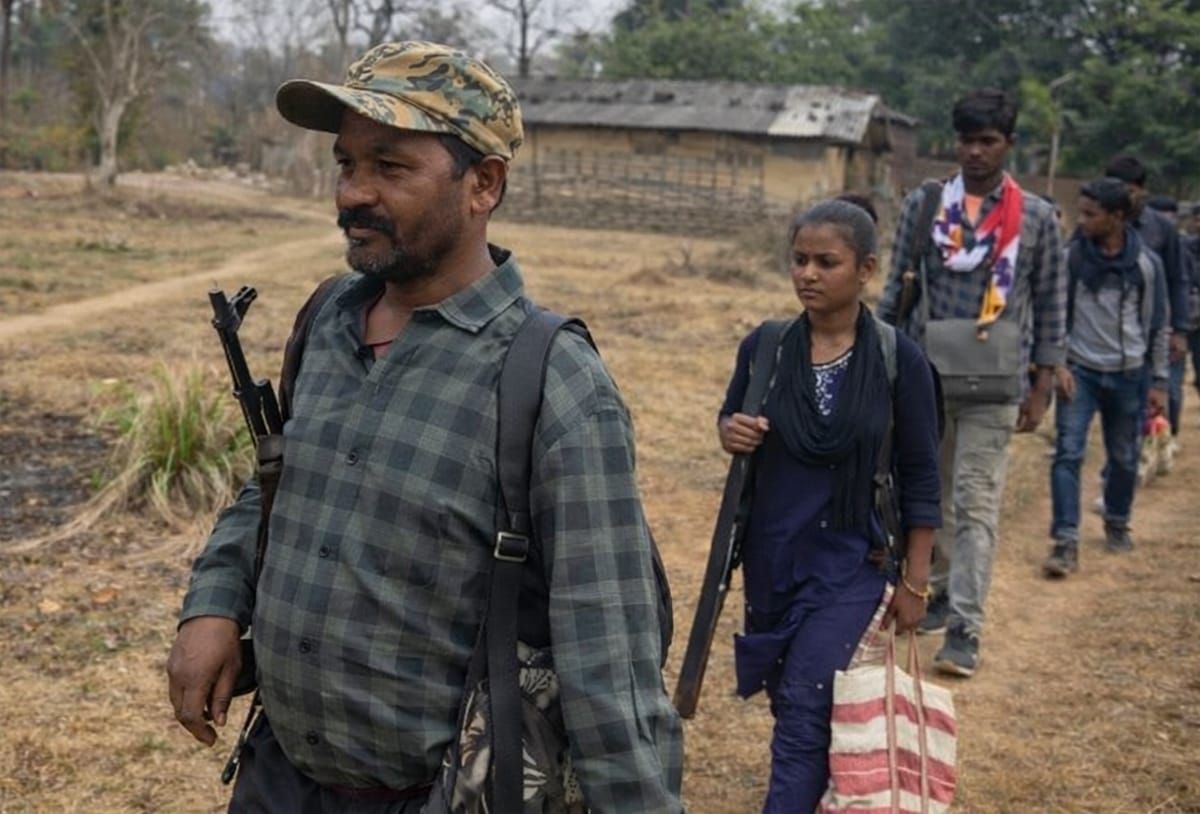
At rehabilitation camps, once-feared Maoists now sit like commoners in white shirts and blue trousers. Mangtu Dada, 35, who joined as a 14-year-old child soldier, admits he was lured by the glamour of uniforms and guns. "There is no place left to hide anymore," he says, gesturing at the new roads, the security camps, the fading popular support. He dreams of driving a taxi. Others are training as plumbers and electricians.

Many, including Mangtu and his wife, are quietly reversing the forced sterilisation that Maoist battalions once imposed on their cadres to create "emotionless human weapons." A senior police official who earlier served as Inspector General (IG) of Dantewada said Maoists used coercion and fear to enforce sterilisation among cadres to keep the guerrilla force lean and mobile, with barely trained "doctors" performing vasectomies on young recruits before permitting marriage. Surrendered cadres, along with a senior Maoist "doctor", Sukhlal Jurri, have corroborated these accounts. The retired officer added that the government is now attempting to reverse the damage, with over fifty men undergoing reversal surgeries and nearly thirty already becoming fathers. The personal costs of the insurgency run deeper than the violence on the surface.
Karregutta Hills on the Chhattisgarh-Telangana border was once a fortified Maoist bastion, riddled with landmines and used as a key hideout. Security operations over the past few years have broken that hold. Officials now speak of plans to open the region for tourism, even as memories of conflict linger. About 100 kilometres from the fallen Karregutta Hills lies Jagargunda, the place which saw some of the bloodiest ambushes by the Maoists. They have killed 55 members of the Indian paramilitary Central Reserve Police Force (CRPF) in 2007 and another 76 personnel in 2010. Their most talked-about attack happened in May 2013. The rebels ambushed a convoy of the Indian National Congress at Darbha Valley and killed 27 people. While Congress leader and the anti-Maoist militia Salwajudum founder Mahendra Karma was killed on the spot, the erstwhile Chhattisgarh Congress chief Nand Kumar Patel and a senior Congress leader Vidya Charan Shukla died from the injuries on June 11.
However, the dreaded March-May Tactical Counter Offensive Campaign season has passed this year without a single major incident due to the near cessation of Maoist activities. Police data shows that over 2,700 Maoists have surrendered in the last two years. More than 150 new security camps have come up. IG of Bastar Range P. Sundarraj puts it plainly: "The elimination of top leaders and the breaking of their organisational and financial backbone have left them too weak for large-scale attacks. The long era of Maoist violence in Bastar has effectively ended."
The roots of the erstwhile Naxal movement run deeper than the 1967 Naxalbari spark. They lie in the unfinished land question that survived even Independence, the promise of land to the tiller that remained largely unfulfilled for millions of peasants and tribals. The Telangana Armed Struggle of 1946–51, the first major communist-led peasant revolt in India, was crushed, but its memory endured. The Naxalbari uprising of 1967, described as 'spring thunder' by Radio Peking, marked the next turning point. Yet the movement peaked before it could achieve its stated objectives. Due to its preference for violence, straitjacket-like ideological positions and state suppression, the movement was crushed within a few years. The movement then splintered, mutated, and eventually found its most lethal expression in the tribal heartlands of Bastar, Gadchiroli, north Telangana and southern Odisha through the People's War Group (PWG) and later the CPI (Maoist), culminating in the PWG's merger with the Maoist Coordination Committee (MCC) in 2004.
The movement ran its course over decades, and finally, the Indian state responded decisively. The Narendra Modi government launched a pressure campaign against the Maoist party, setting March 31, 2026, as the deadline. This stern stance and continued pressure campaign gave clear results. By mid-2026, Bihar, Maharashtra and Odisha were expected to be declared Maoist-free states. The once-mighty leadership is reduced to ghosts. Ganapathy, the ageing ideologue who guided the Maoist party for decades, now 76 and frail, has vanished from the radar since late 2024. Speculations are rife that he is undergoing medical treatment in urban areas, or he could have fled to the Philippines and Nepal. As of today, there is no confirmation on his whereabouts.
According to police information, the conflict zone has shrunk to tiny pockets in Chhattisgarh's Bijapur and Jharkhand's East Singhbhum, where perhaps 80 hardened rebels remain cornered. Misir Besra, the last active hardliner in his late 60s, is holed up with barely 40 cadres in Jharkhand's Saranda forests, surrounded by security forces. Even his family is urging him to surrender.
The Maoists, who once fought against the grievances of tribal people and state neglect, increasingly failed to keep pace with the evolving developmental aspirations of the people. Over time, the movement began to be seen as a burden rather than a vehicle of change. As the red flag vanishes from India's forests, the question that lingers is whether this peace will be more than a pause. Comparisons are inevitable, and three broad pathways emerge from global and Indian experience: the militarised reconstruction model seen in Sri Lanka's Jaffna after the Liberation Tigers of Tamil Eelam (LTTE) chapter ended; the negotiated peace with partial development model seen in Mindanao in the Philippines after the MILF pact; and closer home, the surrender and reintegration model of the Chambal ravines, where dacoits surrendered in the 1970s not merely to force but to a mix of Gandhian persuasion, farmland and dignity.
In Jaffna, roads, schools and homes were rebuilt after the war, much of it with Indian assistance, but civilian life continues to unfold under a heavy military shadow, with unresolved land occupations, limited political autonomy and a lingering trust deficit between the state and the Tamil population. In Mindanao, the peace accord led to the creation of an autonomous political arrangement and brought improvements in infrastructure, welfare schemes and incomes, yet governance remains uneven, with factional rivalries, weak institutions and periodic violence testing the durability of peace. In Chambal, mass surrender in the 1970s was followed by open jails, allocation of agricultural land and a degree of social acceptance, allowing former dacoits to reintegrate into society, rebuild livelihoods and gradually disappear from the landscape without triggering a resurgence.
India's approach in the Red Corridor today appears to blend elements of all three models, but with its own distinct flavour. The revised Surrender-cum-Rehabilitation policy offers cash grants, monthly stipends, skill training, housing and, in some states, even pathways to police jobs. The old SAMADHAN security doctrine has been coupled with a sustained developmental push, with roads, mobile connectivity, banking and public services reaching areas that had long remained outside the state's presence.

Surrendered fighters are not just disarmed; they are being given tools, training and a stake in the new order. Yet the real test lies deeper, in the soil and in the human heart. Will the new roads and schools truly address the old tribal grievances, such as land rights, forest produce, and cultural dignity, or merely pave over them? Will the stipends and training create lasting livelihoods, or will resentment return when the initial flush of relief fades?
For now, the guns have fallen silent in the forests. In Baleveda, Sundarlal Wadde continues digging his bamboo poles, earphones still playing Bollywood tunes. In Pedhakorma, children recite their alphabet under a new school roof. In the rehabilitation camps, former child soldiers dream of driving taxis and leading a peaceful life.