
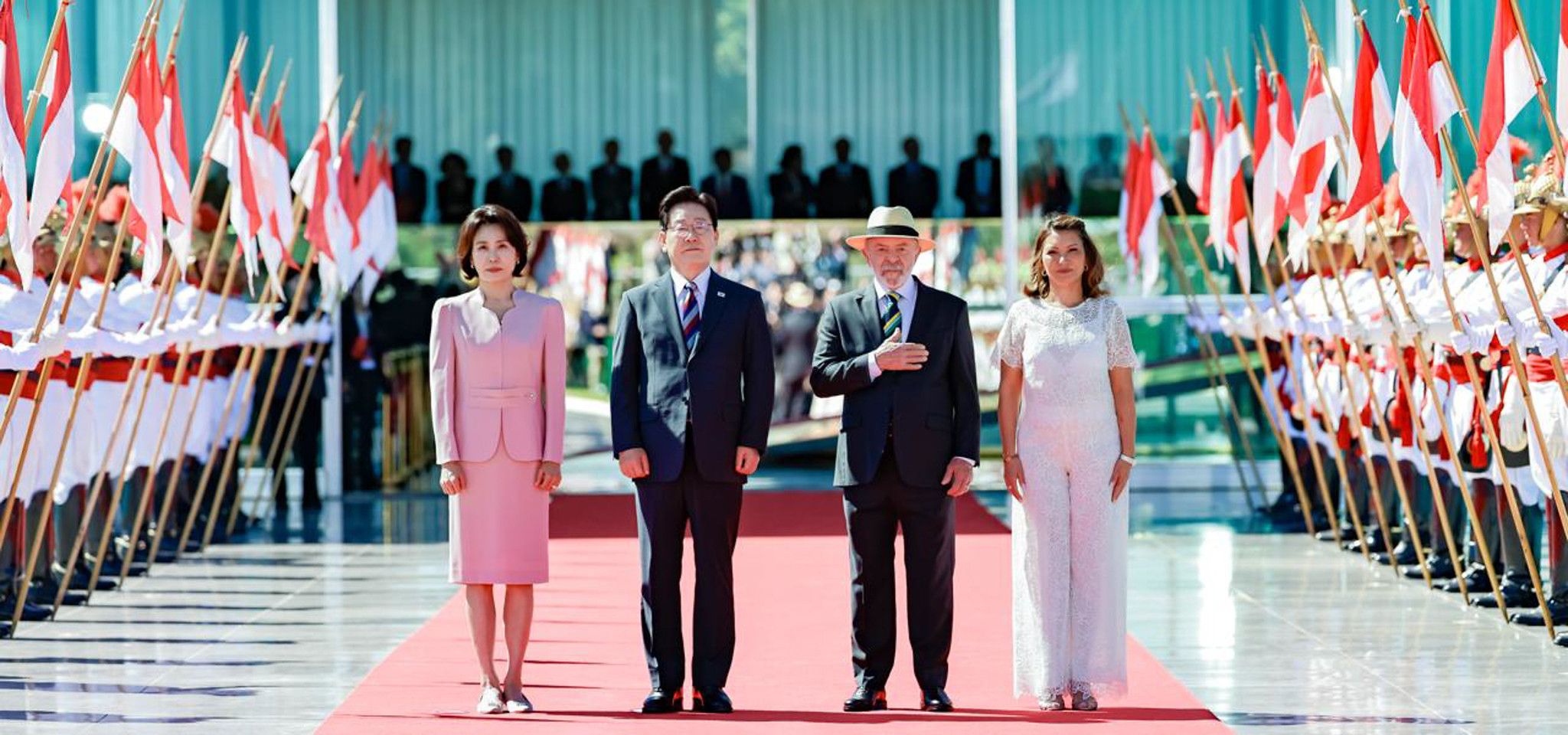
A decades-old but long-dormant relationship between Seoul and Brasília appears to have rapidly revived. South Korean President Lee Jae Myung and Brazilian President Luiz Inácio Lula da Silva met in Brasilia on Monday (July 27), their second summit this year and Lee's first state visit to Brazil – the first by a South Korean president in over a decade.
What makes the timing notable is less about the partnership itself than each country's ties elsewhere. South Korea remains one of Washington’s closest allies, hosting roughly 28,500 US troops under a decades-old defence treaty and coordinating closely with the US on technology controls and supply-chain security. Brazil, by contrast, has leaned toward Beijing and Moscow even as it has clashed with Washington over tariffs and allegations of US meddling in its politics and elections.
That South Korea is accelerating this particular relationship right now indicates that trade and resource interests are, in some cases, beginning to outweigh alliance loyalties. The relationship between the two middle powers, however, isn't new. Formal diplomatic ties between the two countries date back to 1959–62, and Brazil is already home to Latin America’s largest Korean community – nearly 50,000 people – and stands as South Korea’s largest trading partner in South America. What had gone missing was a high-level contact: February’s summit marked the first visit by a Brazilian head of state to Seoul in 21 years, meaning the relationship had simply gone quiet rather than not existed. At that meeting, held in Seoul, the two leaders agreed to expand cooperation in critical minerals, trade, technology and culture, elevating ties to a strategic partnership.
Monday's summit built directly on that reset. Minerals sit at the centre of the pitch. Brazil holds one of the world’s largest reserves of rare earths and other strategic minerals – including niobium, graphite and nickel – but much of that supply remains unprocessed, with refining still concentrated in China. South Korea, which needs these materials for EV batteries and semiconductors, wants to diversify away from Chinese and Vietnamese suppliers, and POSCO’s investment in Brazil’s Caldeira rare-earth project reflects that push.
Investment from Seoul, in turn, would let Brazil move up the value chain from raw ore exports to higher-value processed materials.Monday’s talks went further, with the leaders agreeing to launch a joint defence industry committee and pursue a military information-sharing pact akin to South Korea’s GSOMIA arrangement with Japan, alongside deeper cooperation in aerospace, semiconductors and space.
Both sides also pushed to revive stalled negotiations on a South Korea–Mercosur trade agreement, the bloc comprising Argentina, Brazil, Paraguay, Uruguay and Bolivia. Washington and Brasília remain at odds over tariffs and election-interference disputes. That South Korea – a treaty ally of the US – is speeding up a dormant relationship with Brazil regardless suggests that access to lithium, rare earths and resilient supply chains is starting to shape alliances as much as military commitments do.