
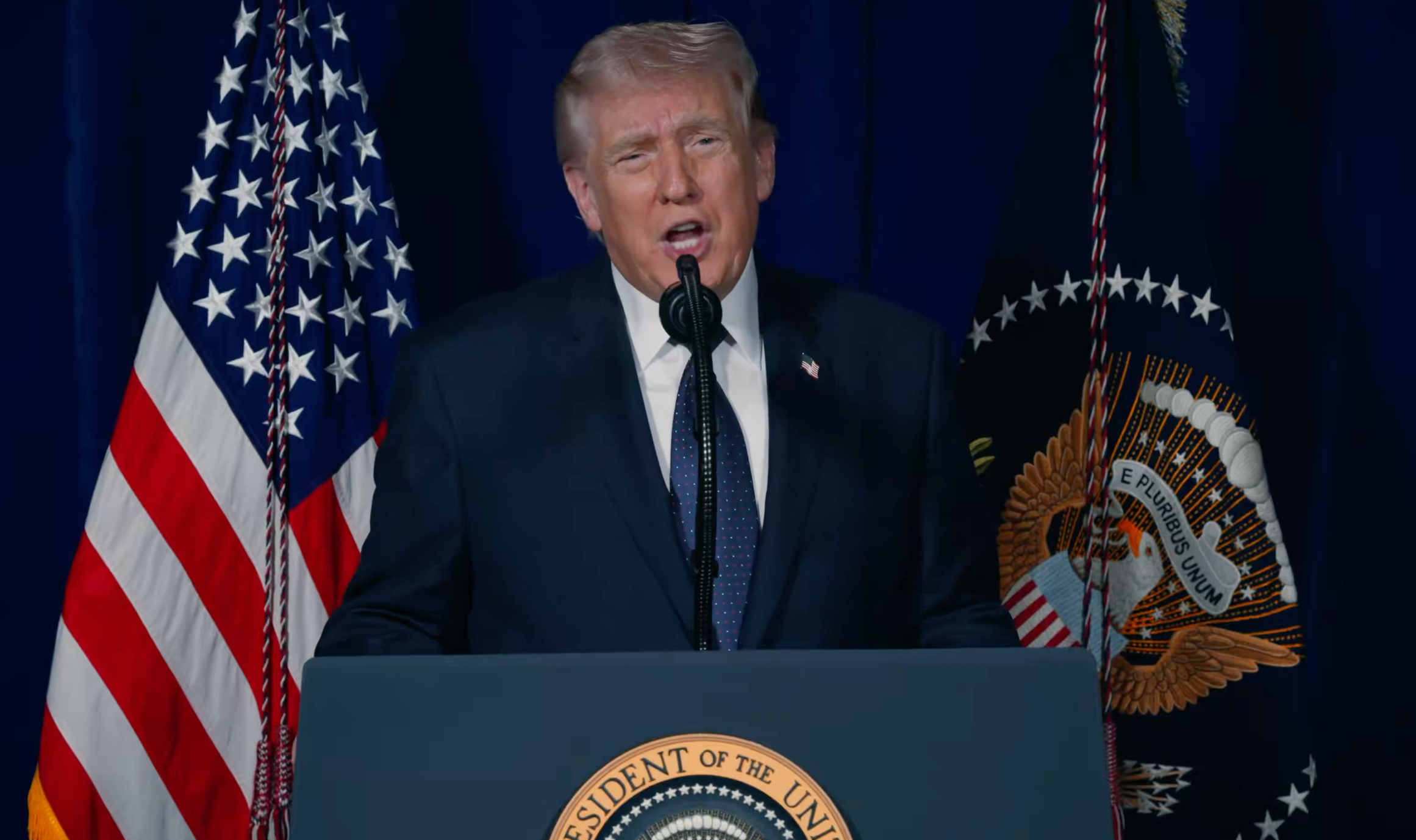
US President Donald Trump has invoked India’s electoral system in his renewed campaign for mandatory voter photo identification, and his own ambassador in New Delhi has amplified the argument. On Truth Social, Trump cited a remark he attributed to India’s Chief Election Commissioner (CEC) Gyanesh Kumar, who reportedly asked, “How can you have elections in the US without a valid Photo ID?” That exchange traces back to a meeting between Kumar and US Ambassador Sergio Gor in New Delhi on August 12, as both sides pledged closer cooperation on election management.
US Ambassador Sergio Gor then backed Trump on X, calling him “absolutely correct” and pointing to India’s 646 million-strong electorate, every one of whom needed an ID to vote in the country’s last general election. “Congress should pass THE SAVE AMERICA ACT!,” Gor wrote.
What the SAVE Act would do

Trump is seeking to make voter identification and proof of citizenship central to the US electoral debate ahead of the 2026 midterms. Under the Safeguard American Voter Eligibility (SAVE America) Act, voters would need to provide documentary proof of US citizenship to register for federal elections, alongside stricter photo ID requirements at the ballot box and tight limits on mail voting. Trump has argued the legislation is necessary to stop non-citizens voting and to protect election integrity, a claim he has repeated across platforms alongside long-standing allegations of mail-in and other fraud.
The evidence gap
The numbers, however, don’t support the scale of the claim. A Reuters investigation found that since federal law criminalised non-citizen voting in 1996, only 129 people have been charged and just 73 convicted, many of them legally present in the US or caught up in administrative errors rather than coordinated fraud. One such error surfaced in New Jersey, where Governor Mikie Sherrill disclosed in July that a software fault had added roughly 6,600 non-citizens to the voter rolls, an error caught and corrected in June 2024. Around 400 of those wrongly registered are reported to have cast ballots, though it is unclear in which elections.
Why the India comparison is shakier than it looks
The timing is awkward in the sense that India’s Election Commission and its voter rolls have themselves been under sustained fire. Kumar has overseen the Special Intensive Revision (SIR), an exercise to purge deceased, duplicate, shifted and otherwise ineligible entries from the electoral rolls. The Commission says this makes the rolls more accurate, but opposition parties and civil society groups have alleged that the process has disproportionately hit Muslims and other marginalised communities – in India’s West Bengal, districts with large Muslim populations such as Murshidabad, Malda and North 24 Parganas accounted for a very high share of voter deletions, prompting accusations from opposition leaders of deliberate targeting.
The Commission, however, has rejected this in the Supreme Court, calling the allegation a “communal approach” and noting the electoral database does not record religion; the Court upheld the Commission’s conduct of the Bihar SIR, though the wider dispute continues. Critics go further, questioning the neutrality of the Commission itself. Kumar has faced accusations – including from principal opposition leader Rahul Gandhi – that the poll body has colluded with the ruling BJP and enabled electoral fraud benefiting the party, allegations the Commission denies.
There is also a more basic problem with the comparison that Trump and Gor are drawing: India’s voter ID card is not proof of citizenship. The Election Commission itself told the Supreme Court that Aadhaar, ration cards and EPIC (voter ID) cards do not establish citizenship and cannot alone justify inclusion on the electoral roll, a position the Court has since upheld, ruling that Aadhaar cannot serve as conclusive citizenship proof either.
The very ID system being held up as a citizenship safeguard is, in India’s own courts, explicitly not treated as one – suggesting Trump’s citation of India functions less as a technical model and more as rhetorical cover for his broader anti-immigration push at home.
The EVM irony
There’s a further irony that cuts the other way. A large section of India’s opposition and civil society has spent years demanding a return to paper ballots, arguing India’s electronic voting machines (EVMs) are vulnerable to tampering and that the Commission can’t be trusted to certify them independently. In making that case, opposition MPs have explicitly pointed to the US and Germany as “advanced” democracies that still rely on paper ballots.
So even as Trump holds up India’s voter ID regime as a model for the US, a significant constituency in India is holding up the US’ own paper-ballot system as the model India should return to.
Political fallout
Congress spokesperson Pawan Khera turned Trump’s praise back on both him and the Election Commission, sarcastically suggesting that Trump take Kumar – and India’s EVMs – to the US permanently, signing off with “To SIR With Love, from India”.
The irony deepens given Trump’s own conduct: he voted by mail in Florida’s Republican primary on August 17, even as he pushes to tighten mail-in restrictions nationally. Meanwhile, the Bipartisan Policy Center has questioned what additional barrier the SAVE Act actually addresses, given non-citizens are already barred from voting under existing US law. For Trump’s base, though, the India endorsement – now doubled by his own ambassador – is likely to land well regardless of the holes in the comparison.