
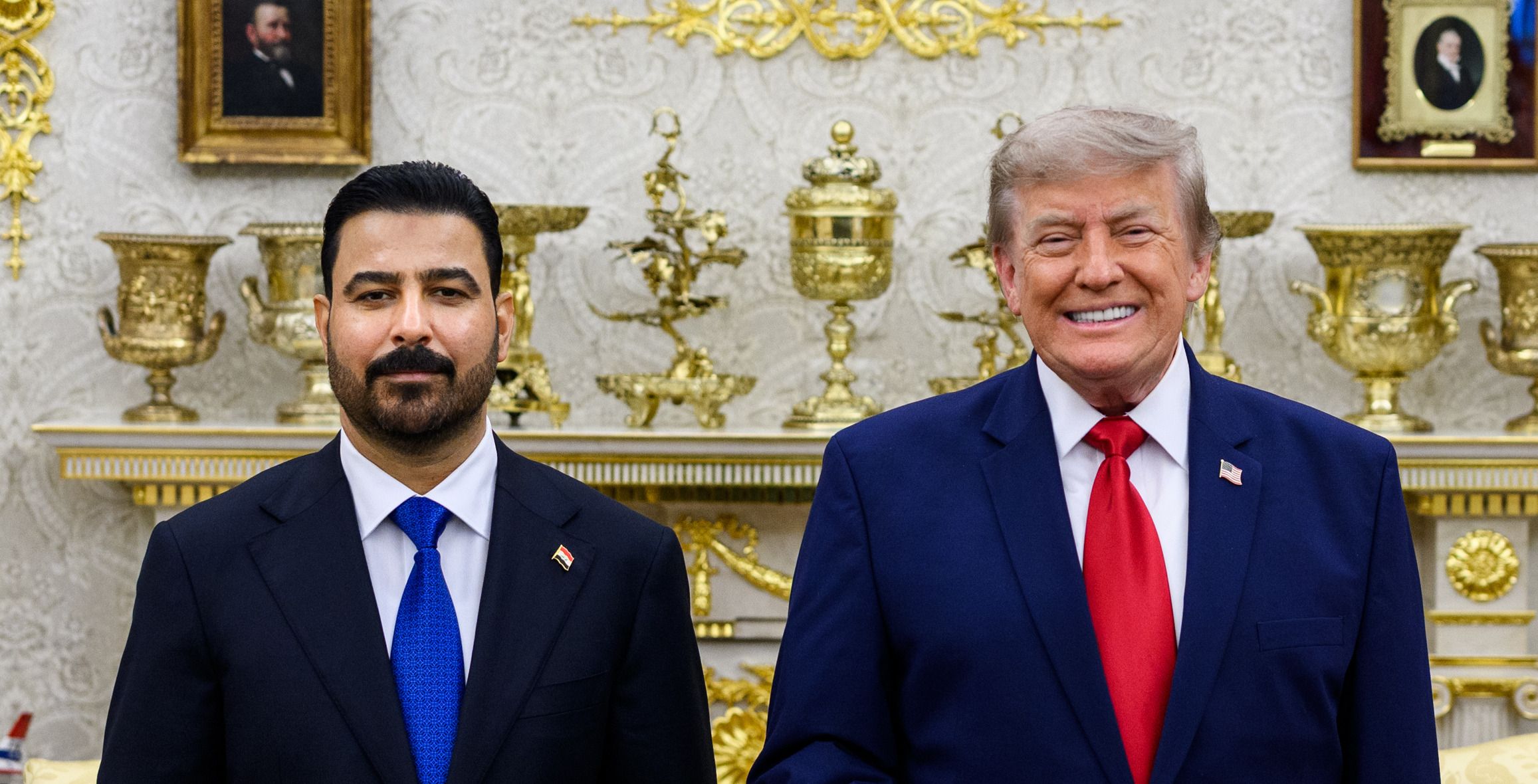
The United States will complete the withdrawal of its armed forces from Iraq, bringing to a close 23 years of military presence and one of Washington’s longest-running engagements in West Asia. US President Donald Trump received Iraqi Prime Minister Ali al-Zaidi at the White House on Tuesday (July 14, 2026), where the two leaders confirmed that American forces would leave the country by September 30.
American troops first entered Iraq in 2003 to depose the government of Saddam Hussein, ostensibly over an alleged stockpile of weapons of mass destruction that was never found, and the mission subsequently evolved into a counter-Islamic State campaign. Washington's continued military footprint had long been a source of friction in Iraqi politics, with Iran-aligned factions repeatedly demanding a complete pull-out.

A transition years in the making
The drawdown has been under way for nearly two years. In September 2024, Washington and Baghdad began discussing the phasing-out of the US-led coalition mission against ISIS, and the Pentagon has consistently framed the transition as a reflection of improved Iraqi security capacity. Since the defeat of the Islamic State’s territorial “caliphate”, Iraq's military has benefited from years of American training, intelligence-sharing and access to the international financial system.
Factions favoured by Tehran remain deeply influential in Iraqi politics, yet have so far largely stayed out of the direct US-Iran confrontation. At the White House, Trump said American forces were “there to help” Iraq and to “protect them if need be”, but that Washington no longer believed such protection would be necessary. Al-Zaidi, speaking through an interpreter, confirmed the same deadline: American forces would be “out of Iraq” by September 30, while “American companies will enter”. He added that after that date, Baghdad “will not allow any entity to bear arms outside the state”.
That pledge is already being tested. Iraqi officials later said that Baghdad has set pro-Iran armed factions a deadline of September 30 to surrender their weapons to the state, though several of the most powerful militias, including Kataib Hezbollah, have rejected the demand outright.
A withdrawal against the backdrop of open war
What makes the timing striking is that the withdrawal of US troops comes not in a period of calm, but in the midst of active hostilities between the United States and Iran. The conflict that began in late February 2026 escalated sharply again in the past fortnight: an interim ceasefire collapsed after Iranian forces struck commercial vessels in the Strait of Hormuz, prompting fresh American air strikes and Iranian retaliation against US bases and shipping across Bahrain, Kuwait, Qatar, Jordan and the United Arab Emirates. Trump reinstated a naval blockade this week and formally notified Congress that hostilities with Iran had resumed.
It is against this backdrop that Trump and al-Zaidi also discussed the Strait of Hormuz on Tuesday, with the US president reiterating that no party should be permitted to charge tolls for passage through the waterway.
Oil, pipelines and an “economic partnership”
Securing American investment in Iraqi oil, gas and power was central to al-Zaidi's Washington visit. Trump described his counterpart as a “fantastic champion”, while al-Zaidi called the trip the start of an “economic partnership”. On July 4, Iraq’s parliament said a deal was imminent to link Basra and Haditha via a two-million-barrel-per-day pipeline, involving Iraq, Qatar’s Urbacon Trading & Contracting (UCC), and the American firms Chevron and TI Capital. Al-Zaidi also raised the scale of Iraq’s wartime losses, saying the country’s damage exceeded $400 billion and that many Iraqis still live in destroyed homes or displacement camps – one reason, he said, he wants “a fair share for Iraq in OPEC”.
Kurdistan featured prominently too. With a considerable US troop presence still stationed in the Kurdish region, al-Zaidi reiterated Kurdistan’s significance to Iraq. Iraq has for two decades served as a battleground between Tehran and Washington, and as the crucible from which Islamic State of Iraq and the Levant (ISIL) emerged after the 2003 invasion.
A troubled inheritance
During Saddam Hussein’s rule, Iraq and Iran fought one of the twentieth century’s longest wars, from 1980 to 1988, leaving an estimated one million people dead or wounded. After the US toppled Hussein, Iraq’s political landscape was transformed: Iran expanded its influence through political allies and armed groups, while the two neighbours also built extensive trade, energy and religious ties that persist today.
Yet, beneath the current rapprochement lies a much older rivalry – a conflict rooted in disputes over the Shatt al-Arab waterway. Baghdad has also feared that Tehran’s post-revolutionary Shia Islamism would spread to Iraq's own Shia majority, and a broader contest between an Arab Sunni-led Iraqi state and a Persian Shia Iran. Washington backed Baghdad for much of that war, which left roughly 500,000 dead and entrenched a mutual distrust that outlasted the 1988 ceasefire by decades.
It was, paradoxically, the 2003 US-led invasion that reversed this dynamic, toppling Iraq’s Sunni Baathist government and empowering the Shia parties and militias through which Tehran has cultivated influence in Iraq ever since. Even so, some analysts believe Washington still hopes to draw on Iraq’s older suspicion over Iranian domination, and on the economic leverage it retains over Baghdad.
That leverage is increasingly being converted into infrastructure. Washington, Baghdad, Riyadh and Kuwait are together accelerating pipeline projects – including the planned Basra-Haditha line and the rehabilitation of the old Kirkuk-Baniyas route – designed to let Gulf oil bypass the Strait of Hormuz altogether, eroding the chokepoint leverage Iran has wielded throughout the current war.
What withdrawal might mean for the wider conflict
Analysts are divided on what a full American exit means for a region still at war. Sukumar Muralidharan, New Delhi-based senior journalist and analyst, called the timing of the withdrawal “a bit strange”, given that the US remains engaged in active operations against Iran. He told NWS that there may be a longer-term calculation at play: Washington strengthening economic co-operation with Iraq while entrusting regional security to Iraqi forces.
Muralidharan cautioned that pro-Iran elements within Iraq “are still strong”. They won a significant share of seats in the last election and came close to securing the reappointment of former prime minister Nouri al-Maliki. With the US now at war with Iran, and Tehran retaliating against US allies including the UAE, Bahrain and Kuwait, he said that Washington “must have a high level of trust” in al-Zaidi’s government to proceed with withdrawal at all.
“The future is a bit uncertain," Muralidharan told NWS. Should Iraq drift back into Iran’s orbit, he said, American strategic dominance in the region could be undermined – and neighbouring US allies, Kuwait most acutely, threatened, given its position wedged between Iran and Iraq.
A similar analysis has also been shared by several Western institutes. The Washington Institute has argued that a US withdrawal risks ceding ground to Iran-aligned militias already embedded in Iraq’s state institutions, warning that the coalition’s departure would strip away a key mediator between Baghdad and the Kurdistan Regional Government.
The Foundation for Defense of Democracies has separately noted that Kataib Hezbollah, one of the most powerful Iran-backed militias, has threatened a “prolonged war of attrition” aimed at pushing the American presence out of Iraq altogether.
Some others believe that the withdrawal could embolden the Coordination Framework – the Iran-aligned Shia parliamentary bloc – to expand its political leverage. Whether September’s withdrawal proves to be a genuine handover of sovereignty to Baghdad, or a vacuum that Iran-aligned forces move to fill, is likely to become clearer only once the wider war between Washington and Tehran itself runs its course.