
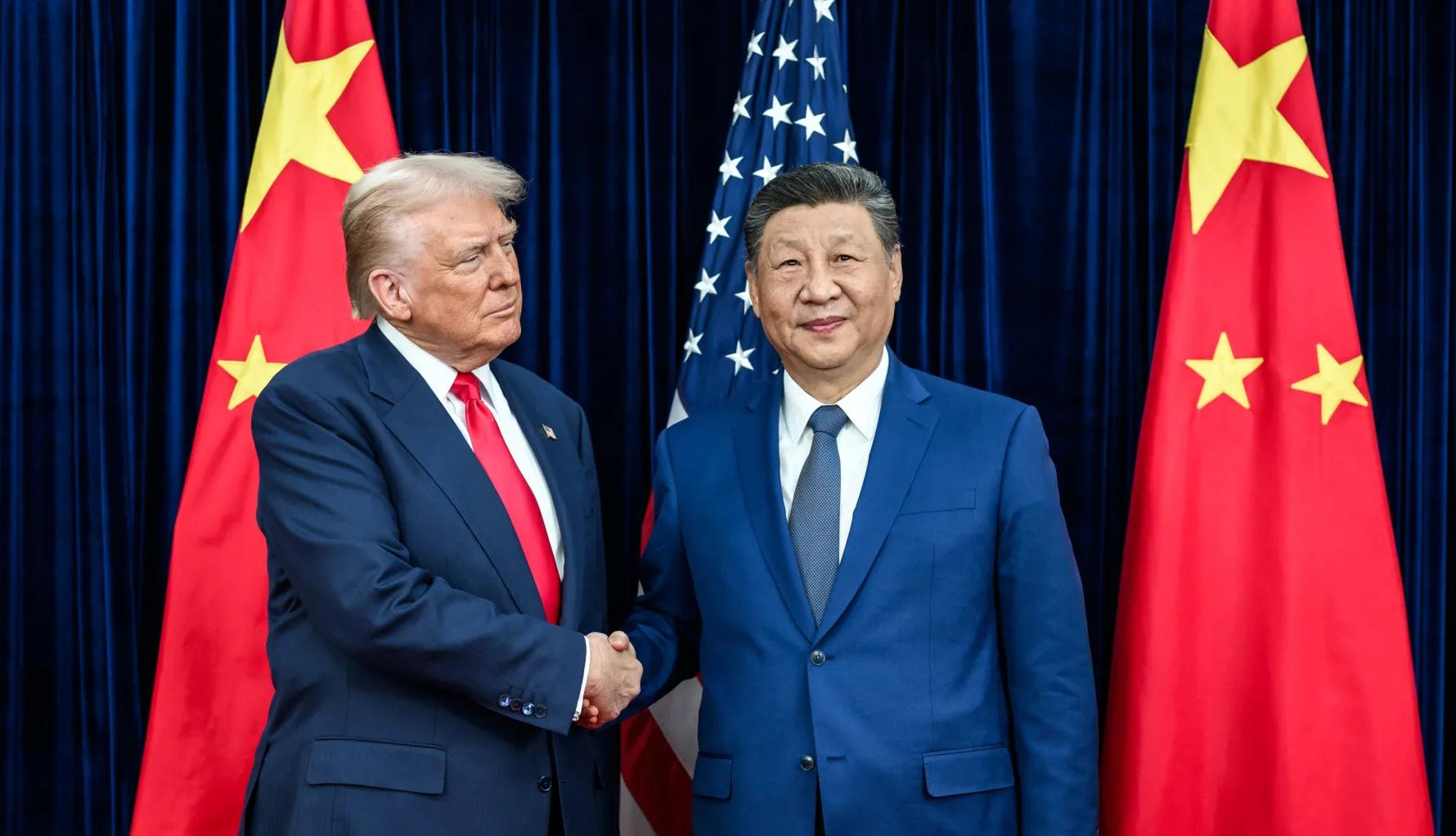
China has forced the United States into conciliation, with far-reaching consequences for the entire Asia-Pacific region.
Although President Xi Jinping described the two-day summit with President Donald Trump in the second week of May as a "landmark" event, no substantial agreements were signed between the two leaders, and key differences between the two countries remain unresolved.
The summit was largely confined to a handful of business agreements. Trump claimed that China would purchase 200 Boeing aeroplanes and $10 billion worth of agricultural products from the United States. China had not been buying planes from Boeing for seven years, during which time Boeing's European rival, Airbus, had been reaping rich dividends in the world's largest aviation market.
Trump also claimed that the Chinese side would purchase advanced chips from the American chipmaker Nvidia. Washington had previously barred Nvidia from continuing its lucrative business with China at the height of the trade war. China has since developed its own home-grown chip industry; many experts say it is only five years behind the United States in semiconductor technology. Notably, Trump, who had earlier accused China of stealing American semiconductor technology, is now levelling the same accusation at Taiwan.
Trump claimed that tariffs did not come up for discussion during his talks in Beijing. Washington has, however, proposed the creation of a new Board of Trade to oversee business with China. American officials say such an arrangement would result in both countries cutting tariffs on goods worth around $30 billion, though the Chinese side has made no commitments to this effect. China appears to be in no mood to bail out the beleaguered Trump administration from the situation it currently finds itself in. The tariffs and the war in Iran have taken a heavy toll on the American economy.
Veteran Chinese Foreign Minister Wang Yi told the media that the two leaders had spoken for nearly nine hours and had "achieved overall stability after experiencing ups and downs" in their bilateral relations. President Xi has accepted Trump's invitation to visit the United States later this year, and the two heads of state are also expected to meet on the sidelines of the G20 and APEC summits scheduled later this year.
A Shift from Trump's "De-coupling" Policy?
It was Trump, during his first term, who initiated the policy of "de-coupling" America's economy from China. The Biden administration continued this hardline approach. The visit of former House Speaker Nancy Pelosi and an American congressional delegation to Taiwan during Biden's term had infuriated Beijing. Trump's domestic approval rating is now at an all-time historic low, and internationally, even Washington's traditional allies have distanced themselves from him. Some NATO countries, such as Spain, have strongly criticised his actions in Venezuela and Iran.
Many international affairs commentators from the Global South were critical of the red-carpet welcome extended in Beijing to a head of state who has ordered the assassinations and kidnappings of heads of state and senior officials of countries long in Washington's crosshairs.
After the Trump visit, there are still no signs of the Iran war, launched jointly by the United States and Israel, ending any time soon. The Strait of Hormuz, through which China, India, and East Asia receive much of their energy supplies, remains closed. Trump claimed that Beijing and Washington were aligned on the need to end the war in Iran.
China’s Unequivocal Stance on Iran War and Taiwan Red Line
The Chinese government has been unequivocal about its stance. A Chinese Foreign Ministry statement said the war had "inflicted severe losses on the people of Iran and other regional countries" and that the conflict had "put a heavy strain on global economic growth, supply chains, international trade order, and the stability of global energy supply, which hurts the common interest of the international community". Speaking during the Trump visit, the Chinese Foreign Ministry spokesperson emphasised that the war on Iran should not have been started in the first place, and that "shipping channels should be reopened as soon as possible" in the Persian Gulf region. China has been working to resolve the impasse there, having put forward its own four-point proposal at the outset of the war and a five-point peace roadmap issued jointly with Pakistan.
The hardline American stance on Taiwan - the most critical "red line" for China at this juncture - has not fundamentally changed. On the first day of talks, Xi told Trump that Taiwan was the "most critical issue" for China and that if mishandled, it could "put the entire China-US relationship in an extremely dangerous situation". Xi went so far as to warn that disagreements on Taiwan could even lead to "a clash" between the two countries.

On his way home from Beijing, Trump told the American media that President Xi had asked whether Washington would intervene militarily in Taiwan. Trump offered no response, while saying that the last thing he wanted was another war. There are indications that the Trump administration may further delay or even cancel the $14 billion American arms package for Taiwan.
The steep American tariffs imposed on China remain in place, although China has successfully forced the US’s hand. Tariffs on Chinese goods had reached 145 per cent at the start of Trump's term; it was only after China retaliated with tariffs of its own and restricted the export of rare earth minerals that Washington brought the rate below 50 per cent. The absence of a joint communiqué at the end of the summit is a further indication that the two countries remain far apart on key issues.
Trump’s ‘Monroe Doctrine’ derails amidst Iran’s spectacular resilience
The Pentagon's annual report, released late last year, stated that China was working to push the United States out of the western Pacific and militarily encircle Taiwan. The American military has repurposed bases in the Philippines as part of its "First Island Chain" strategy, positioning HIMARS and Typhon missile systems to deter a Chinese attack on Taiwan. Some of the Philippine bases from which America operates are fewer than 280 kilometres from Taiwan. Military tensions in the region had been building rapidly since Trump's first term.
Trump's visit to China had originally been scheduled for April, but his ill-judged war on Iran, conducted in tandem with Israel in March, necessitated a rescheduling. He had hoped to arrive in Beijing as a conquering hero, having effected regime change in two of China's closest allies, Venezuela and Iran. Trump may have succeeded in Venezuela but has spectacularly failed in Iran. Before the events of January, the bulk of Venezuela's oil was exported to China. The Trump administration also forced the Panamanian government to hand over control of the Panama Canal to an American-run company, unceremoniously ejecting a Chinese-owned firm that had previously operated it.
Under the so-called "Monroe Doctrine" promulgated by the Trump administration, the United States considers the entire western hemisphere its "backyard". Trump has threatened to take over the Panama Canal, Greenland, Canada, and now Cuba.
China's growing economic footprint in Latin America and the Caribbean has long irked Washington. Had America succeeded in achieving its military goals in the Persian Gulf, it would have established a stranglehold over major global strategic chokepoints in preparation for a military conflict with China, bringing the energy resources of much of West Asia under American control.
The failure to strangle China through economic and military means prompted the Trump administration to pivot to diplomacy. Wes Mitchell, a former US Assistant Secretary of State in the first Trump administration, writing in Foreign Affairs, argued that Trump is seeking a thaw with Beijing in order to "buy time and get the pieces in place - for a stronger future position". The United States, he wrote, wants to build "a deeper arsenal of weapons, backed by a reanimated American industry, that is less reliant on its main rival to develop lifesaving medicine, power the US economy, or acquire the materials to wage war".
Tariffs and other coercive measures introduced during the first Trump administration more than seven years ago have failed to achieve their intended goals. China's economy has continued to perform well despite the disruptions caused by the pandemic, tariffs, and now the war on Iran. China is keeping pace with the West in the technology sector and may be a step ahead of the United States in robotics and artificial intelligence.
Trump did not react adversely to President Xi's description of the United States as "a nation in decline", instead claiming - in his inimitable style - that Xi had been referring to America under Biden.
President Xi urged the visiting American president to avoid the "Thucydides trap" - a reference to the ancient rivalry between Sparta, then the dominant hegemon, and the rising power of Athens. As the ancient Greek historian Thucydides wrote, "It was the rise of Athens and the fear that this rise engendered in Sparta that made war inevitable." Chinese commentators have also drawn comparisons between the Sino-American rivalry and that between Rome and Persia, noting that what began as bitter conflict eventually settled into cohabitation - the two empires described by contemporary chroniclers as "the two eyes of the world".
“Constructive strategic stability” versus “strategic competition"
During the summit, the Chinese side introduced the concept of "constructive strategic stability" as a possible framework for the future relationship. "The common interests between China and the US outweigh our differences," Xi said. "Stability in China-US relations is a boon to the world." The Chinese Foreign Minister described America's acquiescence to this concept as the most important takeaway from the summit, expressing hope that the language of "strategic competition" that was until recently Washington's preferred formulation would be set aside.
Washington will not be in a hurry to concede China equal status. Even so, Trump described the summit as a meeting of G2 leaders. "It's the two greatest countries - I call it the G-2," he told American reporters.
The Trump-Xi talks may upset the strategic calculations of America's Asia-Pacific allies, which have already been unsettled by the conciliatory tone Trump struck during the two-day visit to China.

Japan's new right-wing Prime Minister, Sanae Takaichi, had previously stated that a Chinese attack on Taiwan would constitute "an existential threat for Japan".
Taiwan has reason to worry. Trump has suggested that the proposed multibillion-dollar arms deal with the island could serve as a "negotiating chip" with China, and has warned the government in Taipei against unilaterally declaring independence. He has also voiced doubts about America's ability to defend Taiwan against a full-scale Chinese invasion. Since 1982, Washington has not consulted Beijing before signing defence deals with Taiwan; Trump, if his comments are any indication, may break with that precedent.
Indian policymakers fear that their country's role as a crucial balancing power in the region may diminish. In his second term, Trump has been targeting India on tariffs. India currently faces a higher American tariff rate than China. Should economic ties between the United States and China improve further, global investors may once again shift towards China. Interest within the White House in the Quad grouping appears to be waning. China has long been critical of the Quad, which it views as a quasi-military alliance spearheaded by Washington. India is particularly wary of the G2 concept, fearing it would marginalise middle powers such as itself.