
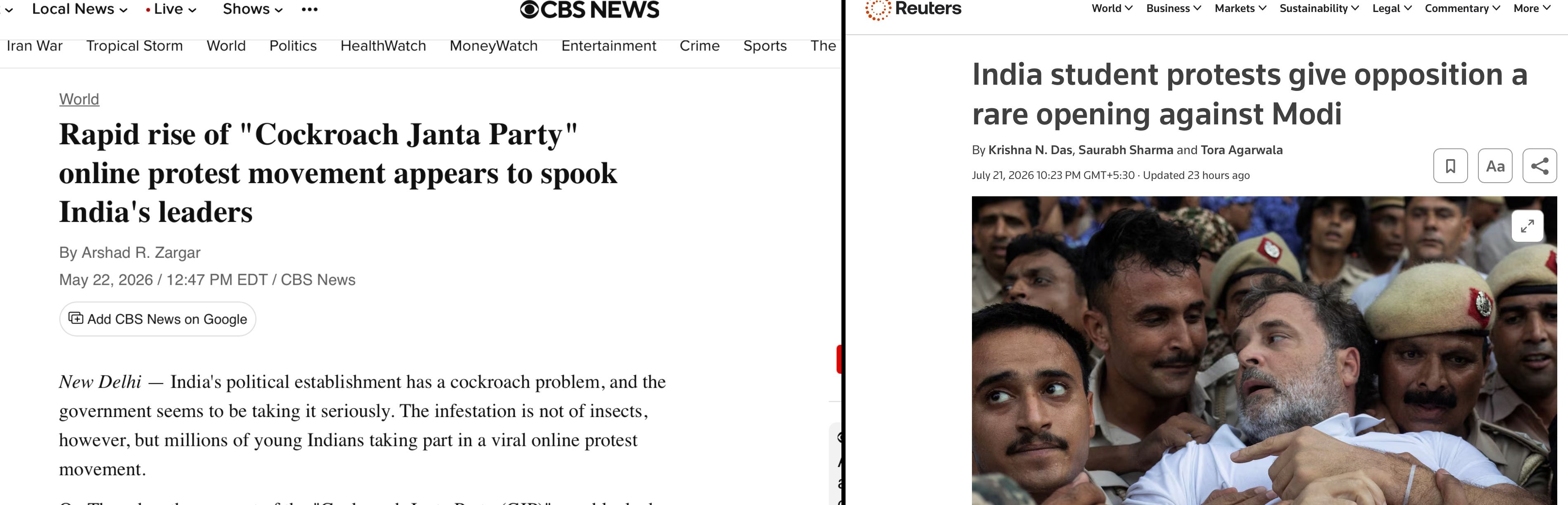
Global media asked why India’s youth had taken to the streets. Indian media asked what had happened on the streets that day. That split has defined coverage of the Cockroach Janata Party (CJP) protests – the biggest story out of India this month.
The CJP began in May 2026 as a satirical X account, started by Abhijeet Dipke, a US-based student of Indian origin, after a loose remark from the Chief Justice of India equating unemployed Indian youth with “parasites”. Two months on, it has grown into the largest platform for India’s young and unemployed to vent their anger at what they see as a rigged system.
The trigger was a string of exam paper leaks across Indian states, which convinced job aspirants that only the wealthy could get ahead. When more than ten million protesters swamped Delhi on Monday, police crackdowns only hardened their resolve.
The global lens: explaining why
The Washington Post, the Guardian and Deutsche Welle (DW) have all covered the movement, and largely treated it as a symptom of deeper unrest among Indian youth. The Washington Post called it a reflection of growing anxieties among India’s young. CBS News zeroed in on how fast the movement gained momentum. The Guardian went further, framing it as an unexpected challenge to the Modi government and pointing to humour as a way of channelling frustration with governance.
The story has since outgrown the exam-leak trigger. Reuters has tapped into the broader narrative of unemployment, declining faith in public institutions, and shrinking economic opportunity for young Indians. International outlets have also dwelt on the symbolism: the Washington Post, CBS News and the Guardian all frame the “cockroach” as a badge of resilience – an insult reclaimed as political identity – and note how memes, humour and satire have become organising tools in their own right. Al Jazeera and the Guardian have focused on the police response, reporting on the use of teargas and batons against protesters.
Reuters and the Washington Post have treated the movement as a political story rather than a purely youth-led one, examining its potential as an electoral issue given India’s youth, comprising nearly 50 per cent of the population. Reuters, DW and the Washington Post have all highlighted the CJP's decentralised structure — no conventional leadership, yet able to mobilise millions — drawing comparisons with other digitally driven protest movements worldwide.
The Indian lens: chasing the moment

Indian big media, by contrast, blacked out the story for over two months, then covered Monday’s protests blow-by-blow but rarely paused to explain them. Coverage stayed episodic: the meme yesterday, the march today. India Today's account of the 20 July Parliament march, for instance, was framed around whether police preparedness had failed and whether authorities had underestimated the scale of the mobilisation.
NDTV and the Times of India similarly focused on police action and sporadic violence during the protest, with less attention to what was driving the protesters themselves. Much of this reporting also politicised the movement early, dwelling on whether the opposition had orchestrated it – prioritising interpretation over immediacy.
NDTV’s coverage of the CJP securing police permission for the Delhi march is typical of this blow-by-blow approach.Two big outlets, apart from numerous smaller media houses, broke from the pattern. The Indian Express tracked the movement’s arc from a social media campaign to a full-fledged youth movement, while the Hindustan Times did ground reporting on how protesters’ grievances extend well beyond the original NEET paper-leak controversy. On the whole, though, Indian media overlooked the themes global coverage foregrounded – unemployment, institutional distrust and civic mobilisation – in favour of tracking the protest as breaking news and a catalyst for alleged chaos in the national capital New Delhi.