
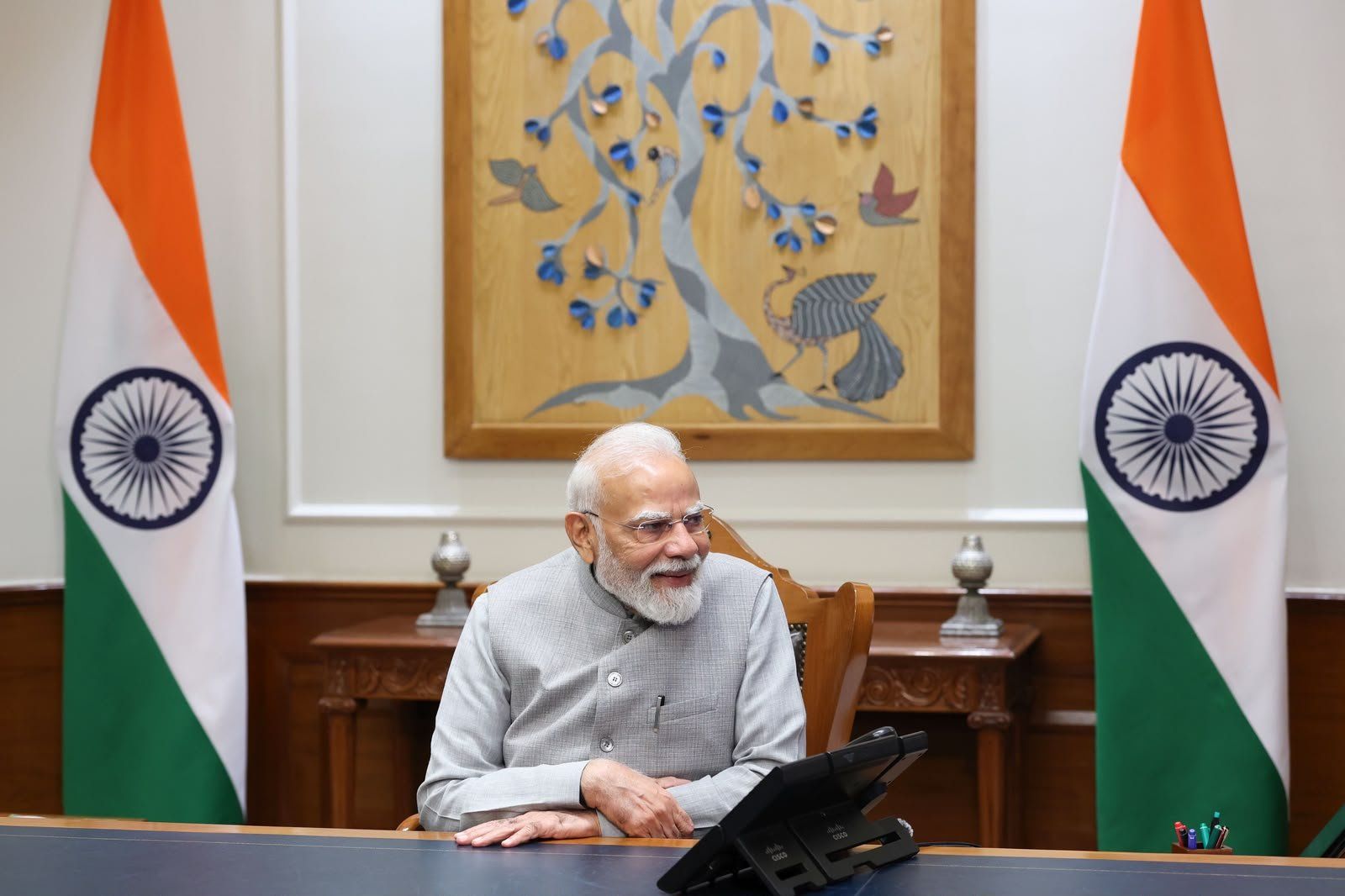
India is everywhere and decides almost nothing. That is the uncomfortable truth behind a decade of “Vishwa Guru" (World's Guide) rhetoric – pushed by both the Indian government and the media. The record, however, tells a different story. Since 2014, New Delhi has sold itself as a rising pole in a multipolar world, with Prime Minister Narendra Modi’s record foreign travels and “bear hugs” offered as proof of stature.
But visibility is not influence. Look past the photo-ops to the neighbourhood, West Asia and the Trump-era transactions that now define India’s foreign policy, and a starker picture emerges: a country reacting to events it once hoped to shape, its strategic autonomy increasingly a matter of selective convenience rather than practised reality.
The “Neighbourhood First” paradox
Modi's first term opened with a grand gesture – South Asian leaders invited to his 2014 swearing-in. Twelve years on, the South Asian Association for Regional Cooperation is moribund and China’s footprint has only grown. In the Maldives, the 2023–24 “India Out” campaign carried Mohamed Muizzu to power, though Male has since recalibrated: Muizzu hosted Modi for a state visit in July 2025 and the two sides signed a raft of agreements on economic and maritime security, a reset driven less by goodwill than by the Maldives’ debt distress.
In Nepal, boundary disputes remain unresolved. In Sri Lanka, Chinese capital still dwarfs India’s.Bangladesh is the sharper cautionary tale. New Delhi bet heavily on Sheikh Hasina’s Awami League for fifteen years; when her government collapsed in August 2024, India was caught flat-footed, and the Muhammad Yunus-led interim administration tilted visibly towards Beijing and Islamabad.
February 2026’s election has offered a partial correction: the Bangladesh Nationalist Party, led by Tarique Rahman, won a commanding majority, and Modi was reportedly the first foreign leader to phone the incoming prime minister. But the same election handed the Jamaat-e-Islami 77 seats as the principal opposition – its strongest showing yet, concentrated precisely along India’s border. A friendlier government in Dhaka does not erase the structural drift towards Islamist and anti-India politics that Hasina’s fall exposed.
The Trump factor and strategic autonomy
The India-US relationship, anchored by the Quad, has deepened on paper. But Donald Trump’s second term has repeatedly exposed how transactional it really is. Washington imposed a punishing 50 per cent tariff on Indian goods in 2025 – the highest levied on any US trading partner– explicitly tied to India’s purchases of Russian oil, and Trump paired the pressure with public warmth towards Pakistan and unwelcome offers to mediate on Kashmir, which New Delhi has flatly rejected.
The tariff was only cut to 18 per cent in February 2026, and the price was steep: India agreed to halt Russian crude purchases altogether and open its markets further to American goods. The episode that was meant to showcase India’s resilience – defying Western pressure to keep buying discounted Russian oil – ended instead in capitulation once Washington raised the price of resistance.
The damage lingers well beyond the tariff line. On the Council on Foreign Relations’ President’s Inbox in mid-July 2026, South Asia scholar Sadanand Dhume described the relationship as having gone from “on a high” in early 2025 to a “rollercoaster” by mid-2026, citing tariffs, Trump’s musing about a US-China "G2", and the Pentagon quietly dropping “Indo” from Indo-Pacific Command.
Pew’s most recent numbers bear this out: American favourability in India stood at just 45 per cent in June 2026, its lowest since polling began in 2002, with Trump’s own personal approval down to 39 per cent – a 13-point fall in a single year.
Iran tells a similar story. India’s ten-year contract to run Chabahar Port, its route to Central Asia that bypasses Pakistan entirely, has been left to wither under US sanctions. Washington revoked India’s long-standing waiver in September 2025; a six-month reprieve lapsed on April 26, 2026 with New Delhi reportedly weighing a temporary transfer of its stake to an Iranian entity rather than lose the project outright.
A decade of investment and diplomatic capital in a project sold as proof of Indian strategic autonomy is now, by India’s own budgetary silence – zero rupees allocated in Budget 2026 – effectively in retreat.
A zombie Quad and a hedge towards Beijing
Nothing captures the drift better than the Quad itself – once billed as the institutional core of India’s Indo-Pacific strategy. It has not held a leaders’ summit since 2024; a planned 2025 gathering in India never materialised amid the tariff dispute.
Dhume’s blunt verdict on CFR: the grouping is “in zombie territory”. That same drift is visible in the Pentagon’s own vocabulary: the renaming of Indo-Pacific Command to simply Pacific Command this year has been read across the region as a quiet US pivot away from the framework that once put India at its centre.
Faced with that vacuum and an unpredictable Washington, Modi has quietly hedged towards the very power the Quad was designed to counter. His trip to China for the Shanghai Cooperation Organisation (SCO) summit last August was his first in seven years; direct flights between the two countries have since resumed and trade has ticked up, even as the underlying Himalayan boundary dispute – unresolved since the 1950s and the site of deadly clashes as recently as 2020 – remains as intractable as ever. It is recalibration born of necessity, not conviction, and it says as much about New Delhi’s shrinking room for manoeuvre as any tariff figure does.
The domestic shadow on foreign policy
Foreign policy keeps getting hostage to domestic politics, and cricket has become the clearest proof. In January 2026, the BCCI ordered Kolkata Knight Riders to release Bangladeshi pacer Mustafizur Rahman from their IPL squad, citing communal tensions in Bangladesh, without offering a public explanation. Dhaka suspended IPL broadcasts in retaliation, sought to move its T20 World Cup fixtures against India to Sri Lanka on security grounds, and was instead dropped from the tournament by the ICC.
Pakistan, in solidarity, refused to play India altogether at the same World Cup – handing Islamabad a costless diplomatic win over a sport New Delhi usually wields as soft power. A boardroom decision, driven by domestic sentiment, ended up isolating India rather than Bangladesh.
Military success, diplomatic vacuum
Operation Sindoor, India’s May 2025 strikes on terror infrastructure in Pakistan following the Pahalgam attack, was a genuine military achievement. However, its diplomatic afterlife has been messy. Trump has repeatedly and publicly claimed credit for brokering the ceasefire, even invoking trade leverage – a claim New Delhi has dodged at every turn.
The Indian foreign minister S.Jaishankar told the Parliament that there was no third-party mediation and no Modi-Trump call for weeks around the flare-up but has never clearly refuted Trump’s claims. Pakistan took the opposite approach entirely: it publicly thanked Trump and formally nominated him for the Nobel Peace Prize, a gesture New Delhi could never have made and one that visibly warmed Washington to Rawalpindi.
Months later, Islamabad repeated the trick, playing a prominent, US-acknowledged role in brokering the ceasefire that ended the Iran war – a conflict in which India, despite deep economic and diaspora stakes in West Asia, had no seat at the table at all. A year on from Sindoor, Pakistan’s ties with Washington, Beijing, Turkey and Saudi Arabia have all strengthened, while India’s earlier tilt towards Israel, at Iran’s perceived expense, has yielded no comparable leverage.
Ukraine has followed the same arc. Modi’s line to Vladimir Putin that “this is not an era of war” earned global headlines in 2022. India has since had no discernible role in shaping where that war goes.
The Cost of Confusing Motion for Momentum
India’s ambition to lead is legitimate for the world’s most populous nation and sixth-largest economy – a rank it has recently slipped to, behind the UK, on IMF figures, even as it remains the world’s fastest-growing major country. But leadership is not measured in air miles or embraces.
It requires strategic consistency that can survive both domestic political cycles and the transactional instincts of powers like Trump’s America. “Neighbourhood First” cannot remain a slogan while Jamaat-e-Islami gains ground on the border and Chabahar is quietly wound down. Strategic autonomy cannot be invoked selectively – resilient on Russian oil until the tariff bill arrives, absent altogether on Iran, and now hedged towards Beijing precisely because Washington has grown unreliable. A foreign policy built on personal chemistry and a zombie Quad is not a strategy; it is an improvisation. Until New Delhi replaces one with the other, it will keep being seen everywhere and consulted nowhere that matters.