
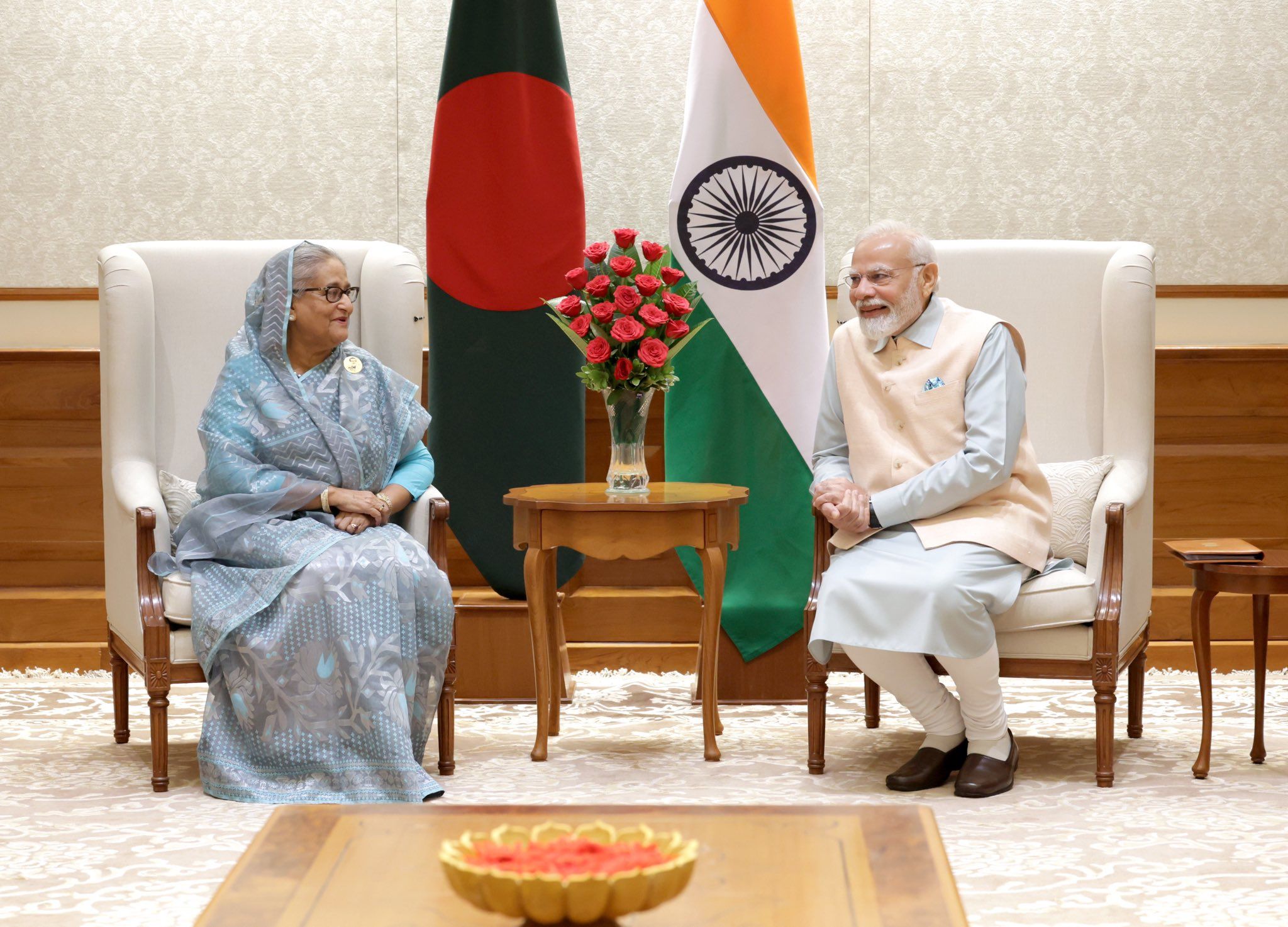
For the first time on record in a report tabled in Parliament, India’s Ministry of External Affairs has confirmed to a Parliamentary panel that Bangladesh’s request to extradite former prime minister Sheikh Hasina remains “under examination” – more than eight months after Dhaka lodged it, and nearly two years after she fled to India. The response came in the Parliamentary Standing Committee on External Affairs’ action-taken report, tabled on July 30, even as MPs on the panel simultaneously pressed New Delhi to use Bangladesh’s political transition to rebuild ties.
What the government told the panel
The MEA’s written submission said the request “is being examined by the competent authorities of the Government of India in accordance with applicable law and established procedures”, and noted the committee’s recommendation on the matter “for compliance”. The response shows that the government may not be ready as yet to commit to Hasina's extradition. This built on fuller testimony that the committee had recorded earlier from foreign secretary Vikram Misri, who told MPs that sheltering Hasina was consistent with India’s humanitarian tradition of aiding those facing an “existential crisis”, and asserted she had not been given a political platform or any space to conduct political activity from Indian soil.
The committee’s own observations went further than the extradition question alone. It described Hasina’s stay as reflecting India’s “civilisational ethos” of offering refuge to people in distress, while also formally recording that Bangladesh had sought her extradition and asking the government to keep Parliament updated.
Separately, the committee urged New Delhi to use Tarique Rahman’s election to seize this political moment to reset the bilateral relationship, calling for outstanding issues to be resolved with urgency and in the spirit of 1971 (year of Bangladesh’s independence), and recommended reviving parliamentary exchanges between the two countries. It also flagged continuing concern over rising violence, curbs on democratic freedoms, growing radicalisation and attacks on minority communities in Bangladesh since August 2024, and cautioned against “revisionist” retellings of the 1971 Liberation War, recommending deeper academic and cultural exchange to preserve that shared history for younger generations. On water-sharing, it said that the stalled Teesta agreement was overdue for fresh momentum and called for cooperation to be broadened beyond major rivers to include aquifer recharge, river rejuvenation and climate resilience.
A relationship that soured after Hasina’s fall
Hasina was, for fifteen years, one of India’s closest regional partners. Her government cooperated closely with Delhi against anti-India insurgent groups and expanded cross-border trade and connectivity. Her ouster upended that. Her removal, and India’s decision to shelter her, stoked anti-India sentiment in Bangladesh, compounded by border disputes, tit-for-tat trade restrictions and hostile rhetoric on both sides.
The interim government under Muhamaad Yunus, and now Tarique Rahman’s elected administration, has leaned towards China and Pakistan as a result – Yunus made China the destination of his first state visit as leader, and Dhaka and Beijing signed a defence agreement in January for a drone plant near India's border. Ties dipped further after violence linked to anti-India politician Sharif Osman Bin Hadi’s killing in December, prompting India to summon Bangladesh’s High Commissioner in protest.
It is against this backdrop that the committee’s push to “reset” relations matters. New Delhi appears to be weighing how to extend cordiality to the new Dhaka government without abandoning the position it has held since August 2024 – and the parliamentary response, by carefully justifying Hasina’s continued shelter as principled and non-political rather than adversarial, is doing double duty: defending a decision New Delhi has already made, while signalling to Dhaka that the humanitarian rationale is not a hostile one.
The legal and strategic balancing act
Under the India-Bangladesh Extradition Treaty of 2013, amended in 2016 to ease the process, extradition is not automatic. Either side may decline a request that it considers politically motivated or inconsistent with due process; India's own Extradition Act, 1962 permits refusal on similar grounds. Bangladesh insists the cases against Hasina – including a November 2025 death sentence handed down in absentia for crimes against humanity – are criminal rather than political; India has repeated only that the matter remains under examination.
The stakes explain the caution. India and Bangladesh share a 4,000-km border, deep trade ties and counter-terrorism cooperation. Extraditing Hasina risks signalling that India won’t protect leaders who seek refuge; refusing risks deepening the rift with Dhaka’s new government at a moment China is actively courting it. Hasina herself has said she plans to return to Bangladesh around December with senior party colleagues to face trial voluntarily, telling Reuters she could be arrested or worse but had to go – and separately telling AFP she is fully aware of what may follow.
The Indian Parliament, for now, seems intent on keeping the legal process formally separate from the wider relationship – while using the same report to signal that New Delhi wants ties with Dhaka to stabilise regardless of how the Hasina case is eventually resolved.