
Myanmar’s military intensified attacks on civilians ahead of the junta-run elections last December and January, a UN investigative mechanism said on August 11, adding fresh scrutiny to the military government’s efforts to gain international legitimacy and re-engage with Southeast Asia. The polls were widely criticised by Western governments and rights groups as neither free nor fair, delivered a win for a military-backed party and paved the way for junta chief Min Aung Hlaing to become president.
The eighth annual report of the Independent Investigative Mechanism for Myanmar (IIMM), made public on August 11, detailed a series of war crimes and serious abuses, including torture and sexual violence committed by junta forces over the past year.
“Over the past year, the Mechanism's investigations showed that the frequency and intensity of war crimes and crimes against humanity committed by the Myanmar military and by various armed groups continued to escalate,” the IIMM said in its report.
Investigators said the evidence was drawn from more than 1,600 sources. The UN estimates the conflict has left some 3.6 million people internally displaced, a number expected to near 4 million this year. “Behind every piece of evidence we collect are people whose lives have been devastated by these crimes,” said IIMM chief Nicholas Koumjian.
Two-pronged approach
The report underscores how violence has not eased since the military overthrew the civilian government led by Aung San Suu Kyi in February 2021. That event sparked a civil war that has killed an estimated 100,000 people and drawn in the military, the People’s Defence Forces and powerful ethnic armed organisations.
The military has increasingly relied on air power – including low-cost aircraft, drones, motorised paragliders and gyrocopters – against civilian targets. The IIMM said it had documented attacks on homes, schools, hospitals, religious buildings and displaced-persons camps.
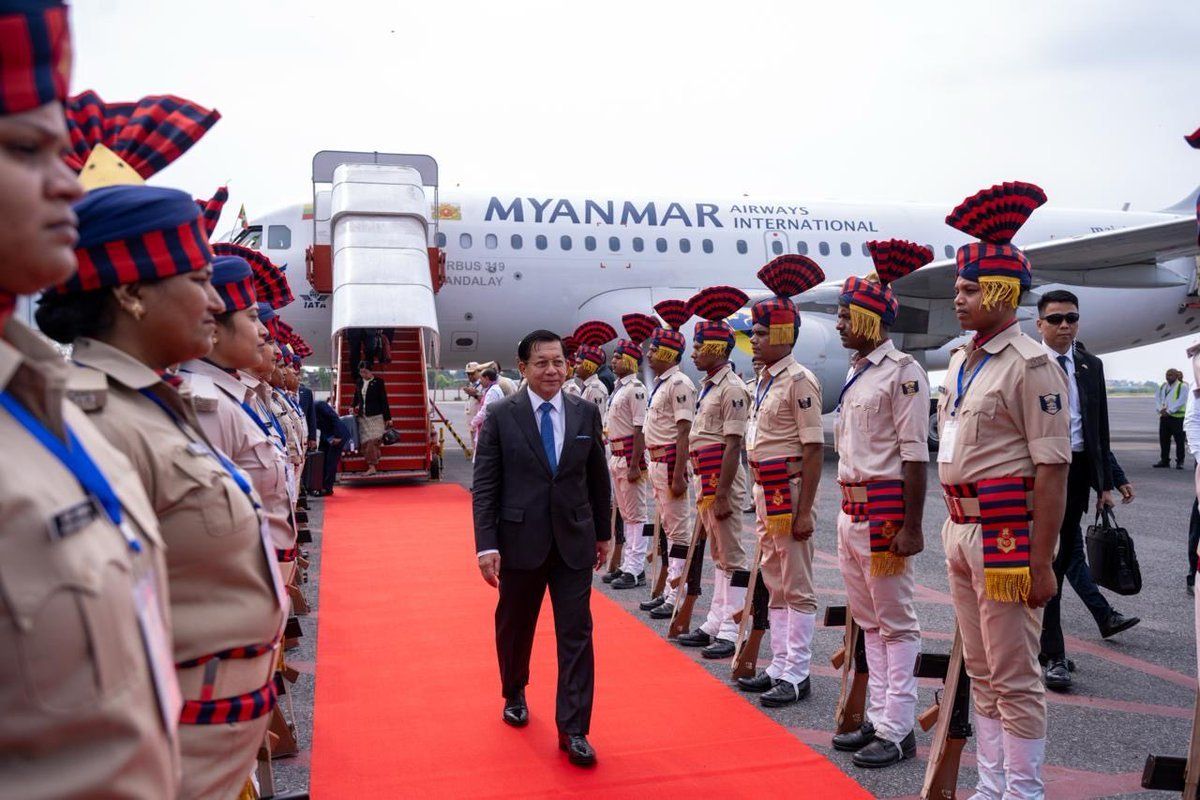
The findings come at a significant moment for the junta, which has been seeking diplomatic re-engagement with the Association of Southeast Asian Nations (ASEAN). The report was released days after Min Aung Hlaing's August 6-7 visit to Thailand, which was seen as part of his efforts to gain greater international legitimacy.
Top Myanmar diplomats met ASEAN foreign ministers in July, their first in-person meeting since the coup. The bloc’s special envoy, Philippine Foreign Minister Maria Theresa Lazaro, has been holding talks with parties to the civil war in an effort to open a channel for dialogue.
ASEAN’s 2021 Five-Point Consensus, which called for an immediate end to violence, humanitarian assistance and engagement by an ASEAN special envoy, has produced little progress. Myanmar’s military junta has rejected the consensus, arguing that the situation has changed since the elections. Myanmar has also pushed back against continued involvement by the ASEAN envoy, saying the envoy is no longer necessary following the election.
Lack of diplomatic sincerity
That diplomatic outreach has been complicated further by the junta’s handling of Aung San Suu Kyi, who was moved from prison to house arrest in late May and has had her sentence reduced from an original 33 years to 18.
In July, Myanmar’s foreign ministry told Lazaro that the Nobel laureate would be “looked after”, referring to her as “a sister”. The junta also allowed a representative of the International Committee of the Red Cross to meet with Suu Kyi and released images of the meeting.
Yet ASEAN envoy Lazaro has previously been denied permission to meet with Suu Kyi, a striking contradiction. ASEAN renewed that request through a chair statement on August 7, calling the Red Cross visit “a positive step” while pressing for Suu Kyi’s “complete and unconditional release”. However, Myanmar’s foreign ministry rejected it again days later, insisting any release “shall only be carried out in accordance with the law”.
Releasing images of the Red Cross meeting allows the junta to project a degree of humanitarian openness at the very moment it is seeking greater diplomatic engagement with its Southeast Asian neighbours.
Suu Kyi’s wellbeing remains central to the issue: access to her has become a litmus test of whether Myanmar is genuinely willing to cooperate with ASEAN. The military’s refusal to let ASEAN’s envoy meet with her exposes the limits of the bloc’s leverage.
The challenge for ASEAN now is to convert this opening into tangible outcomes – humanitarian access, meaningful dialogue and, ultimately, a reduction in violence.