
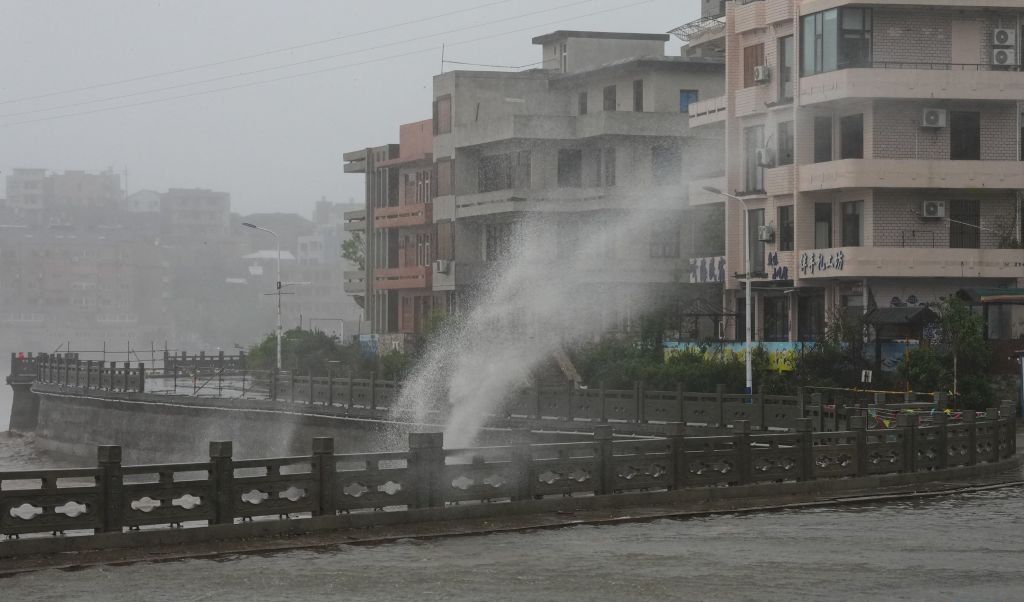
Typhoon Dolphin, the most powerful tropical cyclone to hit China this year, has hit eastern China hard while affecting other parts of East Asia and Southeast Asia, including Hong Kong, Taiwan, Japan and the Philippines. On Sunday (August 9), over a million people were evacuated and moved to safety across eastern China as the powerful typhoon made landfall amid fears that torrential rain would cause flooding and landslides.
Dolphin made landfall near Yuhuan in Zhejiang province, with sustained winds of 151 km/h. Wenzhou, a coastal city in Zhejiang province, opened over 1,500 emergency shelters and relocated more than 900,000 residents, while neighbouring Taizhou had already moved about 390,000 people to safety by Saturday evening. About 98,900 people were evacuated from high-risk areas in neighbouring Fujian province.
China
The typhoon’s effect was particularly visible in Shanghai, the commercial capital of the country. A weather station in central Shanghai recorded nearly 313 mm of rain in the 24 hours to Monday morning – the highest 24-hour rainfall recorded there in more than 150 years. Another station recorded nearly 400 mm. More than 1,500 flights to and from Shanghai were cancelled, while ferries and other public transport services were also suspended in affected areas.
The storm has weakened after moving inland. However, forecasters have warned that some areas could receive up to 500 mm of rain and face the risk of flash floods, rising rivers and landslides. The storm is now expected to track further inland toward Hubei and Henan, with Beijing bracing for significant rainfall from Tuesday to Thursday and authorities warning of flash floods and landslides in the capital's surrounding hills.While cities in Fujian and Wenzhou evacuated people, Shanghai, Jiangsu and other provinces prepared for heavy rainfall and flooding. Emergency authorities initiated response measures – ferries, construction activity, rail services and flights were suspended. Shanghai also relocated more than 215,000 people from areas considered at risk by Sunday evening.
Hong Kong
Dolphin also affected Hong Kong, but in an unusual way. Rather than bringing major flooding, the typhoon helped push hot air over the territory. Hong Kong recorded its highest temperature ever, 36.9°C, on August 9 – the highest since official records began in 1884. In the New Territories, Sheung Shui climbed to 39.8°C, the highest reading at any automatic weather station since they were installed in the 1980s.
Philippines
Although the Philippines did not experience a direct hit from the storm, the country saw intensified rains as Dolphin strengthened the southwest monsoon. The resulting bad weather caused flooding and landslides across Luzon. In the mountain resort city of Baguio, a landslide buried several houses, killing four people and leaving six others missing. At least 12 people died and eight remained missing across northern Luzon in total, while more than half a million people across 33 provinces were affected by the enhanced monsoon.
Japan and Taiwan
On August 8, Japan was hit by Typhoon Dolphin. It mainly battered the Okinawa prefecture and nearby Amami Island, cutting power to over 50,000 buildings across Okinawa and Kagoshima prefectures and injuring six people. Flights to and from Okinawa were cancelled. In Taiwan, at least 78 flights were cancelled, mostly international. Northern parts of the island were hit by heavy rain, although no evacuations were ordered.
How Dolphin Formed
Dolphin formed in the western North Pacific, one of the world’s most active tropical-cyclone basins. Typhoons form over warm tropical oceans, with the heat from the ocean encouraging evaporation. Warm, moisture-rich air rises, and when water vapour condenses into clouds, it releases heat that helps power the developing storm. A pre-existing weather disturbance, sufficient moisture and relatively low vertical wind shear are also needed for a tropical cyclone to develop.
The name 'Dolphin' is part of the rotating naming system adopted by the Economic and Social Commission for Asia and the Pacific (a UN regional commission) and the World Meteorological Organization’s Typhoon Committee for tropical cyclones in the western North Pacific and the South China Sea. The Japan Meteorological Agency maintains the official list and uses the names sequentially. Dolphin was contributed by Hong Kong and refers to the Chinese white dolphin, which lives in Hong Kong waters and is also a Hong Kong mascot.
A Pattern of Destructive Storms
Southeast Asia has experienced several destructive typhoons in recent years. In September 2024, Typhoon Yagi caused severe flooding, landslides and extensive infrastructure damage in northern Vietnam after also affecting parts of China and the Philippines. In July 2023, Typhoon Doksuri caused flooding and severe damage in the Philippines, Taiwan and China.