
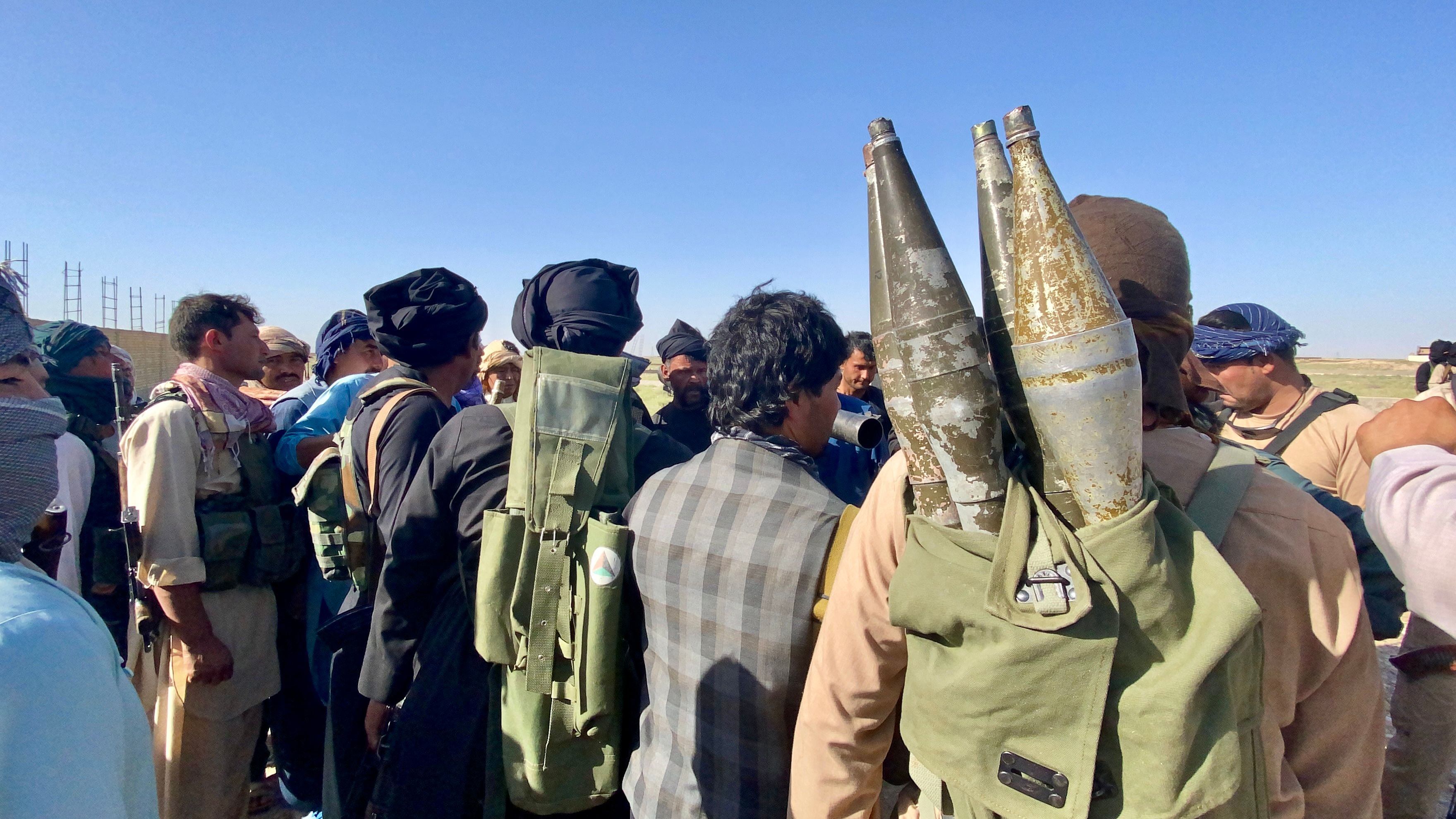
Tensions have temporarily eased between the United States, Israel, and Iran, following a two-week truce between Washington and Tehran. Before the truce, attention was turning to Iran's proxy groups that could be used to expand the battle zone and increase the intensity of the war. Iran could probably use the truce to gather these groups. Fatemiyoun Briga/de, a force composed largely of Afghan Shiite fighters recruited and trained by Iran, was one such group. The Brigade, which played a significant role in conflicts in Syria and Iraq over the past decade, has largely faded from public view in recent years. But analysts and former officials say it remains a potential asset for Tehran, particularly if the current crisis resumes and expands beyond air and naval operations into a broader full-scale regional confrontation.
The two-week truce has offered a temporary pause in hostilities, though it has not resolved the underlying tensions. Exchanges of strikes between Iran and Israel prior to the ceasefire had already raised fears of a prolonged, multi-front war. Whether the truce holds or collapses will determine the conflict’s next phase. In this context, the question facing policymakers and analysts is whether Iran could once again rely on proxy forces such as the Fatemiyoun Brigade if the conflict is prolonged.
The Brigade was formed by Iran’s Islamic Revolutionary Guard Corps (IRGC), primarily recruiting Afghan refugees, many from the Shiite minority living in Iran. Thousands of these fighters were deployed to Syria to support the government of Bashar al-Assad and to combat militant groups, including the Islamic State (IS). During the peak of the Syrian conflict, the brigade was considered battle-hardened and operationally effective, gaining experience in urban warfare and cross-border operations. However, as Iran’s influence in Syria has shifted and the intensity of the conflict has decreased, the group has become less visible.
Still, experts say that reduced visibility does not necessarily mean inactivity. Former U.S. national security adviser and U.S. Ambassador to the UN John Bolton said the group continues to exist and could be reactivated if needed. “Fatemiyoun proxy group is still active and can assist the Iranian regime for its military purposes,” Bolton told NWS in an interview. He added that Iran has historically relied on proxy forces not only in external conflicts but also during periods of internal unrest.
He claimed the Iranian government previously deployed various proxy groups, including Fatemiyoun, to suppress local demonstrators in December and early January. “If the current regime survives, they could consider using them for retaliation,” he said. Bolton added, looking at the group’s background, “They are fully capable of conducting terrorist operations.” He emphasised that any US ground deployment in Iran would likely draw not only Fatemiyoun but also other militant proxy groups like Hezbollah and Hamas into the fight.
Not all observers share that assessment. Afsheen Nareman, an American-Iranian journalist and commentator based in the United States, said Iran’s overall military and proxy capacity has been significantly weakened in recent years. He argues that Iran struggled to withstand intensified US and Israeli attacks in the weeks before the truce. “Fatemiyoun still exists inside Iran, and there are indications they have been used during internal unrest,” he said. “But the regime itself is under severe pressure and may not have the ability to reorganise or deploy them as a major military force.”
Fatemiyoun is going to be destroyed because the Iranian regime no longer has the same capacity it had two years ago to reorganise Afghan refugees under the brigade, Nareman said. He suggested the regime can at best use them for pro-government demonstrations, but reorganising them as a military force would be “impossible” given Iran’s weakened state. He described Iran’s military capability as “like a boxer being repeatedly punched in the ring, struggling to defend himself but unable to turn the fight in his favour.” He also pointed to the difficulty of obtaining reliable information from within Iran due to communication restrictions, adding that while some reports suggest the group remains present, its operational readiness is unclear.
There has been no official confirmation of the mobilisation of the Fatemiyoun Brigade since the truce came into effect. However, some signals suggest the group has not disappeared entirely. A BBC video published on April 4 showed youths carrying Fatemiyoun flags in Tehran, riding in cars and motorcycles and marching on city streets. This public display could be a symbolic response to the threat of US ground forces. Whether such displays continue or intensify during the truce period will be closely watched as a barometer of Iranian intent.
A Fatemiyoun veteran offered further insight, providing a more personal and direct perspective on the group’s legacy and current uncertainties. An Afghan fighter of the brigade, who spoke on condition of anonymity due to security concerns, said he was recruited by Iranian authorities and fought in Syria and Iraq between 2015 and 2016. The fighter, identified here as Husaini, said he was drawn by financial incentives and limited economic opportunities. “At that time, it was one of the few options available,” he said. He maintained contact with former comrades until the US withdrawal from Afghanistan, but has since lost touch with them. He believes most are in Iran and that they have now been invited back to the Fatemiyoun, though he couldn’t confirm. Husaini recounted that the Iranian government recruited thousands of Afghan Shia and Hazara refugees.

Reports indicate that Afghan refugees in Iran have faced deportation over the years. However, those who agree to join the brigade are offered extended residency and better wages. Husaini says high wages—three million Iranian Rials (around $1,000 [at that time]), significantly more than typical migrant wages in Afghanistan—motivated many, including him, who were living in poverty. Husaini said he sustained serious injuries while returning from Syria and now lives with long-term disabilities.
“I broke my leg, my hand and my neck. I have metal in my leg now,” he said. He currently lives in central Bamyan province of Afghanistan, where he works as a local vendor while struggling with ongoing health issues. “I cannot afford the few surgeries I need,” he said. When asked whether he would rejoin the brigade if called upon, he paused for a few seconds before responding. “I’m not sure,” he said. “I cannot run properly anymore.” Analysts say such economic factors could still play a role in any future recruitment efforts, though the broader political and military context has changed.

Sulaiman Aryan, an Afghan journalist who has extensively reported on the Fatemiyoun Brigade, believes the group isn’t widely discussed since Iran’s withdrawal from Syria. “They are not as visible as before, but that does not mean they are gone,” he said. He outlined three conditions under which they could be reinforced: “First, if there is any major threat again from IS in Iraq. Second, if the US sends ground forces to Iran and finally, if there is a major escalation across the region.” The two-week truce does not, by itself, remove any of these triggers; it merely delays them. Aryan, currently seeking asylum in Pakistan due to his journalistic work, says he aims to migrate to a third country. He also notes that Pakistan is not entirely safe for him, as he has “faced detention” there.
Despite the temporary truce, there has been no clear evidence of large-scale mobilisation or stand-down of the Fatemiyoun Brigade. A statement from the brigade circulated in some pro-Iran Telegram channels in late March. The statement condemned the assassination of the supreme leader, Ali Khamenei, and claimed the war would end favourably for Iran. However, such messages remain difficult to verify independently. Analysts say the group’s future role will depend largely on how the conflict evolves. The truce provides a narrow window for diplomacy, but if the crisis re-escalates into a broader ground conflict, particularly involving U.S. forces, the Fatemiyoun Brigade could once again become a relevant component of Iran’s strategy. But if Iran’s military capabilities continue to face pressure, its ability to reactivate and deploy proxy forces at scale may be limited. For now, the brigade remains in a state of uncertainty, neither fully visible nor entirely absent, reflecting the broader ambiguity surrounding the region’s rapidly changing security landscape.