
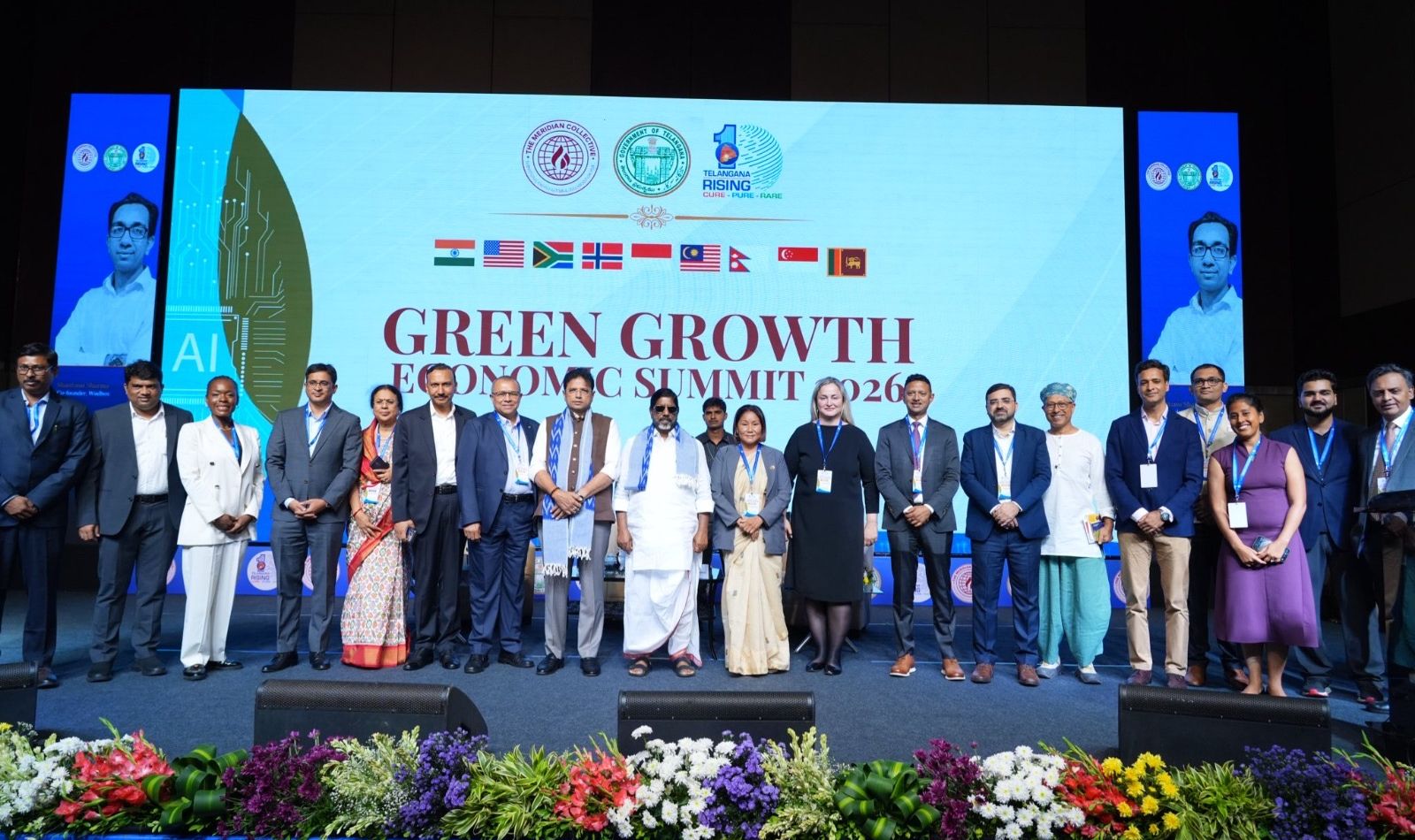
The Green Growth Energy Summit 2026 on July 7-8 in India’s Hyderabad is being held against the backdrop of headlines tracking over 1.16 lakh layoffs across Silicon Valley. For fresh graduates and the millions of ambitious young people across India and South Africa, the sudden disappearance of traditional entry-level tech roles isn’t merely a structural shift. As an apocalyptic narrative takes hold – one where generative AI and intelligent software agents automate tasks while humans sit on the sidelines — governments worldwide are scrambling.
Yet, our response cannot simply be panic. For the democracies of the Global South, it must be a calculated, strategic leap ahead of the curve— an understanding that has brought together international leaders to design a sustainable roadmap to establish green power grids and integrate clean energy infrastructure.
In this shifting geopolitical landscape, both South Africa and India are uniquely caught in the crosshairs of an infrastructure boom. Driven by strict data sovereignty mandates, our countries are becoming home to a buzzing network of hyper-scale data centres. India’s active computing capacity has quadrupled over the last five years to 1,500 megawatts, while South Africa has solidified its status as the African continent's digital anchor, hosting over 56 advanced data centres.
Hardware alone cannot insulate an economy from automated displacement. If we only build concrete walls and power the server racks without investing in the minds that write the code, we will merely be landlords to a digital empire owned entirely by the Global North.
We are faced with a fundamental choice: do we wait and watch as this digital transformation reshapes our societies from the outside, or do we aggressively leverage our collective talent pool, inherent resourcefulness, and youthful demographic advantage to pioneer the next generation of solutions?
A roadmap for the Global South
To move from the periphery to the centre of the AI revolution, our economies must focus on a triad of structural interventions: building our talent to develop next-generation "Agentic AI" tools, fostering hyper-localised tech ecosystems in non-metropolitan towns, and radically restructuring our foundational skilling systems.
The first step requires demystifying the technology itself and putting it directly into the hands of those who need it the most. The conversational ease of large language models might seem nerve-wracking, yet this accessibility is our greatest asset. For a youth in a tier-3 Indian town or a young entrepreneur in a South African township, intuitive AI interfaces serve as a blank canvas for localised innovation.
Generic AI models built in Silicon Valley do not understand the socio-economic realities of a primary health clinic in Limpopo or a small retail shop in Uttar Pradesh. True innovation happens when we build specialised Agentic AI – software capable of autonomous reasoning and executing multi-step complex tasks – tailored to our local landscapes.
We see this spark in grassroots movements like Masakhane in Africa and AI4Bharat in India, which are open-sourcing AI architectures to break through the English-language barrier and communicate natively in isiZulu, Xhosa, Hindi, or Telugu. We see it in organisations like Silulo Ulutho Technologies, which has scaled dozens of IT centers across South Africa's township communities and is now actively training youth to deploy AI utilities for local micro-enterprises.
By creating localised "training sandboxes" outside our traditional metropolitan tech hubs, our governments can deliberately introduce youth to these agentic tools and provide the resources necessary to turn localised problem-solving into viable businesses.
India, having successfully scaled global digital public goods like the Unified Payments Interface (UPI), possesses the deep macro-blueprint for managing these technological shifts. Combined with forward-thinking regional leadership -- such as the sandboxes currently being conceptualised here in India’s Telangana – we have the dynamic framework required to decentralise innovation. We must also secure the low-hanging fruit of the immediate physical infrastructure boom. Building and maintaining massive data centres demands an entire ecosystem of technical professionals, ranging from data centre architects to specialised cyber-security teams.
This infrastructure boom directly intersects with our imperative for a green energy grid. The massive power demands of AI computing mean that our technological expansion must be fuelled by renewable energy investments. Connecting public skilling programmes with strategic placement in these emerging green-tech and renewable industries will ensure that the local physical footprint of the cloud translates directly into sustainable domestic employment. Cross-border collaborations, the need of the hour.
Finally, it is not just about technical skilling; it is about rewriting our mindsets. For the longest time, colonial education built a workforce structured merely to serve rather than create. The advent of artificial intelligence challenges the human mind to do the exact opposite: to create new products, challenge delivery systems, and move from responding to producing innovation.
The question that stares at us is how do we collectively build sandboxes that prompt the next round of innovation? The historical paradigm where Silicon Valley builds the core intelligence while the Global South merely operates the low-wage call centres or cleans the raw data must come to an end. By aligning our policies, opening cross-border sandboxes, and backing our youth with dedicated capital, India and South Africa can together demonstrate that the age of AI does not herald the end of opportunity — but the birth of an entirely new, more equitable model of growth.