
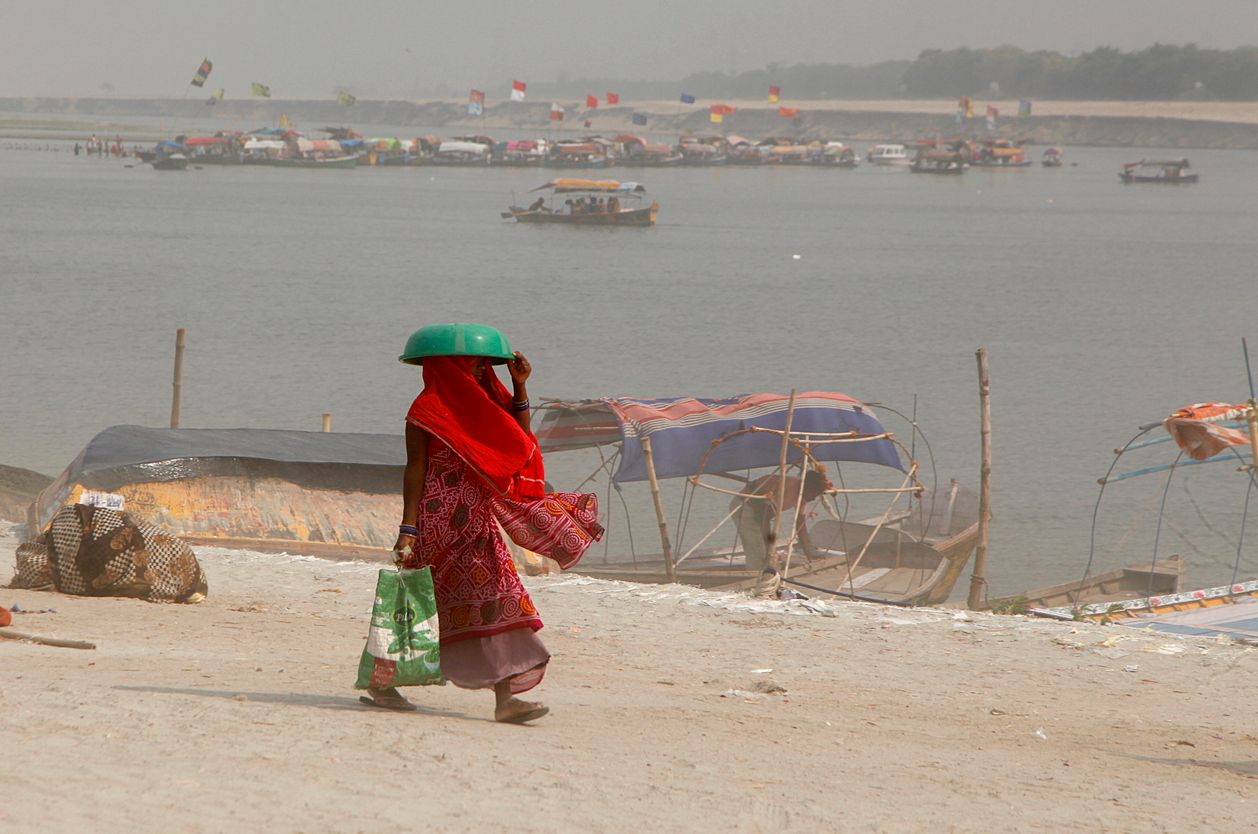
Surya Rao, a 65-year-old fruit seller, has been riding his TVS moped through villages of Andhra Pradesh’s West Godavari district for as long as he can remember. A familiar and amiable face for over 40 years, he is known among consumers for his fresh, juicy mangoes and papayas – fruits that have become as routine in local households as the man himself.
Over the years, however, India's extreme heatwaves between April and June appear to have worn him down. “The fruit is not the same any longer, and neither is the weather,” Rao says, hoisting a bagful of papayas onto the tightly fitted carrier of his frail-looking motorbike.
“In my childhood, the fruits were juicier than what you get today. The unpaved roads had a cooling effect on even the most scorching afternoons,” he recalls.
“But now, rampant grafting has stripped mangoes of their natural juices, ruining both taste and texture. Tiled pavements, cemented roads, and air conditioners blasting hot air into the open have turned the surroundings into a furnace,” says a visibly-tired Rao – and, this is before his work day has even properly begun.
“There is no original seed left,” he says. “If you ate a Rasalu mango 30 or 40 years ago, you could taste the sweet juice running down your hand. Today's crop gives you a lot of pulp but barely a drop.”
Rao has experienced heat in its most brutal forms, forced as he is to travel long distances to sell his fruit. “Everywhere, there are tar-laden roads now. Buildings are concrete and cement. Traditional materials such as thatch, baked-clay tiles have all but vanished,” he says.
“Everything traps heat. The sky bears it down; the pavements, the roads, the buildings throw it back up. People eat foods that heat the body from within. There is heat inside you and heat outside. There is no escape.”
Pointing at plumes of smoke rising from burning farm stubble along the road to Palakollu in West Godavari, Rao notes that this was never a practice among farmers in his younger days. “Now everybody does it. Earlier, farmers used stubble to feed their cattle. But now, barely anyone rears cattle anymore,” he says.
Rao believes farmers in Andhra Pradesh have borrowed the practice from their counterparts in northern India. Mechanised farming leaves little usable stubble for feed, and burning it clears the land far more quickly for the next round of cultivation.
“Heat is coming from everywhere,” he says, returning to his refrain.
Tsunami of Heat
Rao is far from alone. Millions of daily wage workers across India’s vast informal sector have seen their lives upended by increasingly severe heatwaves. This year, dangerous heat set in as early as February in some southern states, a full two months ahead of its typical onset. According to the India Meteorological Department's (IMD) February monthly summary, average maximum, minimum, and mean temperatures were all above normal for the country as a whole, running higher than usual by 1.35°C, 1.02°C, and 1.18°C respectively.
March, too, ran warmer than normal, with Nandurbar in the western peninsular state Maharashtra recording the month's peak at 42.4°C. April brought little relief: its final week was particularly punishing, culminating in a high of 47.6°C at Banda, Uttar Pradesh, on April 25.
May descended on New Delhi like a furnace, with temperatures spiking to 43-44°C. The night of May 25 was the city’s warmest in 14 years, at 32.4°C – a grim record, given that night time is when the body recovers from the day’s heat. For millions of Indians without access to air conditioners, even that brief respite has disappeared. A May 26 report recorded 46.5°C in Rajnandgaon and 45.1°C in Raipur in the central Indian state of Chhattisgarh. By June 2, Khammam in neighbouring Telangana had hit 43°C.
This is not a heatwave. It is a tsunami of heat.
Extreme heat has been tormenting large swathes of the country, and there is little relief on the horizon. With the IMD forecasting a below-normal monsoon owing to a super El Niño, the heat and humidity are likely to persist well into the coming months.
The ‘minor’ could be the major
A new study by researchers at the Indian Institute of Technology (IIT), Bombay sheds light on what drives these events. The team examined the rise in pre-monsoon heatwaves over the Indo-Gangetic Plains, unpacking the atmospheric conditions that cause them to intensify.
While large-scale high-pressure systems - known as anticyclones - set the stage for a heatwave, “what ultimately decides whether and where a heatwave forms is local land-atmosphere interaction,” says Karthikeyan Lanka, the study’s author and an associate professor at the Centre of Studies in Resources Engineering (CSRE) at IIT Bombay. The research identifies two distinct types. Moist heatwaves are preconditioned by pre-monsoon showers that saturate the soil and produce low night time clouds that trap heat. Dry heatwaves, by contrast, form over parched soils under clear skies and are driven by direct surface heating.
“A central - and somewhat counterintuitive - finding is that horizontal advection, the blowing in of hot air from elsewhere, long assumed to be the primary driver, contributes almost nothing in this region,” Lanka tells NWS.
The practical implication, he adds, is that tracking these local precursors – rather than simply monitoring incoming hot air – is key to identifying more reliable, location-specific early warnings.
The researchers had initially assumed, based on prior work, that heatwaves over the Indo-Gangetic Plains (IGP) were driven by hot air sweeping in from the north-west and the arid regions beyond. Their plan was to trace these air parcels back to their source, so that monitoring those regions could give forecasters a head start.
What they found, however, was that incoming hot air was only a minor factor.
That discovery pushed them toward local explanations. “If the heat isn't being imported, then it must be generated locally, within the atmospheric column,” says Lanka.
Sorting heatwave events by humidity revealed a visible divide: events that remained above roughly 50% relative humidity throughout, and those that stayed below. The physics underlying each type, it turned out, were genuinely different. Moist heatwaves work through clouds, latent heat flux, and longwave trapping; dry heatwaves are driven by direct solar radiation and sensible heat flux.
“Humid heat is more dangerous to the body in any single event. Once the air is saturated, sweating stops cooling you,” Lanka explains. It forces the body to work harder to cool itself, draining energy and compounding the health toll.
“Dry heat, on the other hand, is a slower burn. It lingers longer. But even then, prolonged exposure exacts a heavy toll on the body.
Since the India Meteorological Department currently defines heatwaves on the basis of temperature alone, recognising this distinction carries real value – both for forecasters and for public health response.
Having lived in Bangalore and Mumbai for seven years each, Lanka says he has noticed a clear shift in the timing of extreme heat: high temperatures now arrive as early as February, just weeks after winter. Air conditioning , he adds, has risen sharply in recent years.
“In my childhood, playing outside during summer vacation was never a problem. Now, we cannot send our kids out at all,” he says.
A school reshaped by heat
A. Subba Rao, director of Ideal School in Andhra Pradesh’s Jinnuru, holds a firm belief that children must grow at every level – physical, intellectual, and spiritual. But for the 70-year-old, the unpredictable seasons themselves have become an obstacle to that vision. He has watched the heat intensify over the decades and seen its effects on the students in his care.
Even 25 to 30 years ago, he says, the heat was nothing like this. Temperatures were high, but the quality of heat was different. “It did not oppress,” he adds.
“Every season used to be enjoyable. Summer included,” he says. “Now, no season is.”
Rao has also experimented with his school’s uniform, stripping away what he sees as unsuitable trappings. He has replaced ties, coats, and heavy shoes with clothing that lets children breathe and move freely. “In this heat, you’ll be cooked if you wear those things,” he says.

When he founded the school 44 years ago, children learned and played under trees. Over the decades, that gave way to thatched sheds, then roofed structures, and finally to permanent buildings. Throughout, Rao has remained attentive to thermal comfort, designing classrooms and corridors to allow a natural flow of air and prevent suffocation. The school occupies a portion of a four-acre campus. Now, he is installing air conditioning – because, as he puts it, “this generation cannot bear the heat.”
India’s children, and its people, are living inside an oven, Rao believes.
Structural, not seasonal
“India is facing a dangerous combination of very high background temperatures, persistent dry and hot pre-monsoon conditions, and regional circulation patterns that favour the accumulation of heat over northwest and central India,” says Davide Faranda, Research Director at the French National Centre for Scientific Research and coordinator of ClimaMeter, a platform that produces rapid climate attribution reports. Faranda is an expert in extreme weather events, with a focus on quantifying how much greenhouse gas emissions influence the likelihood and severity of such extremes.
Drawing on his past work on South Asian heatwaves and the current meteorological situation, Faranda explains that when winds are weak, skies are clear, soils are dry, and rainfall is delayed or absent, the land surface heats with startling efficiency – rapidly pushing temperatures to 45°C and beyond. Once rare, these temperature extremes have become alarmingly routine over the last few years, with grave consequences for outdoor workers, the elderly, children, and poorer urban communities.
“The key point is that climate change is now loading the dice,” he says. The same meteorological conditions that would have produced a severe heatwave decades ago, he avers, are now unfolding in a warmer atmosphere, making the resulting heat more intense, more persistent, and more deadly.
According to a May 25 report, more than 100 people died from heatwave-related causes in Andhra Pradesh and Telangana alone. The full national death toll remains uncounted. What is not in doubt, however, is that decades of fossil fuel burning have turned heatwaves into something far more lethal than they once were. ClimaMeter’s analysis of the April 2026 India heatwaves found that comparable meteorological conditions are now running approximately 2-4°C warmer than in the past. This is consistent with the broader scientific consensus that human-driven warming is intensifying the severity, duration, and health impact of heatwaves across South Asia.
“What worries me most is not only the peak daytime temperature,” Faranda says. “Warm nights, humidity in certain regions, urban heat islands, and repeated exposure over several days can make these events far more lethal.”
Heatwaves are no longer isolated weather anomalies. “They are becoming structural climate risks for India,” he warns, “affecting health, labour, water, electricity demand, agriculture, and basic human survivability.”
A paper published on May 26 by researchers at the University of California, Berkeley, puts the toll in stark terms. A single day of extreme heat, it claims, causes approximately 3,400 excess deaths nationally; a five-day heatwave causes nearly 30,000. The scale of the crisis, the authors say, is both vast and unequal. “The findings indicate that even short-duration heatwaves can result in thousands of excess deaths nationally, while prolonged heat events pose risks comparable to large-scale public health emergencies. Importantly, the mortality burden is not evenly distributed,” the report says.

India’s indifferent response
Against such a backdrop, the Indian government’s response has been woefully inadequate. The federal government places responsibility for implementation and monitoring squarely on provincial governments, as per this government note. In practice, most states have done little beyond issuing advisories. The eastern province Odisha, however, is a notable exception. Over the years, it has shifted work timings, improved water and electrolyte supply, provided sheds for workers and commuters, and taken targeted measures that have demonstrably saved lives.
India relies on Heat Action Plans (HAPs) to manage extreme heat, but researchers say that they are riddled with gaps. The plans fail to account for local conditions and are hamstrung by a cascade of systemic failures: no localised heat hazard mapping, no heat risk or vulnerability assessments, inadequate funding, the absence of a legal framework, and little meaningful monitoring, evaluation, or transparency. The heat is changing behaviour not just among people, but among animals, too.
Govindaraju, a farmer from Penumadam village in Andhra Pradesh, keeps a watchful eye on his cattle as they wade into a pond thick with algae and murky green water.

“Cows would never go into water like that,” he says. “But the heat is cooking them from the inside. So they stand in the stink and the mud.”
Back in Palakollu, the road beside which the fruit-selling Surya Rao has parked his moped has grown so hot that it feels like a river of lava beneath your feet.
“We are like bubbles,” he says, squinting into the glare. “We are like tourists. Mother Earth bears us for as long as she can. Then she lets us go.”