
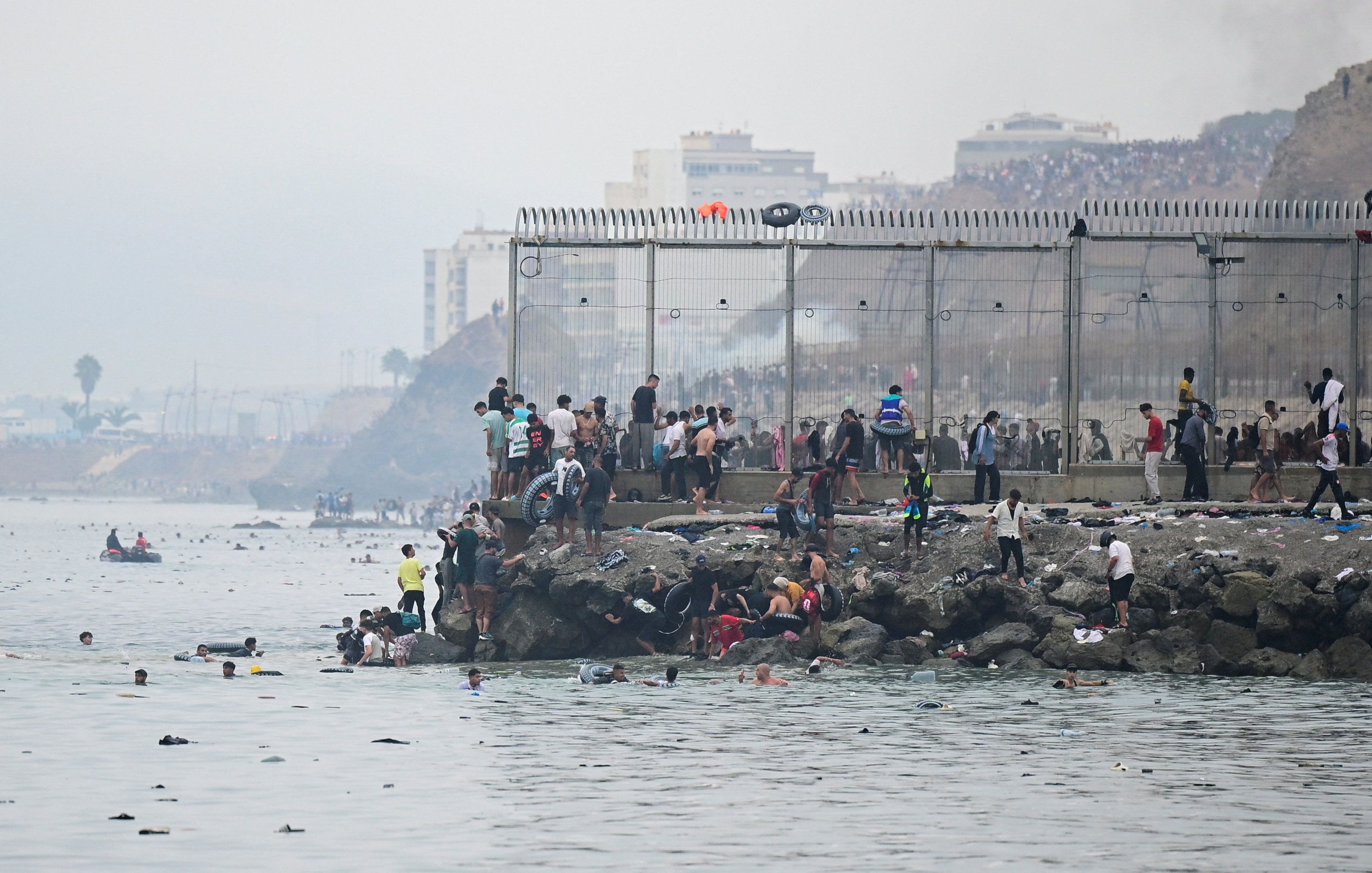
Videos of thousands of Moroccan migrants breaching the border into Spain’s North African enclave of Ceuta went viral on X and other platforms on Thursday (July 30, 2026), drawing sharp reactions from European far-right figures and Elon Musk, who called the surge “absolutely an invasion”. A clip shared by Vox leader Santiago Abascal, accusing Spain’s government of “desperately calling in more hitmen to stay in power”, drew more than 2.2 million views within a day.
The footage – crowds streaming past open gates, people swimming around breakwaters – turned a local border incident into an international flashpoint within hours, and reopened long-running fights in Europe over migration, Schengen, and how member states police their external frontiers. Behind the footage lies a familiar mix of push and pull factors.
Persistent unemployment and economic instability in Morocco and parts of sub-Saharan Africa continue to push people towards Europe, while Ceuta’s status as European Union territory reachable on foot or by sea makes it one of the continent’s shortest, and perhaps also its most dangerous, entry points. Spanish officials blame smugglers for exploiting a recent Supreme Court ruling that limits the immediate return of migrants intercepted at sea, and say viral social media content showing successful crossings – much of it on TikTok and Instagram – has itself become a further draw, romanticising the journey for young Moroccans.
Domestically, a Spanish government programme launched to regularise roughly 500,000 undocumented migrants already in the country has also drawn scrutiny: opposition figures argue it is acting as a pull factor, though migration researchers and refugee-aid groups contest a direct causal link.
What happened
Thousands of migrants crossed into Ceuta on Thursday, prompting Juan Jesús Vivas, head of the Ceuta regional government, to call it “a humanitarian and social emergency” of national proportions and urge Madrid to declare a national emergency. Spain’s Interior Ministry initially said migration flows do not meet the legal threshold for such a declaration, but announced it would deploy troops to reinforce the border. At least nine people, and by some counts as many as 18, died attempting the crossing, mostly by drowning near the Tarajal breakwater; more than 60 deaths have been recorded on the route over the past year.
Authorities first noted a rise in arrivals around July 20-21. About 1500 migrants entered within a week, climbing to between 1500 and 2000 within 10 days, with roughly 200-300 arriving daily by Wednesday. Reception centres built for about 500 people were holding hundreds more, and shelters for unaccompanied minors were reported to be running far past capacity.
Spanish Prime Minister Pedro Sánchez said his government was “fully committed to providing an immediate response”, and travelled to Ceuta on Friday with Interior Minister Fernando Grande-Marlaska.
The geography and history behind it
Ceuta, along with Melilla, is one of two Spanish autonomous cities on Africa’s northern coast – internationally recognised as Spanish and EU territory despite being surrounded by Morocco, and together they form the EU’s only land border with the African continent. That makes Ceuta one of the shortest routes into mainland Europe for migrants, and a recurring flashpoint. The border is reinforced with fencing, surveillance systems, and joint Spanish-Moroccan patrols, but migrants continue to cross by hiding in vehicles, swimming around coastal barriers, and scaling fences.
The scenes echo a May 2021 crisis, when roughly 8000–10000 migrants entered Ceuta within days after Morocco was accused of loosening border controls amid a diplomatic row with Madrid over Spain’s decision to treat a Western Sahara independence leader in a Spanish hospital. Relations recovered in 2022 after Spain backed Morocco's autonomy plan for Western Sahara, but Thursday’s crossings have revived comparisons to that episode.
Global reactions
The episode has drawn responses well beyond Spain, reflecting how migration has become a proxy battle in wider geopolitical and ideological fights. The White House criticised Madrid’s migration policy, with principal deputy press secretary Anna Kelly saying President Trump had “long warned Europe” about the consequences of “far-left, globalist policies”. Italian Prime Minister Giorgia Meloni said her government was prepared to intervene with “extraordinary measures” and called for Spain’s suspension from the EU’s visa-free Schengen zone, arguing the European Commission “must hold Sánchez accountable” for failing to secure an external border.
Israel’s UN Ambassador Danny Danon criticised Spain on X, arguing Madrid should account for its “colonial enclaves in Africa” before commenting on other countries’ policies.Within Spain, opposition leaders used the crisis to attack the government.
Vox’s Abascal called it evidence of government failure, while People’s Party leader Alberto Núñez Feijóo called the situation in Ceuta “desperate”. Morocco, for its part, has said it remains committed to cooperating with Spain on border management, even as the crossings strain a relationship still recovering from the 2021 rupture.
Why it matters geopolitically
Ceuta sits at the intersection of several live fault lines in global politics. Within the EU, migration has become the issue most able to unite and divide member states simultaneously: Italy’s push to raise Schengen suspension – even symbolically – reflects how a decade of arrivals has hardened positions among governments already contending with rising far-right parties at home.
A large, visually dramatic breach at one of the bloc’s few external land borders forces the same argument the EU has been having since 2015: whether frontline states like Spain, Italy, and Greece are being left to manage a shared European problem largely alone.The episode also lands inside a broader transatlantic argument over migration.
Washington’s rebuke of a European government’s border policy fits a pattern of the Trump administration treating migration enforcement as a marker of ideological alignment among allies, not just a domestic policy question. That argument gives incidents like Ceuta a symbolic weight beyond their immediate scale, turning a few thousand border crossings into evidence in a much larger international debate about sovereignty, borders, and the political right’s ascendance across Europe and the US.
The crisis also underscores Morocco’s leverage over Spain and the EU more broadly. Spain’s ability to manage migration depends heavily on cooperation with Rabat on interdiction and returns – cooperation that has proven fragile before, collapsing entirely in 2021 amid an unrelated diplomatic dispute. That dependency means bilateral relations between Madrid and Rabat, not just EU policy, will likely determine whether Ceuta remains a periodic flashpoint or escalates further.