
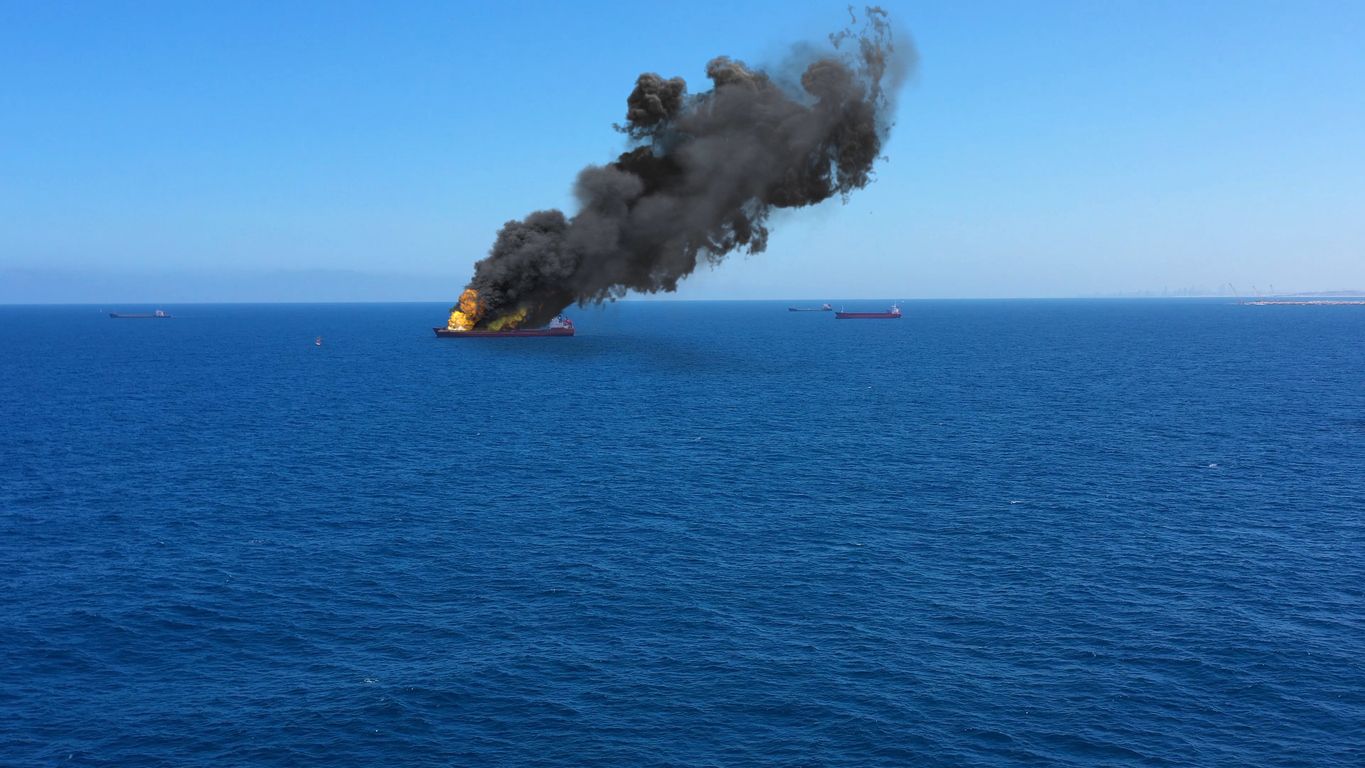
Prayagraj, India: A single damaged tanker has exposed how a sanctioned oil-shipping network keeps functioning despite years of Western restrictions. When a Ukrainian naval drone crippled the Asteri in mid-June, the ensuing rescue – orchestrated by Turkish salvors, an untraceable Indian shell company, and a UAE network allegedly tied to Iran’s political elite – showed that sanctions on paper have done little to stop the ships themselves from sailing.
The Asteri was struck as part of a much larger campaign: Ukrainian forces reportedly hit over 105 vessels in a single eight-day window in July 2026 alone, part of an effort to choke off the revenue Russia earns from its sanctioned “shadow fleet” – older tankers repurposed to move blacklisted oil while evading detection. The Asteri’s case matters because it shows exactly how that fleet stays afloat: not through one loophole, but through a layered commercial ecosystem – of salvors, shell owners, and flag-hopping – built specifically to survive sanctions that already name most of its participants.

The Strike
The Ukrainian Unmanned Surface Vessel struck near Russia’s Port of Kavkaz, tearing into the hull of the 21-year-old Aframax-class tanker – a mid-sized vessel built to carry roughly 80,000–120,000 tonnes of crude. The blast knocked out the ship’s Automatic Identification System (AIS), the transponder that broadcasts a vessel’s location, leaving it dead in the water. Satellite imagery from NASA’s Fire Information for Resource Management System recorded heat signatures burning at the Krasnodar Krai oil terminal for days afterward. The Asteri was one of three sanctioned tankers damaged in the same wave of strikes.

The Bosphorus Escape
The tanker is sanctioned by the European Union, Switzerland and the United Kingdom for transporting Russian-origin crude while using high-risk shipping practices – disabling its AIS transponder, conducting unsafe ship-to-ship transfers, and swapping flags to obscure ownership – under rules that bar it from Western ports and freeze its access to Western insurers and services. Ukraine has separately sanctioned the vessel’s master directly. Yet the disabled Asteri didn’t sit stranded for long: Turkish salvage operators PGE Tugs and Pegasus Salvage towed the tanker through the Bosphorus Strait – briefly halting all transit traffic – to a Turkish shipyard for repairs.
The rescue fits a pattern, not an exception. PGE Tugs’ owner, Serhat Baysal, recently exited a court-supervised debt restructuring after filing in Istanbul’s Anadolu Commercial Court – financial pressure that may explain the firm’s willingness to take on high-risk salvage work mainstream operators avoid. Social media records show PGE has previously assisted other sanctioned tankers earlier this year, including the Vilamoura in March, the James II in late June, and the Marquise in mid-May – each with a history of disabling AIS and switching flags to dodge oil embargoes. Taken together, the repeat assists indicate PGE has effectively become a standing repair option for the shadow fleet, whether by design or default.
NWS contacted PGE Tugs and Pegasus Salvage using their publicly listed email addresses to request comment, but neither has responded so far. This story will be updated if a response is received.

The Mumbai Front
Tracing the Asteri’s ownership leads to a textbook shell company. Maritime registry Equasis lists the tanker’s sole owner and manager as Vanship Maritime Private Limited, an Indian firm incorporated on August 13, 2024 out of a single shared office in CBD Belapur, a business district in Navi Mumbai, Maharashtra – listing its principal business only as "warehousing and support activities for transportation”. Vanship has no website, no working phone line, and a corporate email that bounces on contact. Its three listed directors – Inderlal Yadav, Niraj Naresh Sinha, and Pradeep Kumar Sahu – have no other traceable business history, suggesting they may be placeholders rather than active operators. Corporate filings also tie the company to a second, equally opaque entity, Narayan International Ltd.
A Global Network
The Asteri’s paper trail shows a vessel built to disappear. Before flying Cameroon’s flag, it sailed under at least four other names – Fiora, Vaigai, Tartan, British Cormorant – cycling through registries in Panama, the Marshall Islands and the Isle of Man along the way. Between 2022 and 2024, chartering records tie the ship to a cluster of UAE shell firms – Tarabya Logistics, Fractal Marine, Wanta Shipping and Algae Ship Charter – all since sanctioned by the EU or Switzerland.
This isn’t unique to one vessel. Russia has adapted the same model across its shadow fleet: shell companies, third-party ship managers, lenient flag registries, salvors and repair yards spread across the UAE, India, Turkey and elsewhere, with links swapped out as soon as one draws scrutiny.
The US Treasury was among the first to map this network at scale. It has separately sanctioned more than 50 individuals, companies and vessels tied to a shipping empire it says is run by Mohammad Hossein Shamkhani, son of Ali Shamkhani – a former senior adviser to Iran’s Supreme Leader killed in a US strike in February 2026. Treasury officials call it one of the regime’s most lucrative operations, alleging it blends and ships restricted Russian and Iranian crude to buyers in China and India, staying hidden through AIS blackouts and ship-to-ship transfers at sea.
The Asteri isn’t even the network’s first close call. In January 2025, another Wanta Shipping-managed tanker, the Eventin, lost all power in the Baltic Sea while carrying 99,000 tonnes of Russian crude, drifting toward Germany's Rügen island before it was stabilised.
Vanship Maritime and PGE Tugs haven’t been officially designated as entities assisting the shadow fleet as yet. If they are, India and Turkey could face secondary sanctions from the OFAC and EU over the roles their firms allegedly played in keeping a blacklisted tanker moving.

The Stakes
An Aframax-class tanker like the MT Asteri can carry roughly 700,000–750,000 barrels of crude, making a full cargo worth about US$45–55 million at current market prices. More broadly, Russia's shadow fleet – alleged to be over 600 aging tankers – is estimated to carry 70–80 per cent of the country's seaborne crude exports, generating tens of billions of dollars a year. That makes vessels like the Asteri central to Russia's oil export network, so disrupting even one has financial significance well beyond the value of its cargo.
Yet, the financial and legal machinery behind the shadow fleet remains abstract but the risk to the people aboard isn't. As the Asteri undergoes repairs in Turkey before an expected return to Indian ports like Sikka in the gulf of Kutch, its case makes the structural problem plain and simple: as long as shell companies like Vanship can be formed overnight and salvors like PGE keep pulling damaged ships to safety, sanctions lists alone won’t be enough to ground the fleet they name.