
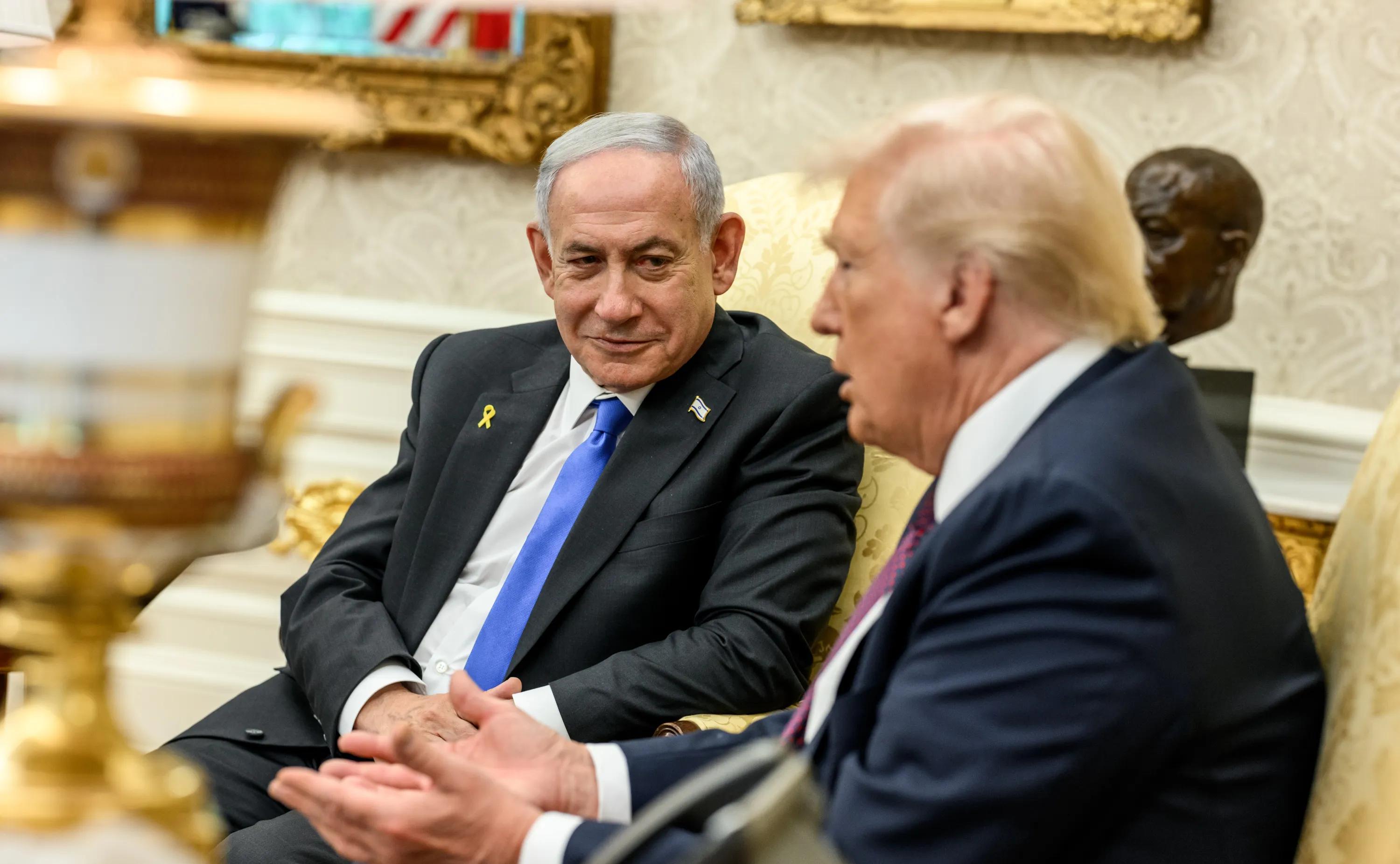
Israeli Prime Minister Benjamin Netanyahu will visit Washington next week, President Donald Trump confirmed on Friday (July 24, 206), as the two allies confront a shifting West Asia and weakening political support for Israel at home. The talks are expected to range well beyond bilateral ties to the wider strategic picture facing both countries.
The two leaders last met in December 2025, when they discussed regional security, a Gaza truce and coordination on Iran. Since then, the landscape has shifted sharply: the US has struck Iran's nuclear sites at Natanz, announced a landmark civilian nuclear pact with Saudi Arabia, and faced continued Houthi attacks in the Red Sea — all of which will shape next week's agenda.
Trump remains one of Israel's staunchest backers, though frictions have emerged over Washington's outreach to Riyadh, its handling of Turkey under President Recep Tayyip Erdoğan, and the pace and scope of Israel's operations in Gaza.
Republican lawmakers have long stood behind the Israeli government, but many Democrats have grown more critical of the military campaign, citing restrictions on aid deliveries and the humanitarian toll. Axios has reported uncertainty over the meeting's precise agenda. A Pew Research Center survey shows the American public has also turned more critical: 60 per cent of Americans now hold an unfavourable view of Israel, up from 53 per cent in 2025.
Confidence in Netanyahu himself has slipped, with 59 per cent of respondents saying they have little faith in him "to do the right thing regarding world affairs". Eighty per cent of Democrats and 57 per cent of Republicans aged 18–49 now view Israel unfavourably.Progressive Democrats — Bernie Sanders, Alexandria Ocasio-Cortez and Pramila Jayapal among them — have pushed back on the use of American weapons where they may violate international humanitarian law. Ocasio-Cortez has argued that "conditioning aid to Israel, as we do with virtually all other US allies, is a responsible course of action".
Senate Democrats have separately called for scrutiny of civilian casualties in Gaza and pressed for greater humanitarian access.Progressive candidates critical of the US-Israel alliance have swept a string of Democratic primaries in 2026 — from New York to New Jersey, California and Colorado — with several winning on Zoharan Mamdani-style pro-Palestinian platforms that even overcame heavy AIPAC- backed spending against them. AIPAC is American Israel Public Affairs Committee, a pro-Israel lobbying group in the US, that works to influence Congress and elections in support of the US-Israel relationship.
All three candidates endorsed by Zohran Mamdani, two of them harshly critical of Israel, won their New York primaries, part of a broader pattern of progressive upsets in New Jersey, California and Colorado that has made opposition to the US-Israel alliance a near litmus test in Democratic primary races this cycle. With these candidates set to enter Congress in 2027, the results mark a real crack in the bipartisan consensus.
Washington has provided Israel with more than US$310 billion in economic and military aid since 1948, support that Congress has sustained on a bipartisan basis for decades. That consensus — not the posture of any single administration — will determine how durable US backing remains. Even Republican support, while still firm on Israel's right to defend itself, has begun to show divisions of its own.With a humanitarian crisis still unfolding, next week's talks on Gaza, Saudi Arabia and the Houthis will be read through this broader political lens. Progress on a ceasefire, hostage negotiations or wider regional diplomacy could help ease the growing criticism of Israel across the American public, Republican and Democrat alike.