
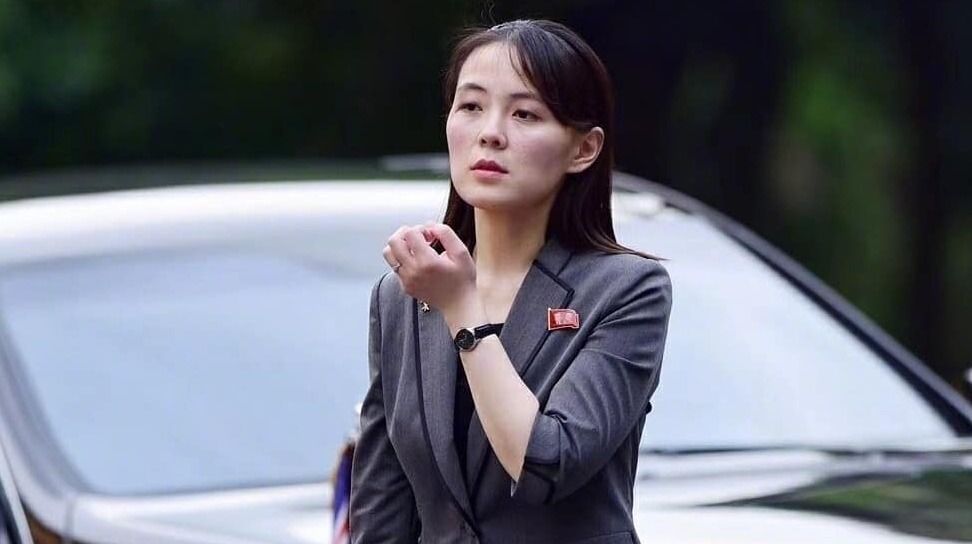
North Korea’s warning on Wednesday (August 5) that it could adopt “additional military options” against Japan highlights a broader strategic realignment taking shape across the Indo-Pacific, with countries increasingly gravitating into rival security blocs amid growing tensions involving the United States, China and North Korea. Kim Yo Jong, the influential sister of North Korean leader Kim Jong Un, accused Japan of abandoning its post-Second World War pacifist principles and transforming itself into a military power capable of launching pre-emptive attacks.
Her remarks came days after Japan tested a US-made Tomahawk cruise missile for the first time from the destroyer JS Chokai on July 31. Kim also cited Tokyo’s participation in US-led military exercises in the Philippines in May as evidence that Washington was encouraging what she described as “dangerous military moves” across the Pacific.In a statement carried by the Korean Central News Agency (KCNA), Yo Jong said, “Japan, a war criminal state, is accelerating its transformation into a war state.” “We should make it regret,” she said, adding that Japan was transforming into a military power capable of preemptive attacks.
The warning comes as the Indo-Pacific witnesses an increasingly sharp geopolitical divide. On one side, the United States has strengthened a network of security partnerships with Japan, South Korea, the Philippines and Australia, while also expanding defence cooperation with NATO allies in the region. Joint military exercises have become more frequent, intelligence sharing has increased, and Washington has encouraged its allies to bolster their own military capabilities amid growing concerns over China and North Korea. Japan has emerged as one of the most prominent examples of this shift.
In December 2022, Tokyo adopted a landmark national security strategy that identified China as “the greatest strategic challenge” and committed Japan to acquiring counter-strike capabilities for the first time since the Second World War. Since Prime Minister Sanae Takaichi’s right-wing government took office, Japan has accelerated an already ongoing military build-up, bringing forward its target of raising defence spending to two per cent of GDP, while expanding long-range strike capabilities and defence partnerships.
It has accelerated purchases of missiles, including US-made Tomahawk cruise missiles, expanded defence spending and intensified military cooperation with the United States and regional partners.Prime Minister Sanae Takaichi announced last year that Japan would achieve its target of raising defence expenditure to two per cent of GDP ahead of schedule, while Defence Minister Shinjirō Koizumi has argued that the country’s armed forces must be strengthened with a “sense of urgency and crisis” in response to growing threats from China, Russia and North Korea.
Tokyo maintains that these measures are purely defensive and intended to deter an increasingly unstable regional security environment marked by repeated North Korean missile launches and China’s expanding military activities.North Korea, meanwhile, has drawn even closer to both China and Russia. Pyongyang has significantly expanded military cooperation with Moscow since Russia’s invasion of Ukraine, while maintaining its long-standing strategic partnership with Beijing.
Although China and North Korea do not always agree on every regional issue, the three countries increasingly share opposition to the US-led security architecture that has expanded across the Indo-Pacific. Kim Yo Jong also accused Washington of driving Japan’s military transformation through arms sales and closer operational cooperation, arguing that the United States was encouraging Tokyo to abandon its exclusively defensive posture. China has voiced similar concerns, although in less confrontational language.
Beijing has repeatedly criticised Japan’s expanding military role and its closer defence cooperation with the United States, Australia and the Philippines, arguing that such partnerships undermine regional stability. Relations between China and Japan remain strained over the disputed Senkaku Islands – known in China as the Diaoyu Islands – as well as Tokyo’s increasingly vocal support for peace and stability across the Taiwan Strait. Japan rejects those accusations, insisting that its military modernisation is a necessary response to an evolving security landscape shaped by North Korea’s advancing missile programme and China's growing military assertiveness. Japan had not publicly responded to Kim Yo Jong’s latest remarks as of Wednesday.