
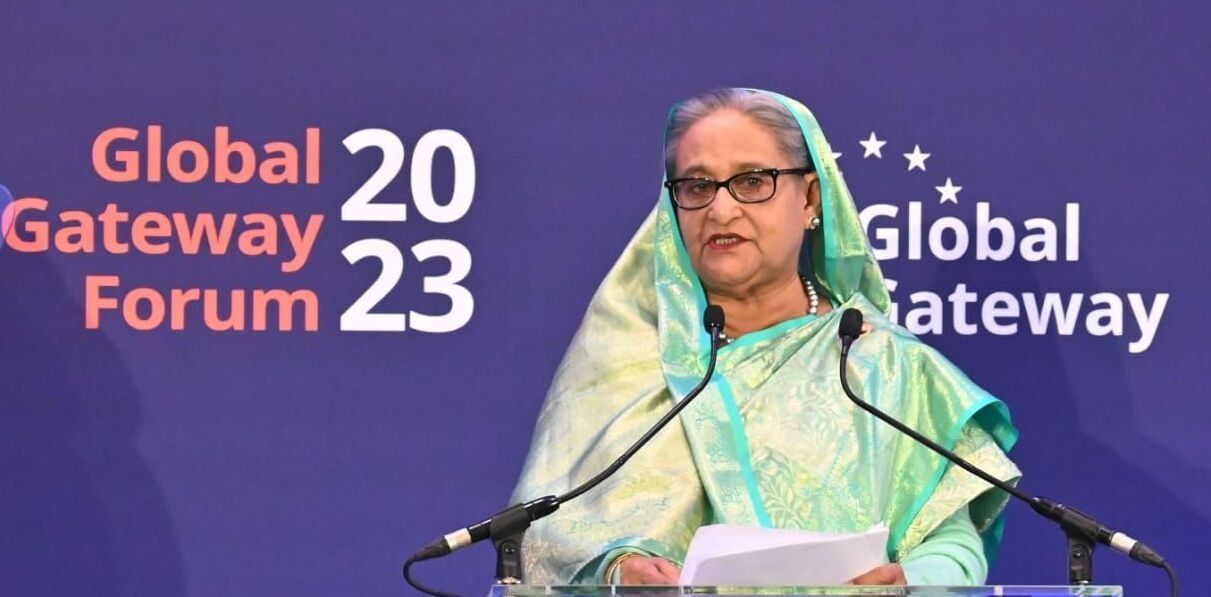
Two years after student-led protests forced her from power, ousted Bangladesh Prime Minister Sheikh Hasina re-entered the country’s political conversation on Wednesday (August 5) with her first public appearance since fleeing to India – reigniting a diplomatic row that has simmered between Dhaka and New Delhi since her ouster. Hasina virtually addressed a press conference from New Delhi, timed to coincide with the second anniversary of the uprising that toppled her government. She was tried and convicted in absentia over the deadly crackdown on the 2024 protests and sentenced to death by Bangladesh’s International Crimes Tribunal.
The event was organised by the Foreign Correspondents’ Club of South Asia in Delhi. Panellists included her son Sajeeb Wazed Joy, former Minister Mohibul Hasan Chowdhury Nowfel, former national cricket captain Shakib Al Hasan, Bangladesh Human Rights Watch USA director Shah Md. Bakhtiar, journalist Waiel Awwad, and writer Abu Obaidha Arin. Shakib Al Hasan’s house was reportedly attacked afterwards for taking part.
Bangladesh’s Ministry of Foreign Affairs released a statement condemning the event, saying it was “outraged” that the “absconding convicted genocider” had been allowed to engage in live interaction with the media, and that she and her associates had “launched venomous vitriol against the State of Bangladesh and her people”. The ministry said it had conveyed its concerns to New Delhi in advance, adding that it “deeply regrets” that the event was permitted to go ahead despite those warnings about its likely impact on the reset of bilateral relations. It called the timing especially painful, describing the address, held on the anniversary of the July Revolution, as “an affront to the sovereignty of Bangladesh and a grievous insult to the martyrs” of the movement.
The ministry further accused Hasina of denying facts on the 2024 killings established by the United Nations, calling it a futile attempt to rewrite a history the Bangladeshi people had already rejected, and renewed Dhaka’s long-standing demand for her extradition under the 2013 India-Bangladesh treaty, saying repeated requests had gone unanswered.
December, a “Month of Victory”
At the press briefing, the 78-year-old Hasina indicated that she plans to return to Bangladesh by December and surrender to the authorities. “I will return to my people,” Hasina said, adding that she would reveal the exact date and details of her return when the time was right. Hasina delivered an audio message and did not appear on video, unlike some other Awami League leaders and her son, Sajeeb Wazed Joy, who spoke earlier.“I know, I may be detained. I may be sent to prison, and they may implicate me in fabricated cases. But fear cannot decide my duty to the people, my life or beyond. My life has been beyond the considerations of personal safety for long,” said, calling December 2026 as “the month of victory”. “You will get to know when I decide to go, she said when asked about her date of return.
The current Bangladeshi government, led by Prime Minister Tarique Rahman since February 2026, asked media outlets not to publish her statements, with the Prime Minister’s Information and Broadcasting adviser saying that doing so would violate a 2024 court order prohibiting the broadcasting of her speeches. As Hasina spoke, protestors in Dhaka reportedly burned an effigy of her.
While Bangladesh’s media did not cover the event, it was widely available on social media. India’s Ministry of External Affairs, meanwhile, denied any involvement in the event and did not endorse any views expressed, describing it as privately organised. Hasina also claimed that the protests, which began as a movement over public-sector job quotas, evolved into a coordinated campaign driven by organised violence, covert direction and propaganda aimed at removing her government and undermining the constitutional order.
She further alleged that the country’s economy had deteriorated sharply since her removal, claiming investment and job creation had weakened, and that more than 20 million people had become unemployed.Relations between Dhaka and New Delhi have remained strained since Hasina’s ouster and her decision to seek refuge in India. Bangladesh has repeatedly sought her extradition under the two countries’ Extradition Treaty, though the process is not automatic: the requesting country must provide sufficient evidence that the alleged offences are extraditable under both countries’ laws, and either side may refuse extradition where it considers the request politically motivated or lacking due process.
India’s parliamentary standing committee on external affairs said on July 31 that the country’s decision to allow Hasina to stay after the political unrest of August 2024 reflected its long-standing humanitarian tradition.
The committee also described Bangladesh as one of India’s most important neighbours and recommended rebuilding bilateral ties, including restoring normal visa services and strengthening diplomatic engagement. The dual messaging underscores the dilemma facing New Delhi: honouring legal process and humanitarian considerations while preserving a strategic relationship with Dhaka’s new government at a time of political transition and regional competition.India is approaching the issue cautiously, not least because Bangladesh is a strategically vital neighbour sharing a 4,000 kilometres border.
The two countries also share deep trade ties, cooperate on counter-terrorism, and rely on critical connectivity routes linking mainland India with its north-eastern states – stable relations with Dhaka remain a key foreign policy priority for New Delhi. At the same time, Hasina was widely regarded as one of India’s closest regional partners during her 15 years in power, a period in which the two countries strengthened security cooperation against anti-India insurgent groups and expanded cross-border infrastructure and trade. With Rahman set to visit New Delhi for the BRICS summit next month, the episode adds a fresh complication to an already delicate diplomatic reset.