
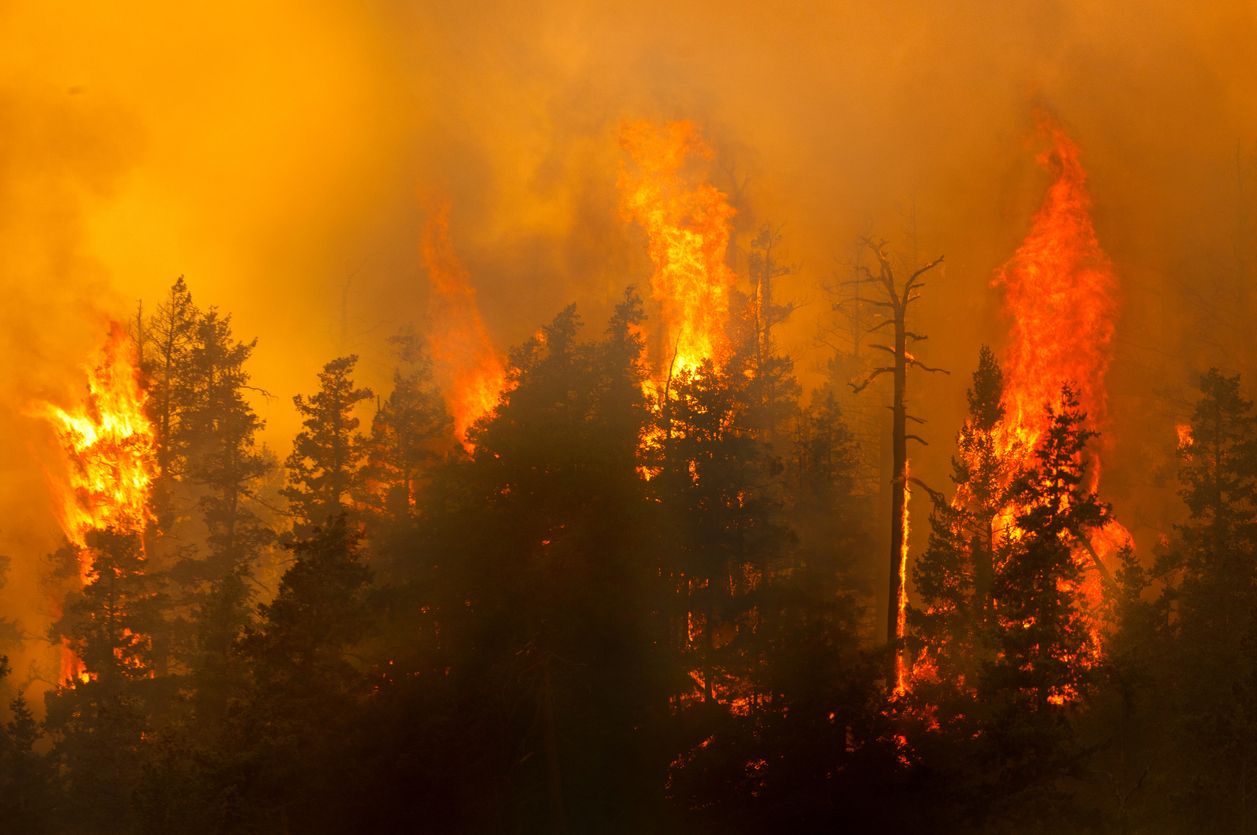
Dense smoke from Canadian wildfires has blanketed the northeastern United States this week, pushing air quality to unhealthy or hazardous levels in New York, Chicago, Detroit, Philadelphia and Washington DC, with parts of Illinois, Michigan, Ohio and Pennsylvania recording hazardous PM2.5 readings.
More than 100 million people across 18 US states and the District of Columbia were under air quality alerts by Friday. The smoke has reignited a diplomatic row between Washington and Ottawa, with US President Donald Trump threatening to raise pollution tariffs on Canadian goods over what he called Ottawa's "willful negligence" in managing its forests, transforming an environmental crisis into a trade dispute.
A tariff threat over wildfire smoke
Writing on Truth Social on Friday, Trump said the cost of the pollution “must of necessity be added to the tariffs Canada is currently paying”, accusing Canadian authorities of failing to properly maintain their forests and brush. He said he intended to raise the matter directly with Prime Minister Mark Carney by phone.The threat is unusual by the standards of previous cross-border smoke episodes.

Smoke from Canadian wildfires has drifted into the US in 2023, 2024 and 2025, prompting emergency coordination between the two countries rather than trade retaliation. Governments elsewhere – including those managing seasonal haze across Southeast Asia – have generally responded with cooperation rather than confrontation. It is, however, consistent with a pattern in Trump’s second term of using tariffs as leverage well beyond conventional trade disputes, including on immigration and border security. He has previously pushed for Canada to fall in line with US demands on trade and security, at times suggesting the country become the "51st state".
Ottawa pushes back
Ontario Premier Doug Ford rejected the criticism on Friday, noting that Canadian crews have supported American firefighting efforts in the past, including during last year’s California fires, and urged critics in Washington to send help rather than "chirp away" from the sidelines. The two countries have a long history of mutual aid on wildfires, with US crews regularly deployed to Canada during severe seasons and Canadian crews reciprocating during major American outbreaks.
The scale of the fires
As of Friday (July 17, 2026), 903 wildfires were burning across Canada, up from 858 the day before, including roughly 200 in Ontario alone, of which 81 were classified as out of control. Nationally, more than 1.9 million hectares (about 4.7 million acres) have burned so far this season – well below the record-setting totals of 2023 and 2025, but enough to send smoke deep into the US Midwest and Northeast.
This broadly matches the federal government's own July tally of active fires and areas burned nationally. NASA satellite imagery has tracked the plumes travelling from fires in Ontario and other provinces across the border.The health impact could be severe. Doctors have warned of a rise in asthma attacks, heart complications and other respiratory and cardiovascular problems linked to the smoke, adding pressure to hospitals already handling a surge in visits. Schools have cancelled outdoor activities, sports fixtures have been disrupted, and some businesses have scaled back operations.
Canadian officials attribute the scale of this year’s fires primarily to climate change rather than forest mismanagement. Ottawa has launched a national Wildland Fire Prevention and Mitigation Strategy to improve inter-governmental coordination and preparedness. Scientists caution that better forest management – controlled burns and fuel reduction among them – cannot solve the problem on its own. Wildfire risk is driven by a combination of weather, climate change, vegetation, lightning and human activity, and much of Canada’s boreal forest lies in vast, sparsely populated terrain where comprehensive fuel management is neither economically nor ecologically practical.
Trump’s tariff threat, however, underscores a broader shift: as wildfire seasons intensify with climate change, the smoke crossing international borders is increasingly being treated not just as an environmental and public health emergency, but as fuel for geopolitical friction.