
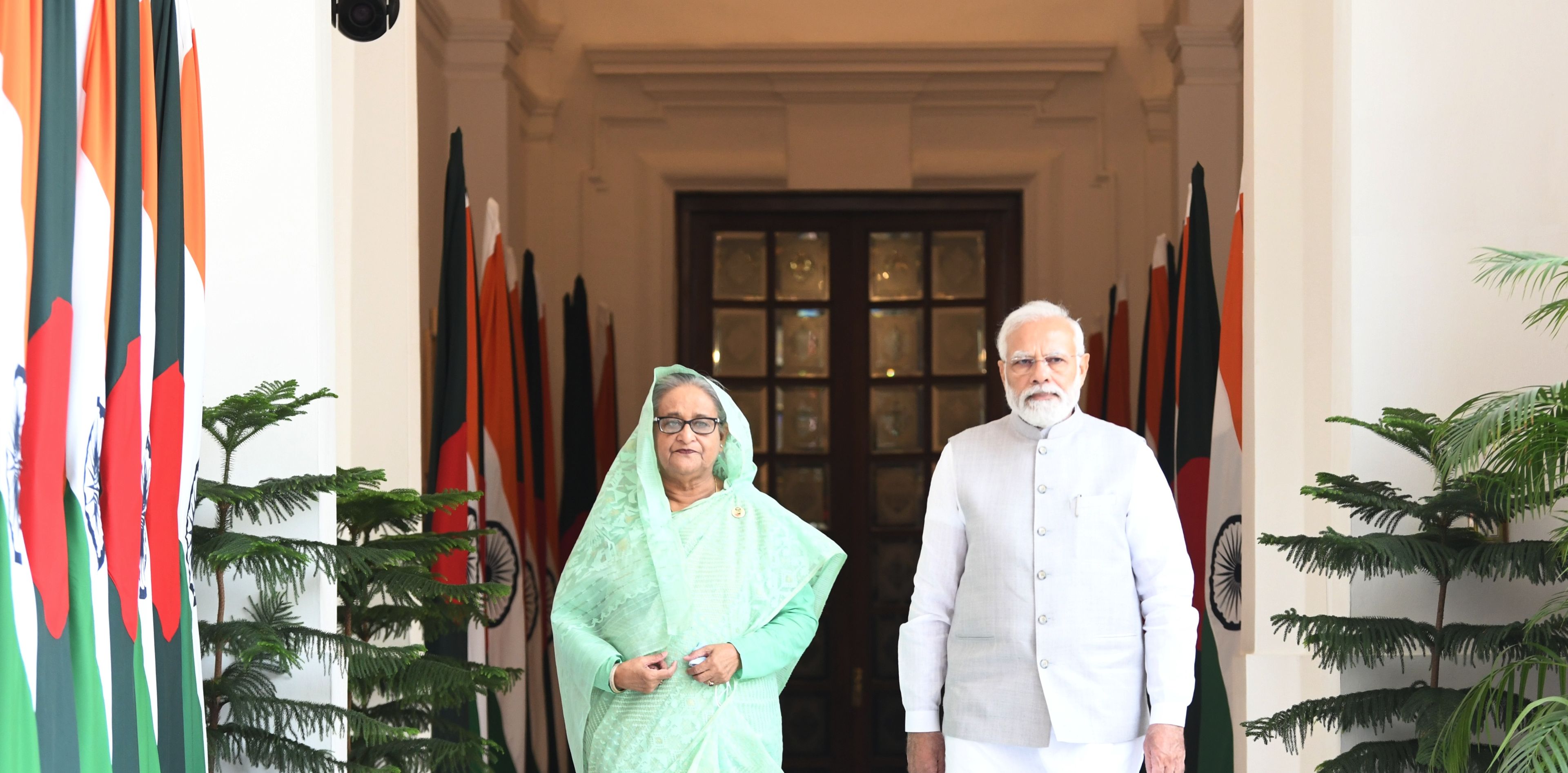
Can India-Bangladesh relations improve while deposed Bangladesh Prime Minister Sheikh Hasina remains in India, not a mute presence, but a politically active one? The question is getting louder in the power corridors of Delhi and Dhaka with every passing week, especially after Bangladesh Prime Minister Tarique Rahman kept India waiting on his decision on attending the BRICS summit in New Delhi, scheduled for September, 2026. The last few months saw developments that show how relations have yet to smoothen out, even two years after Hasina’s government fell to a youth-led uprising.
A Press Conference That Reopened Old Wounds
The latest flashpoint came on August 5, 2026 – the second anniversary of Hasina’s fall – when she held a virtual press conference at the Foreign Correspondents’ Club of South Asia in New Delhi and vowed to return to Bangladesh by December, despite having been sentenced to death in absentia. New Delhi tried to distance itself from the event. Foreign Ministry spokesperson Randhir Jaiswal said India “does not endorse anything that was said from that platform, particularly against the duly constituted Government of Bangladesh.” However, Dhaka was furious.
In an unusually strong language, the Bangladesh government said it was “outraged” that India allowed “the absconding convicted genocider” to launch “venomous vitriol against the State of Bangladesh and her people.” Noting that it had conveyed its concerns about the event to India in advance, Dhaka called it “an affront to the sovereignty of Bangladesh and a grievous insult to the martyrs of the July Revolution.” It said Bangladesh desires a “constructive, mutually beneficial, and forward-looking” relationship with India based on “sovereign equality, mutual respect, non-interference in each other’s internal affairs, and national dignity” – adding pointedly: “Bangladesh will never be a client State.”
Dhaka also noted that it has repeatedly sought Hasina’s extradition under a 2013 agreement, and called her media appearance “detrimental to the development of harmonious bilateral relations.”
The Diplomatic Scramble That Followed
Four days later, Indian High Commissioner in Dhaka Dinesh Trivedi met Prime Minister Rahman, Foreign Minister Khalilur Rahman and Home Minister Salahuddin Ahmed. India’s external intelligence chief, Parag Jain, also visited Bangladesh and met Rahman’s defence adviser.
Trivedi flew to Delhi the next day to brief Prime Minister Modi, fuelling speculation about the mood in Dhaka. As of August 17, Bangladesh had not decided whether to accept India’s invitation to the BRICS summit, sent in July. On August 16, Bangladesh’s foreign ministry said officials of both countries had been in touch for several weeks over a possible Rahman visit, but that Hasina’s August 5 appearance had “vitiated”the process. Any visit, it said, required India to first create “a propitious environment” – specifically, by acting “expeditiously” on Bangladesh’s requests to extradite Hasina and “other fugitive criminals”, including two men arrested in India in connection with the murder of Bangladeshi youth politician Sharif Osman Hadi.
That night, Trivedi told journalists in Dhaka that Rahman’s visit to India should happen “much earlier” than the BRICS summit. Calling Modi and Rahman “people's persons”, he said: “When two such leaders meet and interact, there is no problem, there is no issue, which cannot be discussed and which cannot be sorted out.”
Why Would India Risk the BRICS Summit?
Why India allowed Hasina’s media appearance just ahead of the BRICS summit has intrigued observers. “Maybe India wants to pressurise us against our China outreach. If that is why they allowed Hasina, it is likely to backfire on India, as domestic pressure would mount further on Rahman to speed up a pro-China policy tilt,” a senior leader of Rahman’s Bangladesh Nationalist Party (BNP), told NWS but requested anonymity. An Indian intelligence officer who spoke to NWS offered a different reading: that the Modi government may be trying to create space for Hasina’s return under an assurance – even if not made publicly – that the death sentence won’t be carried out.
“Without Hasina, Bangladesh will continue to have a political vacuum. Under such a situation, any governance failure on the BNP’s part will bring the Jamaat-e-Islami [JeI] to power by default,” he said. “Therefore, it seems India wants [Awami League] back into politics during BNP rule itself, so that they can contest the next election.”Bangladesh’s Political VacuumThe Awami League (AL) was barred from contesting the February 2026 election over its alleged role in violence against anti-government protesters during the July-August 2024 uprising.
The party has not been formally banned, but its political activities remain suspended pending adjudication of that role. For three decades, Bangladeshi politics has been broadly bipolar – an AL-led camp against a BNP-led one, with the Jamaat-e-Islami (JeI) a junior partner in the BNP alliance for much of the past two decades. After Hasina fled, BNP and JeI fell out while competing to fill the vacuum. The JeI, Bangladesh’s largest Islamic party, later allied with the National Citizens’ Party (NCP) – the new party formed by leaders of the uprising – and is now the main opposition.
Allowing Hasina’s appearance just ahead of the BRICS summit is “surprising, to say the least,” says Kolkata-based political scientist Ranabir Samaddar. Given that Rahman’s absence from the summit would mean a loss of face for India, he is puzzled over New Delhi’s thinking – beyond the fact that India, Bangladesh and Hasina are all playing high-stakes games. Speaking with NWS, he expressed his doubts that India has fully grasped the compulsions of the moment: “Earlier, India underestimated Bangladesh’s diplomatic space. It would not be good for either country if there is a diplomatic miscalculation once again.”
He believes India may be trying to pressure Dhaka into accepting Hasina back, and thinks that even if she returns, carrying out the death sentence would be extremely difficult under present circumstances. “Her party will be energised, even if Hasina is lodged in jail.”
A History Bent by the 'Golden Period' – and China's Rise
India-Bangladesh relations saw their “golden period” during Hasina’s 15-year rule, from January 2009 to August 2024, when the AL anchored Bangladesh firmly in New Delhi’s strategic orbit and connectivity, trade, security cooperation and political ties all expanded. Even then, though, Bangladesh’s economic ties with China were growing: Dhaka joined the Belt and Road Initiative in 2016 and elevated relations to a strategic partnership. China is now Bangladesh’s largest trading partner and primary arms supplier, accounting for more than 70 per cent of defence imports in recent years.
Anti-India sentiment had also been building for years, particularly over the Teesta water-sharing treaty. Hasina’s failure to secure Bangladesh a fair share of the transboundary river’s waters dented her popularity, while India’s continued backing of her through disputed election wins in 2013, 2018 and 2023 sharpened the resentment. After she fled to India, bilateral ties plummeted further, and the interim government led by Muhammad Yunus courted China and Pakistan. While the JeI and NCP took a strongly anti-India line, Rahman’s BNP chose a middle path – neither pro-India like Hasina, nor anti-India like the NCP and Jamaat.
Beijing’s Growing Footprint: Ports, Drones and Fighter Jets
India invited Rahman to visit soon after BNP’s landslide election win in February 2026, but strong anti-India sentiment led him to begin his foreign travel with a low-profile trip to Malaysia instead, followed by China – with which the Yunus government had already deepened ties. On January 27, 2026, during the Yunus government’s final Beijing trip, Bangladesh and China signed a government-to-government deal between the Bangladesh Air Force and China Electronics Technology Group Corporation International for a UAV manufacturing and assembly facility, covering technology transfer and capacity-building.
Bangladesh is separately pursuing Chinese J-10CE fighter jets. China remains Bangladesh’s largest source of imports: in FY2024-25, Bangladesh imported US$18.56 billion in goods from China against exports of just $694.49 million, a trade deficit of $17.87 billion, with China accounting for roughly 30 per cent of Bangladesh's imports. Rahman’s June visit to Beijing advanced several strategic projects. First, China proposed direct connectivity with Bangladesh – via Cox’s Bazar and Myanmar to Yunnan – which, given Cox’s Bazar’s road links to Chattogram port, would also give China road access to that port; the two sides also agreed to develop a Chinese economic and industrial zone in Chattogram.
Geopolitical observers see a Chinese presence there as a concern for both the US and India. Second, the two countries agreed to jointly modernise and expand Mongla Port – a smaller facility India had earlier shown interest in, before that stalled, but one located less than 100 km from the Indian Sundarbans, making a Chinese presence there uncomfortable for India. Third, China reiterated its offer to help revive the Teesta project.
Teesta, Trade and the Limits of Leverage
For India, agreeing to Teesta water-sharing would be the clearest way to win Bangladesh over, but domestic politics complicates this: the ruling Bharatiya Janata Party (BJP) also governs the bordering state of West Bengal, whose northern districts are already short of water from the river. India, meanwhile, needs Bangladesh’s cooperation on security – northeast Indian insurgent groups have long used Bangladeshi territory for shelter – and on trade.
Rahman’s China visit has given him more leverage in dealing with India, says Dhaka-based researcher and political commentator Altaf Parvez – though he adds that Rahman cannot afford to snub India by rejecting its invitation outright. “Bangladesh needs a good relationship with India on several issues. The Ganga water-sharing treaty's renewal is particularly important. Besides, a large number of people also want improved relations so that the visa process eases. Medical visas are an important necessity,” he tells NWS.
Energy is another point of dependence: India helped Bangladesh through the recent US-Iran-related crisis, and again in the second week of August amid a fresh energy crunch.

Where This Leaves Rahman
Rahman’s government, elected in February 2026, had signalled willingness to rebuild ties with India, and India showed reciprocal signs of warming – including resuming tourist and medical visa services in June to ease tension over the “push-back” of suspected undocumented Bangladeshi migrants. But Hasina’s continued presence in India has prevented a full reset, leaving bilateral ties vulnerable to recurring friction.
Samaddar believes Bangladesh would ideally like good relations with both India and China: “Both India and Bangladesh will suffer without a satisfactory solution to the Hasina problem.” Parvez agrees, too: “While India needs to respect Bangladesh’s space and sentiments, Bangladesh, too, will have to come to an understanding with India over Hasina in the larger national and regional interest.”
When or how that happens remains to be seen.