
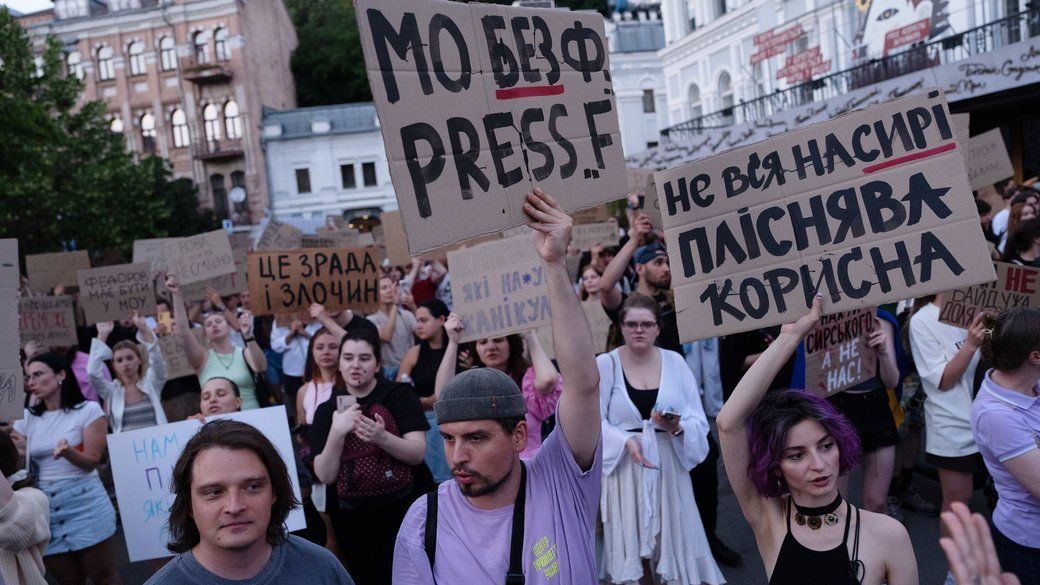
Ukraine has seen one of its largest domestic political backlash since Russia's full-scale invasion began in February 2022, after President Volodymyr Zelensky dismissed Defence Minister Mykhailo Fedorov on July 15 as part of a wider cabinet reshuffle. For a country nearly five years into a war of survival against Russia, the removal of a widely trusted 35-year-old reformer has proved unexpectedly destabilising, both on the streets and within the military.
A rare wartime protestHundreds gathered near the Ivan Franko National Theatre in central Kyiv on Thursday, chanting “Shame!” and holding placards reading “The Russians are celebrating”. Demonstrations spread well beyond the capital, with rallies reported in Lviv, Dnipro, Vinnytsia, Ivano-Frankivsk, Khmelnytskyi, Uzhhorod, Lutsk and Kropyvnytskyi.
Estimates of the Kyiv crowd have ranged from roughly a thousand to two thousand people, a scale of dissent that is unusual in a country where public criticism of wartime leadership has generally been muted. The reaction emerges from Fedorov’s standing: a June 2026 poll by the Kyiv International Institute of Sociology found him the second-most-trusted public figure in the country, trusted by 50 per cent of respondents against 21 per cent distrust – a margin wider than President Zelensky’s own in the same survey.
The power struggle behind the sacking
Fedorov, previously Ukraine’s digital transformation minister, took over the defence portfolio only six months ago and is credited with driving Ukraine's rapid pivot to drone warfare, persuading Elon Musk to cut Russian military access to Starlink, and pushing through procurement and air-defence reforms. That agenda put him on a collision course with the country’s traditional military establishment.
At a press briefing the day after his dismissal, Fedorov said he had pushed Zelensky to replace both Commander-in-Chief Oleksandr Syrskyi and General Staff chief Andrii Hnatov, accusing Syrskyi of stonewalling his reforms for months and eventually issuing him an ultimatum. Zelensky, he said, chose to keep Syrskyi.
Analysts describe the clash as more than personal friction. Veteran and anti-corruption campaigner Yuriy Hudymenko told the Kyiv Independent that it reflected “a conflict between a young technocrat and a general from a largely post-Soviet military school”, playing out over procurement reform, control of the defence ministry’s roughly $100 billion budget, and how far Ukraine should lean into unconventional, technology-driven warfare versus traditional command structures.
Zelensky reportedly told his own parliamentary faction that the ongoing conflict between the two men had simply become intolerable – “it became absurd,” one source quoted him as saying. Some Ukrainian analysts, including Kyiv-based Penta think tank head Volodymyr Fesenko, however, have suggested Fedorov’s rising popularity and a simultaneous sinking approval ratings of Zelensky may have made him politically inconvenient.
A contested successor
Fedorov’s exit follows the resignation of Prime Minister Yuliia Svyrydenko and precedes the appointment of Serhii Koretskyi, former chief executive of state energy firm Naftogaz, as the new prime minister. To fill the defence vacancy, Zelensky named Yevhenii Khmara, acting head of the Security Service of Ukraine (SBU), as acting defence minister, violating the Ukrainian law that requires the defence minister to be a civilian. Khmara would now need to leave the military before parliament could confirm him permanently.
Al Jazeera reports that the Ukrainian parliament has so far been reluctant to vote in a permanent replacement at all, leaving Zelensky in a limbo. A few top-ranked military ranks have also shown the displeasure publicly over Khmara’s appointment.
Will it impact the war?
The stakes go well beyond one ministerial appointment. NATO and German officials acknowledged Fedorov’s role in modernising Ukraine’s forces, and European defence experts warned that the shake-up could slow drone integration and delay missile-production partnerships.
The Kyiv Independent warned in an editorial that Zelensky risked reversing Ukraine’s battlefield momentum at a moment when its asymmetric, technology-driven strategy had begun to pay off. The timing further compounds the risk: the reshuffle came hours after Ukraine signed new drone-production deals with the European Union and days after the US agreed to let Ukraine build Patriot missiles under licence, even as fuel shortages spread across Russia and both sides continue trading attacks on Black Sea shipping that disrupt global grain supplies.