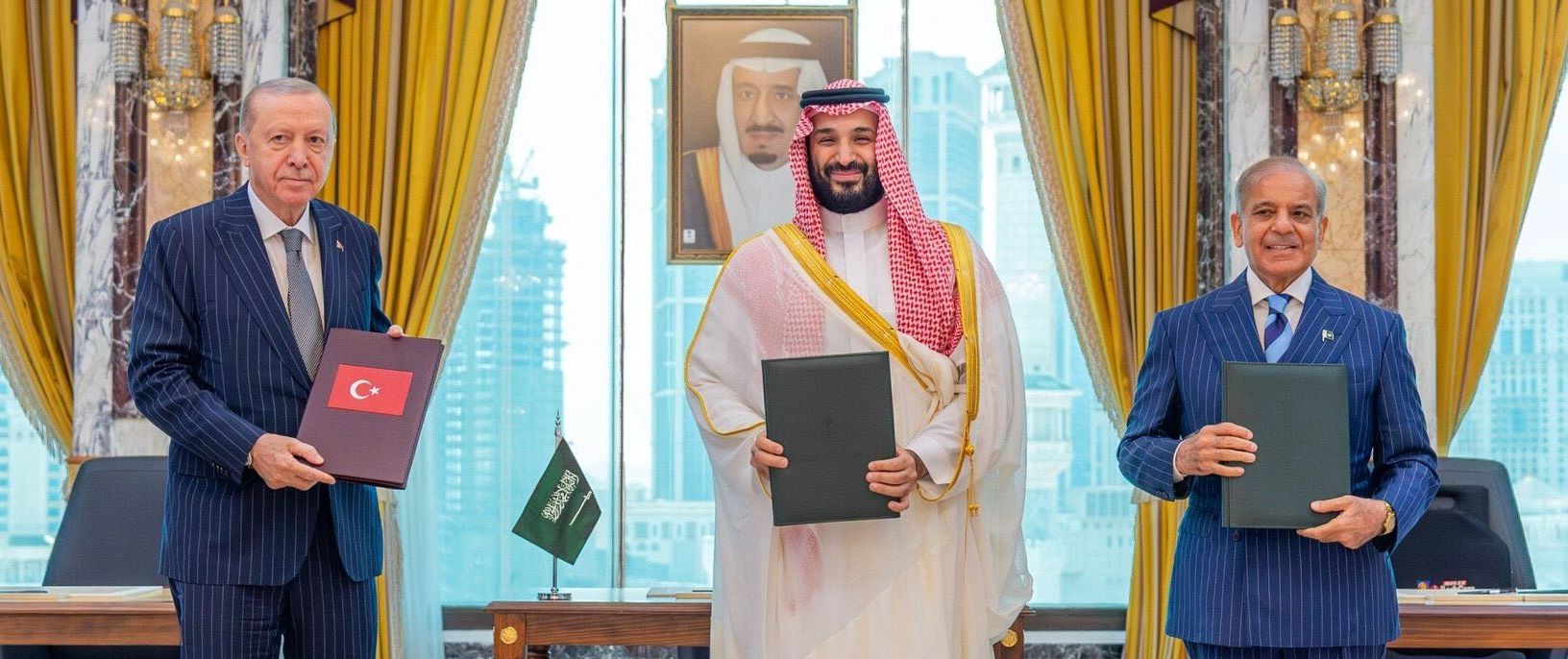
Saudi Arabia, Turkiye and Pakistan formalised a mutual defence pact in Mecca on Friday (August 7), as Saudi Arabia reels from months of missile and drone strikes linked to the US-Israel war on Iran. Saudi Arabia’s Crown Prince Mohammed bin Salman has seen the kingdom struck repeatedly by Iran, the Houthis in Yemen and Shia armed groups in Iraq since the US and Israel attacked Iran on February 28. The three countries signed the “Mecca Joint Defence Agreement” in the holy city, between Turkish President Recep Tayyip Erdogan, Saudi Crown Prince and Prime Minister Mohammed bin Salman, and Pakistani Prime Minister Shehbaz Sharif.
The deal follows nearly a year of negotiations and comes as tensions continue to spike across West Asia. Most importantly, under the agreement, an attack on any one member is to be treated as an attack on all three. However, Turkish Vice President Cevdet Yilmaz said the pact was not aimed at any specific country, and a Turkish official described it as purely defensive, adding that it does not override any existing agreements that the three countries have with other states.
A regionally driven security architecture
“Three of the Muslim world’s most influential states are convening at a moment of heightened uncertainty, demonstrating a growing willingness among regional and middle powers to coordinate more closely on security matters,” Abdulaziz Sager, chairman of the Gulf Research Center, a Saudi-based think tank, told Reuters. “The trilateral framework could strengthen the three countries’ collective diplomatic and defence weight while contributing to the emergence of a more regionally driven security architecture,” Sager added.
What each side bringsEach of the three nations brings something significant to the deal – Turkiye has NATO’s second-largest army, Pakistan is the only nuclear-armed Islamic nation, and Saudi Arabia is among the world’s top oil exporters. Saudi Arabia has been caught in the crossfire between Iran and the US, and the uncertain nature of the US security umbrella has pushed the kingdom to seek out regional defence cooperation – it has also separately launched a coalition of dozens of nations to protect Red Sea shipping after the closure of the Strait of Hormuz choked off its main oil export route.
Building on an existing pact
Pakistan, in May, had deployed 8,000 troops, fighter aircraft and an air-defence system to the kingdom during the Iran war, under its existing bilateral defence pact. That pact – the Strategic Mutual Defence Agreement, signed on September 17, 2025 at Al-Yamamah Palace in Riyadh – committed Saudi Arabia and Pakistan to treat an attack on either as an attack on both. Turkiye’s entry gives Pakistan access to another major military power. While Pakistan offers Turkiye a relationship with a South Asian nuclear power, Ankara brings defence technology and manufacturing capabilities that would complement Islamabad’s military capacity. Taken together, these translate into greater Pakistani capabilities – a development that will matter a great deal to India.
Impact on India
Pakistan aligning itself further with Saudi Arabia also comes as New Delhi tries to deepen its own ties with Riyadh, with which India already shares strong links in defence, energy, investment and strategic cooperation. The new agreement could still hand Pakistan a diplomatic edge, even though the pact is not framed as an anti-India alliance.New Delhi’s response has been watchful rather than alarmed, but it has hardened in tone since the original bilateral Saudi-Pakistan pact last September, when India’s Ministry of External Affairs (MEA) said it would study the agreement’s implications for India’s national security and regional stability, and would take all steps necessary to protect the country’s interests.
Reacting to the trilateral Mecca pact, MEA spokesperson Randhir Jaiswal struck a similar note: “This is also a development that we are closely following, and we shall keep you updated.” Pressed on Saudi Arabia’s role specifically, he pointed to the depth of the India-Saudi relationship as a counterweight of sorts. “India and Saudi Arabia have a wide-ranging strategic partnership that has deepened considerably in the last few years. Our expectation is that our strategic partnership with Saudi Arabia will be pursued keeping in mind mutual interests and sensitivities, within the framework of this partnership,” he said.
Asked whether the UAE or Qatar might also join the arrangement, he cited India’s own “expansive” ties with both Gulf states – Prime Minister Narendra Modi had recently spoken with Qatar’s Emir, while a UAE minister of state had visited New Delhi for talks with the foreign secretary, indicating that India views its Gulf relationships running on a separate track rather than one Riyadh’s new alignment can easily crowd out.
The ministry has also had to push back on speculation the pact has stirred, dismissing a report claiming that India had sought a defence pact of its own with Israel in response as “fake”. What will go in favour of India, however, is that Turkiye’s NATO membership brings its own set of obligations and interests that limit how freely it can act outside that alliance, while Saudi Arabia’s deepening strategic partnership with India – spanning energy, investment and defence – gives Riyadh strong incentive to stay above the fray.