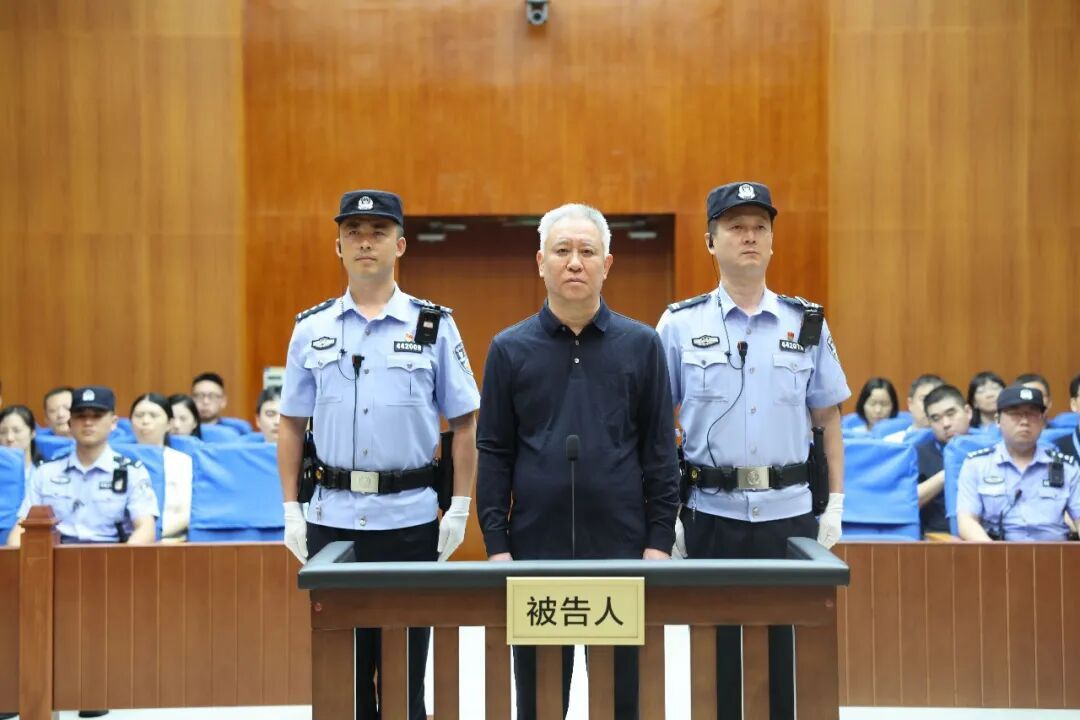
It is rare for a businessman once ranked among the world’s richest to be brought to justice for corporate and financial wrongdoing – but that is exactly what has happened to Hui Ka Yan, founder of China’s Evergrande. Hui was handed a life sentence on Thursday (August 20) after pleading guilty in April to charges spanning fraud, bribery, embezzlement of corporate assets and the illegal absorption of public deposits.
It is a striking reminder that extraordinary corporate success does not necessarily insulate a business leader from criminal or regulatory accountability when authorities determine that laws have been broken. Once Asia’s richest man, Hui built a sprawling property empire and became one of the most prominent faces of China’s real-estate boom.
Powerful businessmen – from India’s Gautam Adani to South Africa’s Gupta family and Mexico’s Carlos Slim – have operated, in very different political and legal settings, at the intersection of corporate wealth, government policy and public influence. To be sure, the comparison is imperfect: the nature of the allegations, the evidence, the legal systems and the outcomes differ substantially from case to case.
Hui founded Evergrande in 1996 and grew it into a conglomerate spanning real estate, finance, electric vehicles, tourism and other sectors. His net worth peaked at US$45.3 billion in 2017, when Forbes ranked him Asia’s richest man.
Evergrande’s spectacular expansion was fuelled by enormous borrowing. After Chinese authorities introduced tighter restrictions on property-sector leverage in 2020, Evergrande’s access to financing came under increasing pressure. The company defaulted in 2021 while carrying liabilities of more than $300 billion, becoming a symbol of the property sector’s broader debt problems. A Hong Kong court subsequently ordered Evergrande’s liquidation in 2024.
The criminal case against Hui went beyond the company’s failure to repay its debts. According to the Shenzhen Intermediate People’s Court, between 2016 and 2021 Evergrande, its property subsidiary Hengda Real Estate and Hui used sustained and large-scale financial falsification to inflate assets and conceal liabilities. The court found that the companies and Hui were involved in illegal absorption of public deposits, fundraising fraud, fraudulent issuance of securities and the unlawful disclosure of material information. It also found that Evergrande and Hui used bribery to obtain control over financial institutions and unlawfully obtain credit and insurance funds, while Hui personally organised the falsification of accounts and diverted company assets under the guise of dividends.
The case, therefore, involved more than a failed property developer: the court found a series of deliberate financial and corporate offences committed over several years. The court said the conduct had “seriously disrupted the socialist market economy order, infringed upon public and private property rights, [and] harmed the integrity of state officials” – and described the sums involved as particularly enormous, the circumstances as particularly egregious and the social harm as particularly serious.
The judgment also illustrates the role of Chinese authorities in the case. The intervention was not limited to a bankruptcy process or a regulatory penalty. The authorities pursued criminal proceedings against Hui and the companies, while separate insolvency proceedings continued against parts of the Evergrande group.
On August 20, the Shenzhen court sentenced Hui to life imprisonment, stripped him of political rights for life and ordered the confiscation of all his personal property. It fined Evergrande Group 8.82 billion yuan (nearly $1.31 billion) and Hengda Real Estate 7 billion yuan (roughly $1 billion), while ordering the continued recovery of illicit proceeds and compensation where the recovered assets were insufficient. Fifty-six other people connected to the cases were sentenced to prison terms ranging from 18 years to one year and 10 months.
That sequence is important when Evergrande is compared with other major business houses. Evergrande is not simply a case of a politically prominent businessman losing his fortune after a corporate collapse; it is a case in which a court made specific criminal findings against the businessman and the companies that he controlled. The other examples below involve a mixture of allegations, regulatory proceedings, commissions of inquiry and court cases, and should not be treated as equivalent.
In India, Gautam Adani offers a useful, if imperfect, comparison. The Adani Group has similarly expanded across ports, airports, energy, infrastructure and logistics, propelling Adani into the ranks of the world’s richest people and turning his empire into a major force in India's economy. Adani's rise has coincided with the ascent of Prime Minister Narendra Modi, making him a controversial figure. Opposition politicians have repeatedly alleged that Adani benefited from his proximity to Modi – a claim Adani denies.
An NWS report examined how Adani’s $250 million US bribery case was dismissed after the Justice Department dramatically reversed course, nearly two years after first bringing charges. New York judge Nicholas Garaufis called the DOJ’s reversal “concerning” and the process behind it “highly unusual”, and also rejected the DOJ’s claim that Indian authorities had already investigated the allegations. While Adani was cleared of US prosecution, the judge’s criticism raised fresh questions about the Justice Department’s own conduct.
Another close comparison is the Gupta family of South Africa – brothers Atul, Rajesh and Ajay – who built a sprawling business empire while cultivating close ties to then-president Jacob Zuma and his family. Zuma has denied any wrongdoing in his dealings with the Guptas, and the family has denied exploiting those ties to win state contracts. South Africa’s State Capture Commission found that Zuma breached ethics rules through his dealings with the Guptas, though he was never convicted of corruption. Where wrongdoing was established, the Commission ordered criminal investigations and the recovery of funds.
Thailand’s Thaksin Shinawatra built his fortune in telecommunications through Shin Corporation before becoming prime minister in 2001, then winning a landslide re-election in 2005. His political and business careers became deeply intertwined, fuelling accusations of conflicts of interest and abuse of power.