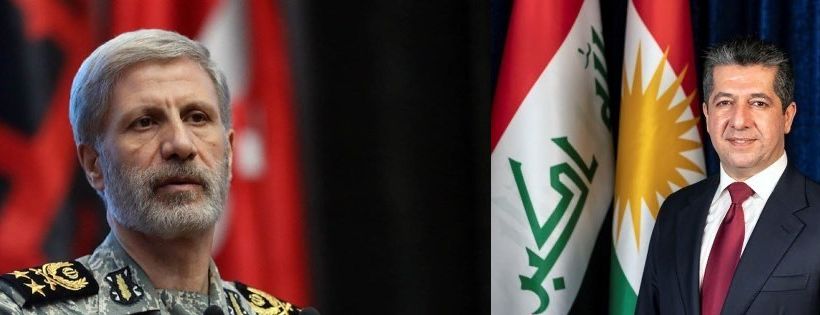
Iran has widened its confrontation with Washington, striking the office of Iraqi Kurdish Prime Minister Masrour Barzani with drones on August 17 – a day after Tehran’s army chief put a bounty on American troops, and just as the 60-day US-Iran memorandum of understanding that had underpinned a fragile calm lapsed without a replacement deal.
The twin escalation lands even as senior figures within Iran’s political establishment continue to press for a negotiated end to the war, underlining Tehran’s possibly deepening internal split between its diplomats and its military.Drone Strike on Barzani’s OfficeAlthough no one was injured in the strike, the Kurdistan Counter-Terrorism Service said that the two drones, fired from Iranian territory, “targeted the private office of the Prime Minister of the Kurdistan Regional Government and the residence of the Security Directorate”, according to a statement carried by Iraq’s state news agency.
Barzani condemned the attack on X as “illegitimate and unacceptable”. It was at least the second time Iran has been accused of targeting a Barzani family residence or office; Nechirvan Barzani, President of the Kurdistan Region and Masrour’s cousin, was reportedly targeted in a similar attack in March.
Nechirvan Barzani has separately been used by Washington as a backchannel to Iran’s Islamic Revolutionary Guard Corps, and Kurdish officials have otherwise resisted being pulled directly into the wider war. The strike on Masrour Barzani’s office, therefore, adds a fresh regional dimension to an already sprawling conflict – one that came a day after reports emerged of the US turning to his cousin as an intermediary.
Bounties and a Lapsed Ceasefire
The attack followed Iranian Army Chief Amir Hatami’s announcement of a US$30,000 reward for capturing or killing American service members, a sum he said would double if carried out by a woman. Separately, senior lawmaker Ebrahim Azizi said in May that a proposed parliamentary bill would offer a 50 million euros (roughly US$58 million) reward for killing President Donald Trump, alongside Israeli Prime Minister Benjamin Netanyahu and the CENTCOM (United States Central Command) commander.
Hatami did not specify where Iranians might expect to encounter American personnel, and there has been no known deployment of US ground troops inside Iran beyond an April operation to rescue a downed pilot. The gap between rhetoric and reality captures the contradiction now defining Tehran’s posture: political figures calling for talks, while elements of the military establishment escalate.
That contradiction sharpened further on August 17, when an Iranian official told Reuters that Iran was ready to shift to a “fully offensive” posture after negotiations for a permanent ceasefire stalled. Tehran, the official said, would be prepared to “escalate tensions in the Strait of Hormuz and wider region” and to launch a “timely and precise” strike to break the US naval blockade if diplomacy failed.
The warning coincided with the expiry of the Islamabad memorandum of understanding, signed in June, which had set a framework for negotiations over Iran’s nuclear programme, US sanctions and control of the Strait of Hormuz. Iran’s foreign ministry has since dismissed the expired MoU as “irrelevant”, with Foreign Minister Abbas Araghchi describing the conflict as having “taken on a new status” rather than a ceasefire awaiting renewal.
Disagreement over who controls the strait has been the central obstacle to a final settlement throughout.Diplomats vs HardlinersFormer President Mohammad Khatami has emerged as one of the most prominent voices pressing for restraint. On August 16, he warned that Iran, though it had withstood external pressure, could not sustain indefinite war, saying: “We cannot live with war. The people cannot, and it is not possible to continue daily life, meet people's needs and govern society under such conditions.” He called for a measured diplomatic approach despite Tehran’s deep distrust of Washington, and argued that prolonged conflict would be an unsustainable answer to Iran’s domestic and foreign-policy strains.
Khatami is not a lone voice. Sitting President Masoud Pezeshkian and other pro-negotiation officials have continued to push for a diplomatic settlement to protect Iran’s battered economy, but face mounting resistance from military and hardline factions who believe Iran can outlast Washington and are wary of conceding ground on Hormuz. That intra-regime divide – with Supreme Leader Mojtaba Khamenei publicly playing down the split to project unity – helps explain why Tehran’s signals have looked so contradictory even within the same week.
Iran’s factions have long been at odds over how to handle Washington, a rift that hardened after Trump annulled the 2015 nuclear deal in 2018 and eroded Tehran’s faith in diplomacy. The regional fallout of the current impasse is already visible: the stalled Hormuz settlement has disrupted tanker traffic and pushed oil prices higher, prompting China to explore Arctic shipping routes and some carriers to reroute via the Cape of Good Hope.
The bounty announcement itself carries more symbolic than practical weight, given the absence of US ground forces on Iranian soil, but its timing is unlikely to be accidental. Coming as the MoU lapsed and talks stalled, it indicated a deterrent signal to Washington and a display of resolve for a domestic audience, rather than an operational plan. Even so, it raises the stakes for any US personnel elsewhere in the region, hands hawks in Washington fresh justification for a harder line, and will make it politically costlier for either side to climb back to the table – precisely as Tehran’s moderates are warning that a negotiated exit is becoming harder to reach the longer the fighting drags on.
Washington, for its part, must judge whether Tehran’s diplomatic overtures represent a genuine opening or another layer of pressure tactics. For Iran, military escalation may strengthen its bargaining position in the short term, but risks making a negotiated settlement progressively harder to reach.