Singapore’s National Environment Agency (NEA) has served notices to seven Indonesian plantation and timber companies to extinguish fires on their land, stop further burning, and submit fire-prevention plans. For the first time, the country issued the notices under its Transboundary Haze Pollution Act, 2014. Talking to the media on Friday (October 16), Environment Minister Grace Fu said, “Our investigation so far suggests that some of the haze experienced in Singapore originated from fires on the lands of seven companies in Sumatra, Indonesia.” When asked, she said fines or charges are among the options being considered.
Daily life disrupted
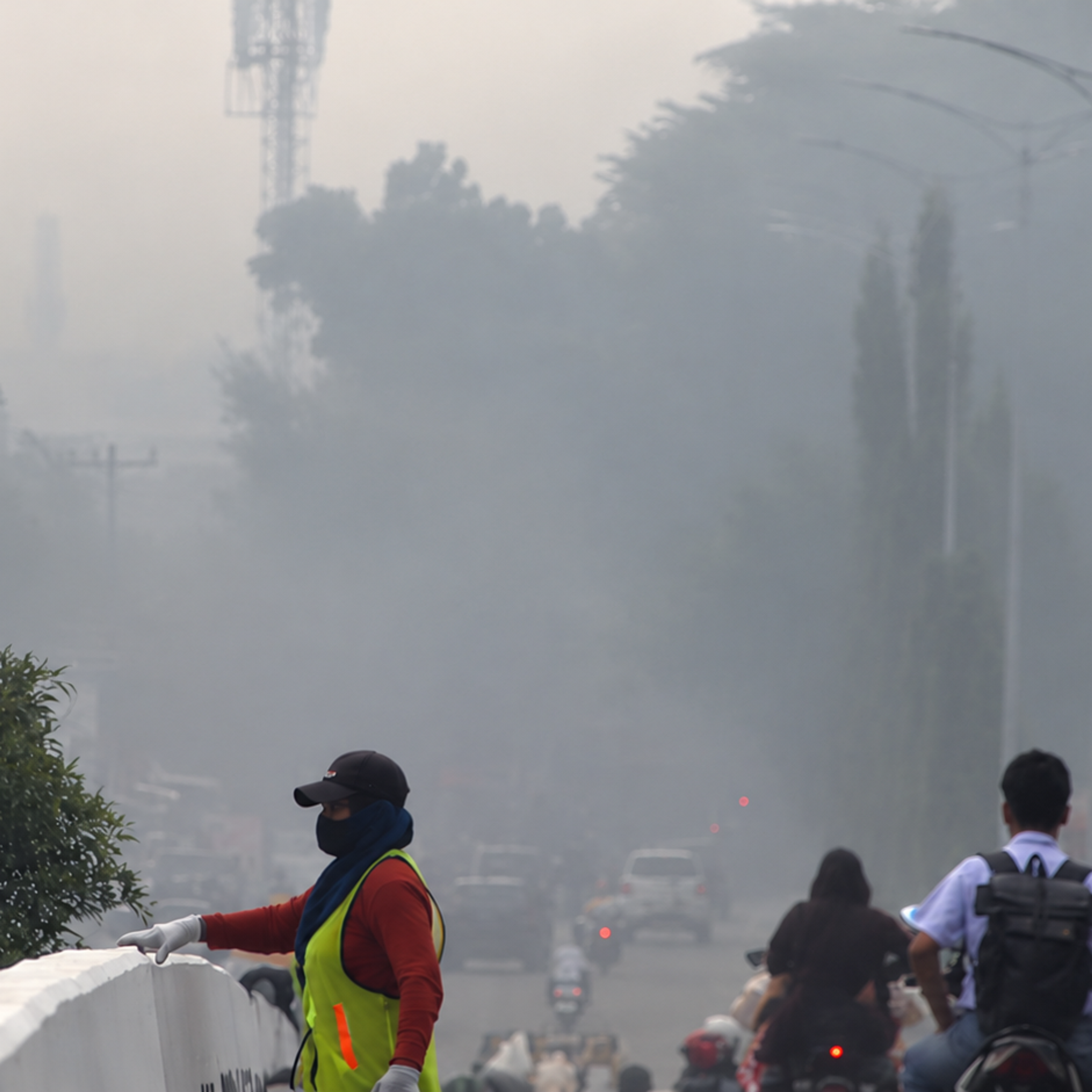
Haze has disrupted daily life in Singapore in several ways, from school routines to health. Air quality hit this year’s high this week, with the central 24-hour PSI reaching 227 on Oct 16, well into the very unhealthy range. The government began distributing N95 masks to vulnerable residents on Oct 14, earlier than planned, and opened air-conditioned rooms in community clubs and some residents’ committee centres as shelters. Schools remain open, but several have cancelled outdoor sports, PE lessons and playtime, and preschools must stop all outdoor and strenuous indoor activities when the air is very unhealthy.
ActiveSG, the national sports programme, closed outdoor facilities, and the accountants’ institute cancelled its annual run. Employers are urged to avoid prolonged or strenuous outdoor work to keep employees healthy. Households have adapted, with residents collecting masks from vending machines and using air purifiers, and older people giving up morning walks. Health effects are showing too: doctors have seen 20 to 30 per cent more patients with haze-related symptoms.
The cost so far
A preliminary estimate puts Singapore’s loss at about S$3.2 billion ($2.5 billion) to S$3.9 billion ($3.1 billion) from this haze. The country lost S$1.83 billion ($1.3 billion) to the 2015 haze. In Malaysia, experts estimate losses of roughly US$150 million to US$370 million a month if the smoke persists. Indonesia, where the fires burn, bears the heaviest burden. According to Celios, a Jakarta-based think tank, the fires could inflict a $6.9 billion loss on Indonesia. World Bank estimates said Indonesia lost $5.2 billion in 2019 fires and $16.1 billion, about 2 per cent of GDP, for the 2015 fires.
Why do companies burn forests?
The NEA has served notices to seven companies - PT Bumi Andalas Permai, PT Bumi Mekar Hijau, PT Paramitra Mulia Langgeng, PT Sumatera Alam Anugerah, PT SBA Wood Industries, PT Hutan Lestari Raya and PT Bangkanesia. (Note: PT is the Indonesian designation for a private limited company.) Singapore’s claim concerns where the fires burned, not who lit them. Indonesian media reports say timber-producing companies burn forests because it is the cheapest way to clear land for planting. Fire removes leftover trees and brush quickly without heavy machinery, and the ash helps crops such as acacia and oil palm take root on poor peat soil.
According to MADANI Berkelanjutan, an Indonesian NGO, companies have been burning forests and peatlands because enforcement has been weak. Current penalties have not created a sufficient deterrent, as fires keep recurring and reigniting in areas under their control.
In 2016, a South Sumatra court found Bumi Mekar Hijau guilty of illegally burning about 20,000 hectares of its concession in 2014. Eleven South Sumatra residents are now suing the same three firms over haze, arguing that repeated peat fires may stem from landowner negligence, such as failing to restore burned areas promptly. Indonesia’s Environment Minister has said these companies could have lit the fire, but he could not provide evidence.
Why Singapore hasn’t acted before
Singapore’s earlier effort went nowhere. It served notices on six companies in 2015 but closed two cases in 2017, and the other four remain open. No company has been fined or sued under the law, and three of this year’s seven were among the 2015 recipients. In a conversation with EcoBusiness, NUS law professor Alan Tan explained why. He said the firms were not forthcoming because what they shared could incriminate them, and smaller firms with no presence in Singapore may be beyond the law’s reach. Much of the evidence sits in Indonesia, and the 2015 effort stirred sovereignty complaints in Jakarta.
What Singapore proposes now
Singapore says it will monitor the companies’ replies and issue more notices if evidence points to other firms. Prime Minister Lawrence Wong said Singapore will act under the law where warranted and explore joint action with Indonesia and other countries, without giving many details. Meanwhile, the country’s stock exchange, Singapore Exchange, has queried listed companies with Indonesian plantation operations. The law allows fines of up to S$2 million ($1.57 million).
Indonesia’s response
Jakarta has not publicly responded to the notices, and the diplomatic risk is that it may bristle as it did in 2015. Fu said she spoke with Indonesia’s Environment Minister, Jumhur Hidayat, last month and has not yet received a response, while stressing that Singapore remains ready to help in whatever way Indonesia sees fit. The silence matters because the last time Singapore invoked the law, Indonesia responded unfavourably, and NUS law professor Jolene Lin recalled cries in Indonesia that Singapore was infringing its sovereignty by issuing notices outside its jurisdiction.
In 2016, an Indonesian minister told Singapore to focus on its own role and not “make so many comments” on the haze. Indonesian media have covered the notices widely, with Republika and Kompas carrying expert warnings of diplomatic implications, and the legal experts quoted say Singapore’s room to act is narrow. Alan Tan of NUS expects Singapore to wait for Indonesia to identify certain companies before acting against them under the Act, making Jakarta’s cooperation the deciding factor.
Jakarta announced that it has named 223 individuals and nine companies as suspects and sealed 57 business entities. Singapore’s challenge is to press the seven firms without appearing to override Indonesian authority over firms operating on Indonesian soil, a balance it failed to strike in 2015 and one that Malaysia, which has said it will send no protest, is avoiding altogether.
What could happen next?
The outcome depends on the companies and Jakarta. If the firms stay silent, Singapore could escalate to information demands and court action; in 2016 it served an information notice on a director of a non-responding firm as he tried to enter Singapore. Then, Singapore’s Water Resources Minister Masagos Zulkifli vowed to take stern action against the firms that caused the haze. However, there was no outcome. The harder test for Singapore is to initiate a prosecution.
Tan expects Singapore to move mainly against companies that Indonesia has itself identified and charged and warns that a case failing for lack of evidence could signal the law is futile. Simon Tay of the Singapore Institute of International Affairs argues it still works by triggering questions and accountability, even without convictions. Lighter winds are expected soon, and any relief could take pressure off the case. Whether this round ends differently from 2015 will turn on cooperation from Jakarta and the companies.