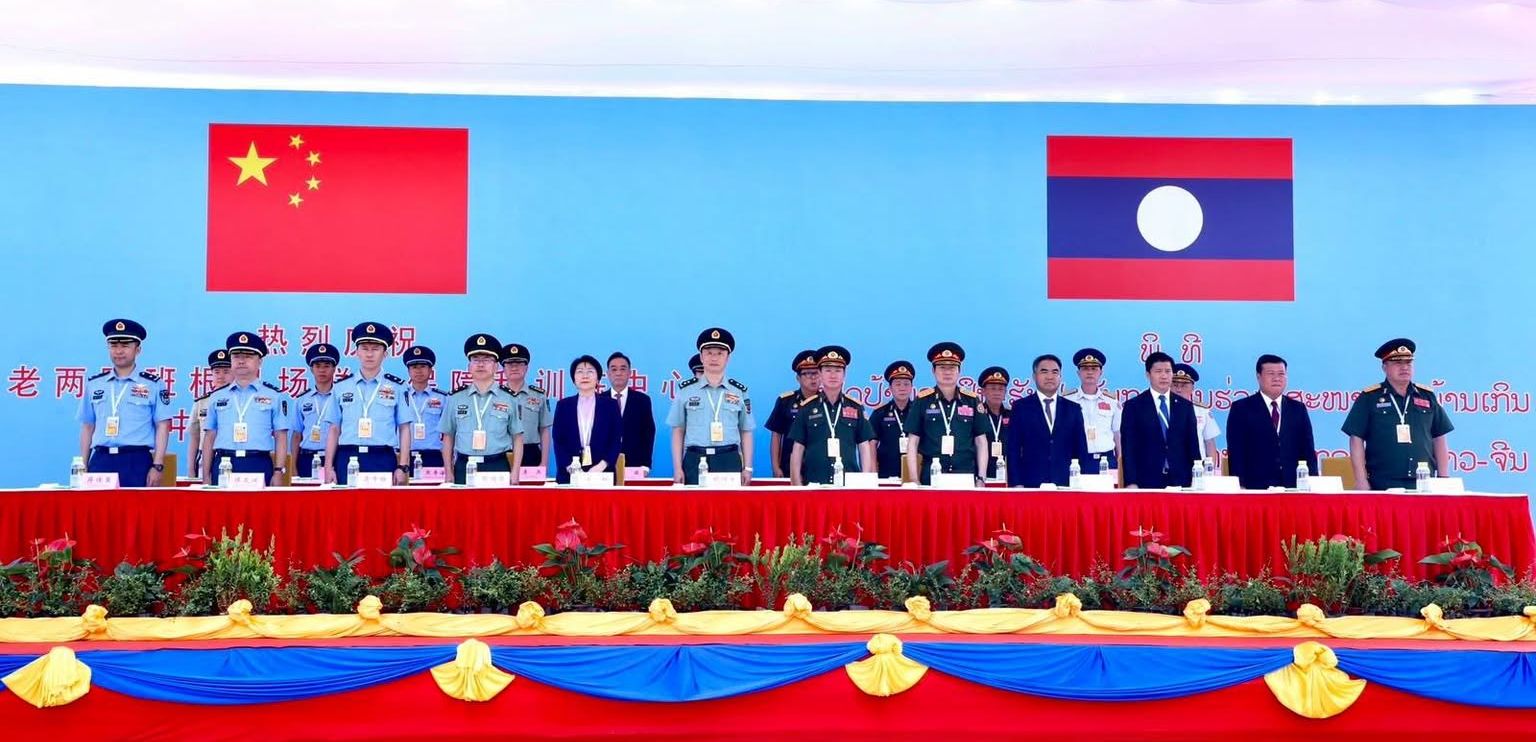
China has opened what analysts describe as its first overseas airbase at Ban Keun Airport in Laos on September 29, adding an air-power facility to Beijing's growing network of military footholds abroad. The airport is located about 45 km from Laos’ capital city, Vientiane. According to China's Ministry of National Defence, the facility includes the China-Laos Joint Support and Training Centre and the China-Laos Friendship Aviation Academy. China and Laos will jointly maintain and operate the two facilities, which are intended to help train Lao Air Force pilots.
Beijing, however, does not officially describe the facility as an airbase. It calls it a joint support and training centre and an aviation academy. The new base gives China its third publicly acknowledged overseas military facility, after its logistics support base in Djibouti in the Horn of Africa and the joint training and support facility at Cambodia's Ream Naval Base. While the first two are naval-themed facilities, Ban Keun is an air-power base.
What will China do there?
China says the facility's immediate purpose is to help Laos improve its military pilot training. The Chinese Defence Ministry said the two institutions were established through mutual respect and equal consultation, comply with the laws of both countries and relevant international law and are “not directed against any third party.” Beijing said the centre would strengthen practical cooperation between the two militaries and contribute to regional peace and stability.
But important details remain undisclosed. China has not disclosed how many Chinese military personnel will operate from Ban Keun, what aircraft or equipment will be based there or whether Chinese aircraft will be permanently stationed at the facility. That uncertainty is central to understanding what Ban Keun could eventually become.
Why analysts say
The facility has already attracted attention because of the model China has used elsewhere. The wording surrounding Ban Keun is similar to the language Beijing used when it established the China-Cambodia Joint Training and Support Centre at Cambodia's Ream Naval Base. Analysts say the joint-facility model could allow China to establish a continuing military presence without initially creating a conventional, exclusively Chinese overseas base.
Brian Hart of the China Power Project at the Centre for Strategic and International Studies (CSIS) told the South China Morning Post that the facility could initially remain genuinely joint but could potentially develop into a deeper Chinese presence. He added that analysts would need to watch how long Chinese aircraft and personnel remain at Ban Keun, whether China gains exclusive access to parts of the facility, and the balance between Chinese and Lao personnel. Those factors could indicate whether the facility remains primarily a training centre or develops into a more substantial PLA presence.
Strategic location
Ban Keun Airport is about 45 km north of Vientiane, in northwestern Vientiane province. The airfield predates China's arrival. It was previously used as a tactical support site within the network of US airstrips in Laos during the Vietnam War and the Laotian Civil War. Satellite imagery indicates construction began at the site around October 2025 and expanded significantly over the following year.
The longest runway is about 2,000 metres long. Reuters reported that satellite imagery showed a large runway, taxiway and several new buildings transforming the site from largely undeveloped land into a significant military facility. The infrastructure can support aviation training and other military activities. But no public evidence currently shows that China intends to deploy combat fighter aircraft at Ban Keun permanently.
Air-force training
The new academy also serves a practical purpose for Laos. The Lao People's Liberation Army Air Force has a small fleet, consisting largely of helicopters and light training aircraft. Its pilots have traditionally depended on foreign partners, including China and Russia, for advanced training. Reuters reported that Lao military personnel have had to travel to countries such as China, Russia and Vietnam for advanced training.
The new facility allows some of that training to take place inside Laos. For China, this creates an opportunity to train Lao pilots and ground personnel using Chinese systems and procedures. Over time, that could increase military interoperability between the two countries and deepen Laos' reliance on Chinese aviation technology, training and maintenance support.
China's overseas footprint
Ban Keun is China's latest step in expanding a military presence beyond its borders.
China established its first overseas military base in Djibouti in 2017. The facility was initially intended to support Chinese naval operations, including anti-piracy missions in the Gulf of Aden.
The Djibouti facility has since expanded. A recent CSIS analysis based on satellite imagery found that China has added infrastructure that could strengthen the PLA's communications and intelligence-gathering capabilities.
China subsequently developed a joint military facility at Cambodia's Ream Naval Base. The Laos facility now adds an air component to this limited overseas network. However, analysts caution against equating China's overseas facilities with the much larger network of US military bases worldwide. The Chinese facilities in Djibouti, Cambodia and Laos differ in their size, missions, access arrangements and operational capabilities.
Location matters
Ban Keun's location adds to the facility's significance. Laos lies at the centre of mainland Southeast Asia and borders China, Vietnam, Cambodia, Thailand and Myanmar. China already has deep economic and infrastructure links with Laos. The China-Laos Railway, a major Belt and Road Initiative project, opened in 2021 and has significantly improved connectivity between the two countries.
Military cooperation has also expanded. Earlier this month, Chinese and Lao forces conducted the Peace Train-2026 joint humanitarian medical rescue exercise in Vientiane. More than 700 personnel participated in the exercise, according to China's Defence Ministry. The new aviation facility adds another layer to this increasingly broad relationship.
Potential PLA foothold
The most important question is therefore not simply what Ban Keun is called today, but how it develops in the future. Reuters quoted Rachel Vandenbrink, a senior analyst at the Australian Strategic Policy Institute, as saying the joint support and training centre could give the PLA persistent access to a logistics hub supporting forces rotating through Laos, potentially with a small forward support element. Another analyst cited by Reuters suggested the facility could represent China's first full-fledged PLA overseas base in Southeast Asia. Those assessments remain interpretations, and the scale and duration of China's military presence remain unknown.