A reported Franco-German draft paper urging the EU to build a trade tool capable of shutting Chinese goods and services out of the market within 24 hours has drawn a sharp response from Beijing, which has threatened reciprocal measures if Brussels goes ahead. The reaction, issued on September 29, comes just days before EU Trade Commissioner Maroš Šefčovič's talks in Beijing on October 8-9. The bloc has framed these as a make-or-break moment for bilateral trade relations, with its trade deficit with China at record levels.
China and the EU are currently holding dialogue under their trade and investment consultation mechanism and exploring ways to address each other's concerns.
China’s Global Times reported that the Ministry of Commerce responded to the information that France and Germany are developing a joint proposal for a new tool modelled on Section 301 of the US Trade Act of 1974. A ministry spokesperson said that if the EU engages in dialogue and consultations with China while stepping up pressure on it, this will seriously undermine mutual trust and harm broader China-EU economic and trade cooperation.
“The EU has itself been a victim of such tools in the past: do not do unto others what you would not have done unto yourself,” the ministry said in a statement issued on Tuesday.
“If the EU engages in dialogue and consultation with China on the one hand while ratcheting up a show of strength against China on the other, this will seriously damage mutual trust, disrupt the overall consultation process and affect the broader picture of China-EU economic and trade cooperation,” it said.
The ministry went on to say that China will “resolutely respond and defend the legitimate rights and interests of Chinese industry” if the EU introduced “discriminatory” restrictions on Chinese firms or products.
Section 301 allows the US to investigate foreign trade practices that it deems unfair and, if talks fail, impose unilateral retaliatory tariffs. The Trump administration used it in March 2018 to announce tariffs on Chinese goods, triggering the US-China trade war. The Chinese spokesperson called the prospective EU instrument a “typical protectionist and unilateral measure”. China, the spokesperson added, has been on the receiving end of such tools and does not want to use similar methods against other countries.
Rapid “shut-out” powers
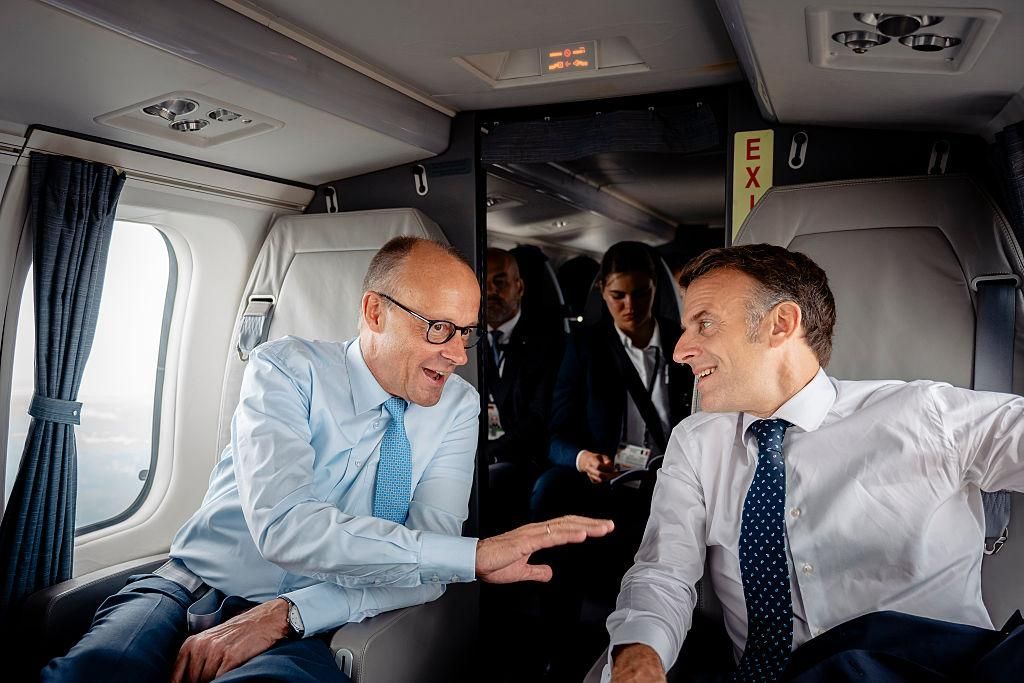
The paper, which is still under development, was reported by Noah Barkin, senior adviser at independent research provider the Rhodium Group. According to his note, officials in Paris and Berlin are finalising the document, which urges the European Commission to fast-track an instrument capable of cutting China off from the EU market “within 24 hours”. French President Emmanuel Macron and German Chancellor Friedrich Merz are expected to approve it in the coming days before it is sent to Commission President Ursula von der Leyen.
Even if the proposal advances quickly, analysts caution that any new tool is unlikely to be operational before 2027. One possible route would be to amend the existing Anti-Coercion Instrument, sometimes called the EU’s “trade bazooka”, which currently requires a qualified majority of member states to approve its use. Under the Franco-German concept, the threshold would be reversed, so a majority would be needed to block action.
Imbalance drives urgency
For the first time, every one of the bloc’s 27 member states is running a bilateral deficit with China. The EU is losing roughly €1bn a day in trade. The EU’s goods trade deficit with China reached €360.6bn ($408.6bn) in 2025 and widened by a further nice per cent in the first half of 2026. The political alignment between France and Germany reflects this mounting economic pressure.
Conventional EU trade defence tools typically take at least 18 months to produce duties. Macron has pressed publicly for faster options since July, when he and Merz met in Germany and called for a joint China roadmap by September. The draft paper now under discussion appears to meet that timeline.
Divisions within the bloc
The draft paper has emerged even as some EU members, including Spain, have advocated dialogue with China rather than confrontation. The split points to a difficult task for Paris and Berlin in building support among the other 25 member states, particularly if the proposal reverses the voting threshold under the Anti-Coercion Instrument so that a majority is needed to block action.
Diplomatic calendar
Šefčovič is due in Beijing on October 8-9 seeking concrete commitments, including limits on Chinese exports to Europe and an extension of the current truce on rare-earth export restrictions. The European Parliament is preparing a critical resolution on China for October 7, and EU leaders meet on October 15-16.
China is also pursuing parallel channels. On September 29, Commerce Minister Wang Wentao held a video call with German Economy Minister Katherina Reiche. The Chinese side said the two “exchanged opinions” on trade issues; the German ministry declined to comment on the reported Franco-German paper. The Global Times subsequently cited an unnamed Chinese observer who outlined possible retaliatory steps, including anti-discrimination probes, security reviews of supply chains and examinations of the impact of foreign subsidies.
Parallel EU initiatives
Separately from the Franco-German proposal, the Commission is drafting a “diversification instrument” that would require companies in critical sectors to source supplies from multiple origins. Šefčovič has indicated that critical inputs should ideally come from at least three different sources. A broader package of new tools is expected in December.
Whether the Franco-German paper becomes formal policy or serves mainly as leverage in the October talks remains unclear. What is certain is that a record trade deficit, slow existing remedies and a crowded diplomatic calendar have pushed both sides into a high-stakes phase of the relationship.