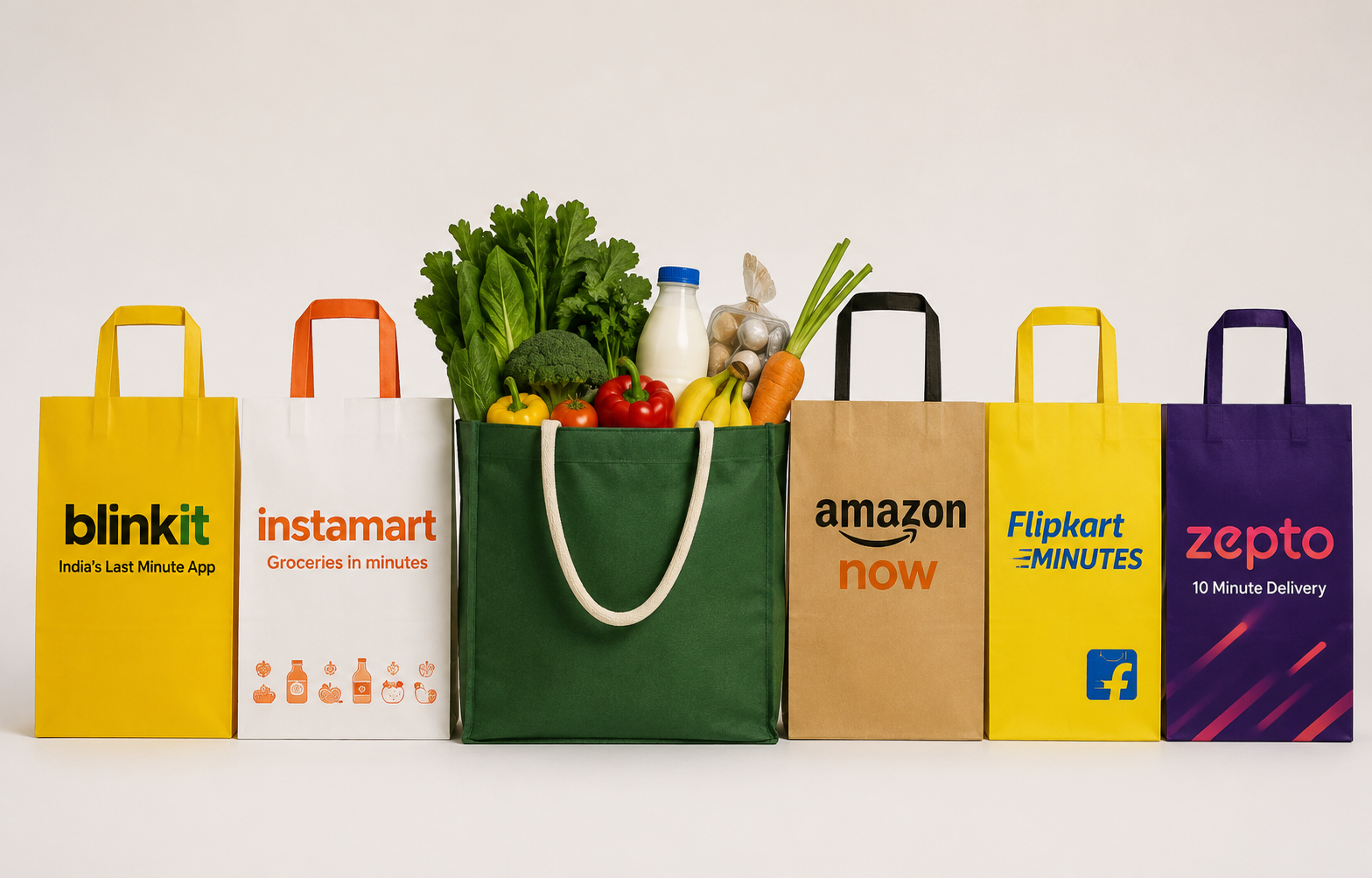
Two years after Walmart-owned Flipkart rushed into India’s quick-commerce race, its Minutes service has all but closed the gap with the market’s entrenched leaders – a sign of how decisively instant delivery is displacing the once-standard practice of scheduling a grocery order for later in the day. Flipkart Minutes is now delivering between 1.1 million and 1.2 million orders daily, nearly triple the roughly 390,000 to 400,000 it managed in November, according to TechCrunch, which cited people familiar with the matter.
That surge has pulled Flipkart within striking distance of Swiggy’s Instamart, which handles roughly 1.4 million orders a day, even as Blinkit continues to lead the pack with 3.4 million to 3.6 million daily orders and Zepto trails at 2.4 million to 2.6 million, as per estimates from market-research firm Datum Intelligence. To chase that scale, Flipkart has expanded its network of micro-fulfilment centres to roughly 1,020-1,050, up from just 340 a year ago, and is adding around 100 more a month as it targets 1,500 by the close of 2026. Average delivery times have meanwhile fallen to around 11 minutes, from 13 a year earlier.
Groceries that no longer wait
The Flipkart figures illustrate a broader shift under way across Indian retail. Even as broader consumer spending has softened, quick commerce keeps growing, a trend Bernstein analysts have flagged in a recent note on the sector’s resilient monthly active-user growth. Satish Meena, an adviser at Datum Intelligence, put the shift bluntly to Tech Crunch: “Can you go back to scheduled delivery now in grocery? No,” he said. “You will not go back.”
Households that once booked a weekly grocery slot are increasingly ordering fruit, vegetables, dairy and staples on impulse, spending an average of roughly INR 400–500 (about $4.20–$5.20) as per Minutes order, with gourmet and organic ranges being added to capture higher-value baskets. Repeat custom is high, too: roughly 65-70 per cent of monthly Minutes shoppers are returning buyers, and as per-customer transactions have climbed 50-60 per cent year-on-year.
Whose money is chasing India’s shopping basket
Behind the ten-minute delivery boom sits an even larger story: a handful of foreign-funded giants – mostly American, with a meaningful Chinese presence – bankrolling the infrastructure needed to win it.
Flipkart itself is now essentially a Walmart subsidiary. The Arkansas-based retailer agreed to buy a 77 per cent stake in 2018 for roughly $16 billion – then the largest e-commerce deal in history – and has since mopped up further shares from early backers such as Tiger Global and Accel, taking its holding to around 80 per cent. Notably, Chinese internet giant Tencent featured among Flipkart’s shareholders at the time of the original Walmart deal, though its stake has since been diluted as Walmart consolidated control.
Amazon, for its part, is funding its own instant-delivery push, Amazon Now, directly from Seattle, with plans to reach more than 300 Indian cities and over 1,000 micro-fulfilment centres after CEO Andy Jassy said orders had been doubling every quarter since launch.
Zepto’s capital table, meanwhile, tilts heavily American. The Mumbai-headquartered app most recently closed a roughly $450 million round led by the Californian pension giant CalPERS, alongside repeat US backers General Catalyst, Lightspeed Venture Partners, StepStone Group and Y Combinator.
Swiggy’s Instamart draws on a more mixed, and more geopolitically fraught, register of capital. Dutch-listed Prosus remains Swiggy’s largest shareholder at around 21 per cent, but the company’s register also includes Japan’s SoftBank and China’s Tencent – a foreign-ownership mix significant enough that Swiggy has been manoeuvring to cap outside holdings and qualify for domestic-ownership status that would give Instamart more flexibility on inventory and pricing.
Blinkit’s parent, Eternal (formerly Zomato), has its own Chinese chapter. Alibaba’s investment vehicle, Antfin, was once among its most prominent shareholders, before it offloaded the bulk of its holding – including an entire 5.84 per cent stake sold in a single block deal – through 2025, trimming Beijing-linked capital from one of India’s biggest quick-commerce operators even as Western institutional investors have stepped into the gap.
A costly race with no finish line
That scale of funding is not incidental. It is the entry price. Instamart alone now serves more than 14 million monthly transacting users from over 1,200 dark stores across 130-plus cities, with over 45 per cent of that network now contribution-margin positive. Meena argues the capital-intensive build-out has already made Flipkart impossible to dismiss. “Flipkart is already a serious player,” he said. “Once you open 1,000 dark stores and [are] doing a million orders a day, it’s serious enough.”
With Amazon accelerating and Flipkart narrowing the gap, India’s quick-commerce contest is increasingly a proxy battle between the balance sheets of American retail, Silicon Valley venture capital and Chinese internet money – all racing to own the moment an Indian shopper decides that they cannot wait until tomorrow for milk.