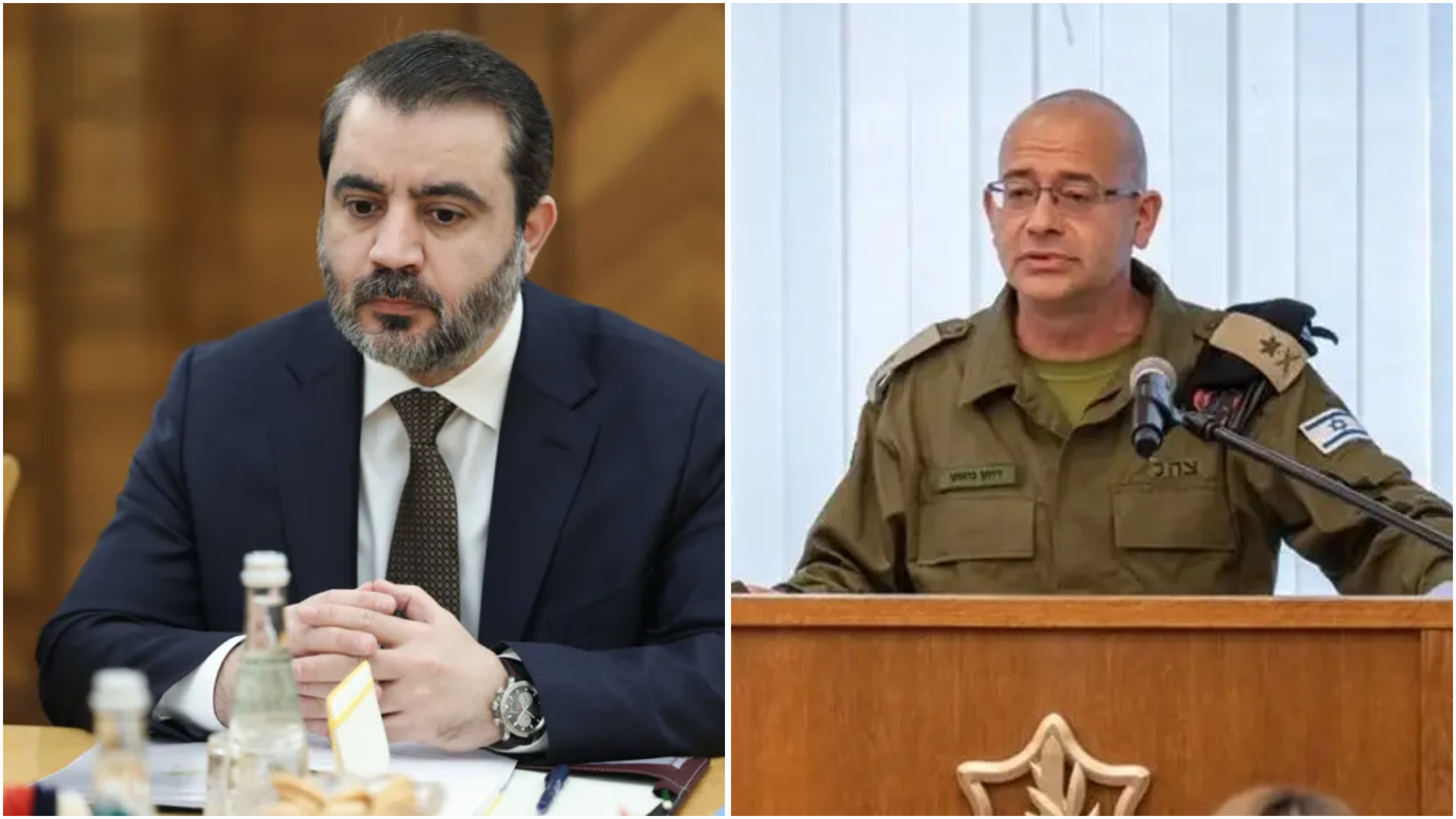
Syria’s Foreign Minister, Asaad al-Shaibani, and the head of Israel’s foreign intelligence service, Mossad chief Roman Gofman, held a closed-door meeting in Jordan on Sunday (August 23), according to AFP. The sit-down, described by multiple sources as an attempt to defuse weeks of rising tension between Damascus and Jerusalem, came just days after Israel bombed a Syrian military airbase and after al-Shaibani publicly urged Israel to seize a “historic opportunity” for peace.
A diplomatic source and a separate Syrian government source told AFP that al-Shaibani met Gofman directly, marking the first contact between the two sides in months. According to the foreign ministry source, the encounter formed “part of efforts aiming at de-escalation after recent Israeli bombardment of Syrian territory, escalating tensions in southern Syria, and in support of stability in Syria and the region”. The talks also touched on bringing “closer the viewpoints between Türkiye and Israel” and ensuring that friction between Ankara and Jerusalem is “not reflected on Syria[n] territory” – a reference to the wider dispute over Turkey’s expanding military footprint in the country.
The meeting was later confirmed by Syrian state media, which reported that a high-level Syrian delegation, headed by al-Shaibani and including the chiefs of Syria's General Intelligence and Military Intelligence services, sat down with a senior Israeli delegation under American mediation, hosted by Jordan. A diplomatic source at Syria’s foreign ministry told the state news agency SANA that the talks focused on “practical steps to de-escalate tensions while exploring ways to return to negotiations”, stressing that any security arrangements “must respect its sovereignty, territorial integrity and sovereign rights”.
The two sides reportedly explored establishing a “special operations room” in Jordan, to be supervised by the United States, aimed at preventing any future military confrontation involving Syria, and potentially Turkey.
“We do not trust Israel currently”
The Jordan meeting followed closely on the heels of a candid interview al-Shaibani gave to Reuters in Damascus, in which the Syrian foreign minister said talks over a security deal that would see Israeli forces withdraw from Syrian territory were expected to resume soon, even though no date had yet been set. He said negotiations had been frozen since the outbreak of the US-Israel war on Iran, and that Damascus’s overriding priority remained halting Israeli attacks on Syrian soil.
“We believe there should be contact, especially with a party that constantly threatens the security of Syria. But if this contact doesn't bring results, then we don't need it,” al-Shaibani told Reuters. “We do not trust Israel currently.”
Despite the mistrust, al-Shaibani struck a note of cautious optimism, arguing that Israel’s reliance on military force in Syria had failed to deliver security. “Israel has tried to maintain its security through brute force, and it hasn’t succeeded” anywhere, he said, adding: “I believe negotiations will resume soon.” Asked how confident he was that talks would restart, he was blunt: “It's very hard to bet on Israel”, though he insisted Syria held “very great hope” of building stable relations with its neighbours, and that “Syria is extending its hand for understandings, for peace, for diplomacy” and regional stability.
The strike that nearly derailed talks
The backdrop to both the interview and the Jordan meeting is Israel’s bombing of the Abu al-Duhur airbase in Syria’s Idlib province on the night of August 18, in which Israeli jets carried out eight strikes on the runway and storage facilities, causing damage but no reported casualties. Israeli Prime Minister Benjamin Netanyahu’s office justified the raid by claiming Damascus was “on the verge of breaching” an understood “status quo in security matters” by allowing Turkish troops and air-defence systems to deploy at the base – an allegation both Syria and Turkey firmly denied. Al-Shaibani had told Axios earlier that Ankara had no military presence at the base and accused Israel of “inventing pretexts to bomb neighbouring countries.”
Syria’s foreign ministry condemned the strikes as “an unjustified act of aggression” and “a flagrant violation of Syria’s sovereignty and territorial integrity”. Even Washington, which has invested heavily in brokering a Syria-Israel accord, distanced itself from the raid: US special envoy Tom Barrack, writing on X, called the strikes “an unnecessary escalation that does not advance regional stability” and urged “all parties to prioritise logical discourse over further military incidents”. Al-Shaibani later said Israel struck the base even after Syria had conveyed assurances that it would not become a Turkish military installation.
Al-Shaibani added that Syria respected Israel’s security concerns but insisted Israel must reciprocate a similar gesture “instead of violating its airspace and conducting raids and arrests in the south of the country”. Damascus, he said, continues to draw on Turkish support for training and military cooperation, “and we won’t forgo support” despite Israeli objections.
A deal “agreed on paper” but never implemented
According to al-Shaibani, Syria and Israel had, earlier this year, “agreed on paper to almost everything” regarding a security arrangement that would have required Israel to halt attacks on Syria in exchange for a phased withdrawal from territory it seized after the fall of Bashar al-Assad. That framework, which built on talks that produced a US-mediated “dedicated communication cell” between the two states, agreed in Paris in January, reportedly envisaged several security zones near the Israeli border, including a UN-only buffer zone and other areas where Syrian forces would deploy with varying degrees of force. Al-Shaibani said Israel nonetheless “sought to evade implementation”: “We did not see they had the real will to reach an agreement.”
The Paris mechanism itself built on a US-brokered disengagement agreement dating back to 1974, which Damascus has pushed to reactivate in full, seeking an Israeli withdrawal to the positions held before al-Assad’s fall on December 8, 2024. In the chaotic days that followed the collapse of the Assad government, Israeli forces moved into the UN-monitored buffer zone and beyond, citing the need to protect Israeli citizens, while carrying out multiple strikes on Syrian military assets, including the defence ministry headquarters in Damascus in July 2025.
Golan Heights still the hardest question
Syria and Israel have technically remained in a state of war since 1948, and Israel has occupied the Golan Heights – seized from Syria during the 1967 Six-Day War – for nearly six decades, a move never recognised as legal under international law by the UN Security Council. Al-Shaibani indicated that Damascus is, for now, setting the territorial dispute aside: the priority, he said, is to “stop Israeli aggression even before reaching a security agreement”, after which “perhaps we can open the topics of peace and the Golan”. Israeli officials have repeatedly signalled they have no intention of returning the plateau to Syrian control.
Barrack said last week that Washington was working to build a mechanism to prevent conflict not just between Israel and Syria but also involving Turkey, whose expanding military footprint in post-Assad Syria has unsettled Israeli planners. Al-Shaibani said no agreement on such a mechanism has yet been reached, insisting it must actually halt Israeli attacks and pave the way to a security deal, rather than “entrenching … Israeli occupation”.
Two American allies, diverging paths
The episode has laid bare an awkward reality for Washington, in which Syria and Israel are, both now counted as American partners, are seeing deteriorating relations despite the fact that President Trump has invested personal capital in both relationships – lifting sanctions on Damascus and hosting al-Sharaa at the White House, while remaining Israel’s principal military backer. Analysts note that Trump has repeatedly overruled Netanyahu’s objections to back Syria’s new leadership, yet has stopped short of restraining Israeli strikes on Syrian territory, exposing the limits of US leverage over Jerusalem even when Washington’s own regional strategy is at stake.
Israel views a rearmed, Turkish-backed Syrian military as a long-term danger regardless of al-Sharaa’s stated intentions, while Damascus regards repeated Israeli strikes and territorial incursions as the chief obstacle to the stability it needs to consolidate power and rebuild. Should this rift widen further, it risks undercutting Trump’s broader ambitions of extending the Abraham Accords into the Levant, and could push Damascus closer to Ankara for security guarantees – even as it keeps a diplomatic channel to Jerusalem open, as this week's Jordan meeting suggests it still intends to.