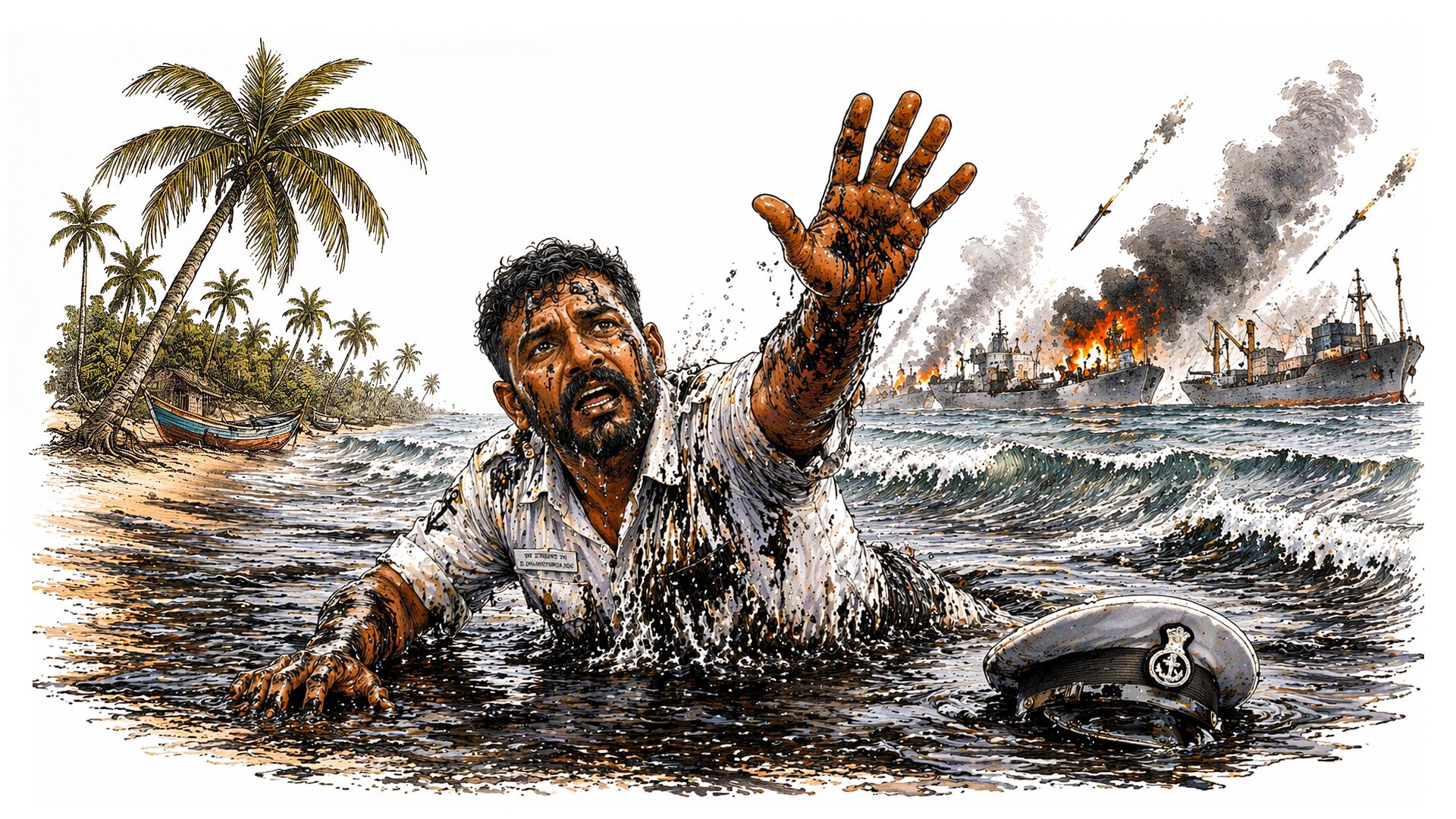
In the Iraqi waters near the Khor-Al-Zubair port in the Persian Gulf, a light-coloured boat sped towards a coral-and-black vessel. Thirty-two-year-old Sayeed Azeem was on board when the unmanned boat slammed into the Bahraini-flagged ship. The explosion that followed sent debris tearing across the deck and filled the ship with black smoke. The attack came a week after Iran's Supreme Leader Ayatollah Ali Khamenei was killed in US and Israeli air strikes. In retaliation, Iran’s elite Islamic Revolutionary Guard Corps (IRGC) is believed to have dispatched the sea-borne drone to destroy the ship owned by a U.S. ally.
Though the attack caused no casualties, Azeem, who was from a small fishing village in southern India, was shaken to the core. The drone struck one of the oil storage containers on deck, destroying it. "We were lucky since the container was empty. Had there been oil in it, the situation would have been disastrous," he supposed. CCTV footage of the attack shows visible damage to the vessel's lower hull. The management, alarmed, ordered the crew to sail immediately to safer waters.
Over the next 48 hours, the damaged ship sailed through one of the world's most contested waterways. Again, a missile came hurtling towards them and narrowly missed. A second close call! The vessel finally reached Dubai, and the crew were allowed to disembark. By then, Azeem had made up his mind: he was going home. But, as he waited at a Dubai airport terminal, believing he was finally safe, a missile struck the runway. The airport was shut down before his eyes. "At that point, I was very afraid. I had been through a lot at sea. But why did I have to face this even on land? I wondered if I would ever get home," he said. Once the authorities cleared the runway and flights resumed, Sayeed Azeem made it back just in time for Ramadan. Today, he can be found at his home in Kalingapatnam village in north coastal Andhra Pradesh, surrounded by family watching the Bay of Bengal from a distance, unsure if he will ever venture into the sea again.
Kalingapatnam is geographically linked to K. Machileswaram and Bandurvanipeta. From these three adjoining villages in the southern Indian state, about 60 men are currently stranded on ships in the Gulf, some in the Strait of Hormuz itself. These villages could surprise any first-time visitor. Quiet lanes open up to rows of independent houses that look like modest villas. There are modern salons and small coffee shops. Nearly 70 per cent of the men here work at sea a shift that has quietly, steadily transformed the fortunes of these villages.

Most of them work as sailors on cargo ships, oil tankers and container vessels across the Indian Ocean, the Persian Gulf and the Red Sea. Fishing, once the mainstay, is now seen as a poor man's fallback. A good placement on a ship can fetch around INR 200,000 ($ 2,148) a month. "So why do anything else?" one resident shrugs. The women of these villages are used to months of separation from spouses, raising children alone and reading faces on video calls for signs of stress. But, with the war now raging across the Middle East's shipping lanes, even that quiet endurance is being put to the test.
Further into K. Machileswaram, I stopped at Mylapalli Umavathi's house. Her son Balu is also a seaman. His ship was struck by a missile near Hormuz and destroyed. He survived by reaching shore in a lifeboat. Though Balu is back safely, Umavathi cannot shake those hours when she did not know if her son was alive.
When the attack happened, Balu called other family members first. However, Umavathi was the last to be told. She says she already knew something was wrong. "My husband was also a seaman. I am used to risky situations. But this was the first time I heard my son crying on the phone. He said it was only by God's grace that he survived. When I heard that, I could not hold myself. It was terrifying," she said. Balu, sitting nearby, was unwilling to revisit any of it.
Not every story in the village that day carried that weight of dread. A few lanes over, I met Gundana Suresh and Triveni, their children tumbling around them. Suresh had crossed Hormuz on a merchant navy ship and reached Mumbai just before the conflict started. Triveni was visibly relieved, but quietly so. "Yes, I am happy he came back early, and he is with us. But I also know there are other women in this village whose husbands are still out there. Their families are waiting. That thought stays with me," she said.
I have learned that there is a seamen’s association in the village. At one time, shipping companies would come here directly for recruitment. To understand how these villages came to produce generations of seafarers, I met Mylapalli Vaikunta Rao, general secretary of the Seamen’s Association. Outside the office stand statues of the first men who ventured into the sea as professional seamen, paving the way for future generations. Rao traced the history back to the 1950s, when fishing was the major occupation in these villages. A local freedom fighter, Kumara Sankara Narayana, noticed British merchant ships at the Visakhapatnam port and began enquiring about recruitment.


Through the 1960s, some of the villagers who went to sea returned with attractive income and stories. A few years later, seafaring had become the default path in these villages. A statue of Sankara Narayana and his wife still stands as a reminder of the historic time which changed the course of the residents and their aspirations.
Rao says the present war is only the latest in a long history of hardships. “It is not as comfortable as people think. War is happening now, but we have faced such situations regularly. There were pirate attacks. We sailed long stretches with no land in sight. In my lifetime, I have seen conflict at sea up close,” he recollected.
Across the three villages, families are now waiting for those still at sea. The hardest visit of the day was to the family of Ramana, whose ship is currently navigating the Strait of Hormuz. His family connected us to him over a crackling phone line. His voice carried exhaustion. “The situation here is worse than anyone can imagine,” he said. He spoke of flashes of explosions seen almost every day. Each time the sky lights up, he fears his ship could be next. As his parents listened, he said he prays and holds on to memories of his family to stay calm. "I used to listen to the sounds of the ocean," Ramana said from somewhere in the Strait. "Now, I wait to hear the whistle of a missile."