Did you know that vetiver grass is native to India, where it is widely known as "Khus Khus"? Its roots run deep in language too: the word vetiver comes from Tamil, meaning "dug-out roots." The 2,000-year-old Sangam literature mentions it as 'omaligai,' used for aromatic baths. The Shakuntalam of Kalidasa records the use of vetiver in constructing bunds and fortifying the slopes of lakes and rivers during the Chola period (circa 985–1014). Vetiver appears in early Ayurvedic texts. It has held a sacred place in Hinduism for centuries. From being used by pandits during final rites and poojas, vetiver is deeply rooted in the Hindu faith.
Beyond its religious uses, P.N. Subramanian, the director of the India Vetiver Foundation, notes that early Indian civilisations cultivated the plant millennia ago to produce fragrances and home products such as mats. Like many Indians, Subramanian grew up with vetiver as an everyday presence, dunking it in coconut oil and applying it to his head to cool off. His house had windows draped with vetiver mats that, sprinkled with water, acted as natural air conditioners; placed in water, the grass absorbs contaminants and purifies it for drinking.
From India to the World
Vetiver travelled from India to more than 100 countries after its extraordinary capacity to protect topsoil from erosion caught the attention of two agricultural scientists working with the World Bank. Richard Grimshaw and John Greenfield, worried about soil erosion worldwide, were searching for solutions.
In 1987, they found what they were looking for, by chance, in Karnataka, India. In a village near Gundlupet, they saw farmers growing vetiver to reduce soil erosion. Having understood the importance of vetiver, Grimshaw eventually founded The Vetiver Network International (TVNI) and built a genuinely global movement that took vetiver from a subcontinental tradition to documented infrastructural use across South America, Asia, North America and Australia.
Today, vetiver's applications are recognised in more than 100 countries, thanks to a network of researchers, practitioners and farmers who carried the knowledge forward. India's native plant is now playing a key role in the Caribbean, more than 8,000 miles away.
Extraordinary grass
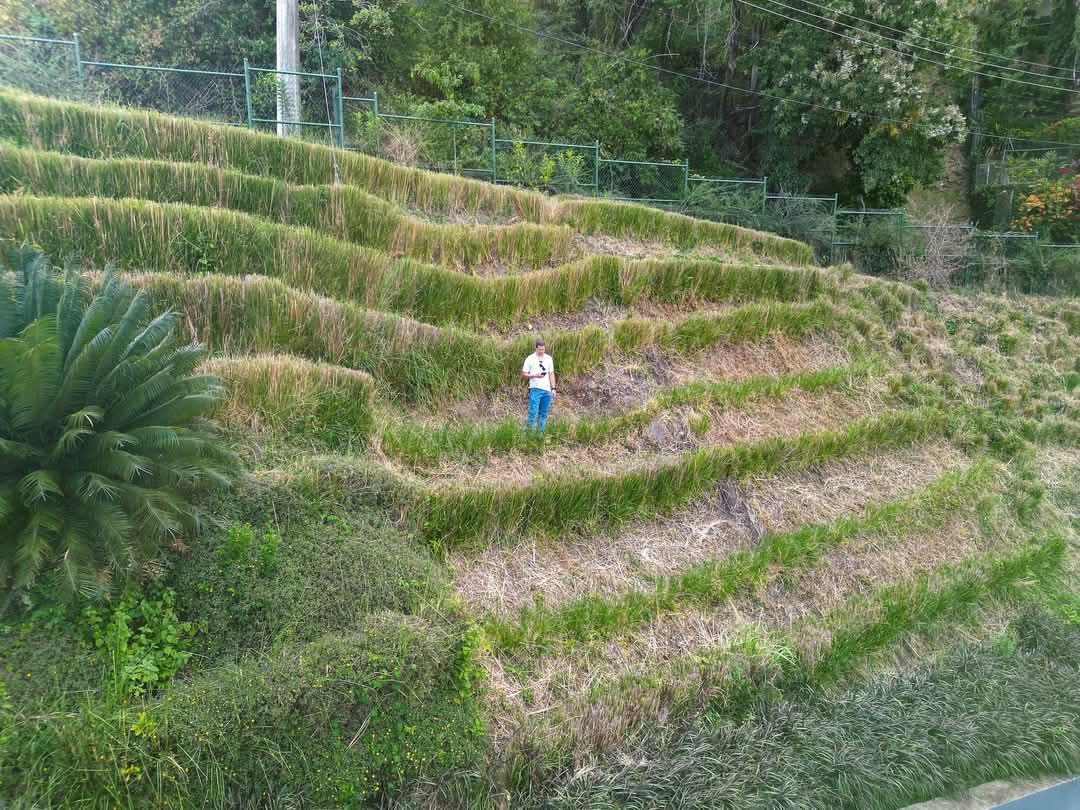
The Caribbean is one of the regions that benefitted most from this magical grass. The NWS recently spoke to Jonathan Barcant, founder of Vetiver TT Ecological Engineering Solutions Ltd (Vetiver TT), to understand the multiple uses of the grass across the Caribbean. A civil engineer by training, Barcant founded the company in Trinidad and Tobago in 2014 and currently serves as its chairman. The company is part of TVNI, the global body founded by Richard Grimshaw. He says the vetiver offers sustainable, nature-based solutions to infrastructure problems and connects today's society with indigenous knowledge that has existed for centuries. "By using this grass, we could move away from grey construction methods that heavily rely on concrete and steel. With vetiver, you are taking a green approach to engineering solutions. For example, instead of building a concrete retaining wall to stabilise an unstable slope, you can plant vetiver, and in due time you'll have strong hedgerows with roots that are 10 feet deep," Barcant explains.
A United States Department of Agriculture Plant Guide confirms this. Vetiver is fire-tolerant, growing a deep fibrous root system extending to 10 feet within two years. Its roots have a tensile strength of 75 MPa — over five times greater than most grasses, and one-sixth that of mild steel, earning it the nickname "living soil nail." Tensile strength is the maximum stress a material can withstand before breaking when stretched. These qualities make vetiver ideal for the Caribbean, which faces both intense dry seasons and devastating hurricane seasons.
Crucially, the plant is also non-invasive. "A lot of countries and clients want to ensure that once vetiver is planted, the plant will not run wild and take over like an invasive species," explains Barcant. To source plants for projects, Vetiver TT maintains nurseries throughout Trinidad and Tobago and has fostered relationships with community members who grow, and supply plants as needed. The company has replicated this model in other islands across the Caribbean by collaborating with the local growers.

Engineering solutions
For Barcant, the mission is simple: "Transform the way the Caribbean approaches sustainable development, one plant at a time." His company has worked on hundreds of projects in Trinidad and Tobago and dozens across the wider Caribbean, funded by the UNDP, the Inter-American Development Bank, the Pan American Development Foundation, and the Green Fund of Trinidad and Tobago. Llevan Ramharrack, scientific officer at Vetiver TT, spoke to NWS about several ongoing initiatives. He has shared three different types of projects that involved slope stabilization, quarry rejuvenation and mitigation of leachate's effect on groundwater.
In Dominica, in November 2025, the company launched the Tarreau Hillside Rehabilitation Project with the Organization of Eastern Caribbean States to stabilise 7.7 acres of hillside. This hillside is overrun with highly flammable citronella grass, which has sparked constant wildfires. The grass also resulted in erosion and rapid runoff during intense rainfall. With the help of local communities, the company is replacing the invasive species with vetiver and planting agroforestry trees such as tamarind and mango to stabilise the slope. Vetiver TT has taken up another slope management project for a community called The Summit, which is nestled in a mountain area called Moka in northern Trinidad. Constructing the concrete retaining wall on the sloping hill area would have cost around $45,000. The company could reduce the cost to US $8,000 using vetiver-based slope-strengthening methods.
For a quarry rejuvenation project, the company collaborated with IA Movement, an NGO, and Close the Loop Caribbean, a circular economy company, in Trinidad. With this project, the company will rejuvenate over 200 acres of former quarries under the National Quarries of Trinidad and Tobago. Vetiver rejuvenates the soil by establishing the primary vegetation cover and helps trees grow by acting as a companion species. "Because the vetiver roots grow deep into the soil, they push apart the gravel to create air spaces so that the roots of other trees that we plant around it will be able to grow more deeply," Ramharrack explains. When leaves grow tall, the team uses the "chop and drop" method, cutting and leaving them to decompose on the spot as natural fertiliser.
Vetiver also has a great role in mitigating the hazardous effects of leachate. For such a project, the company also collaborated with the Solid Waste Management Company (SWMCOL) on a two-year pilot at Forres Park Landfill, the second largest on the island. They are creating a constructed wetland where vetiver roots would filter leachate, a toxic liquid mixture of heavy metals and chemicals, and significantly reduce the landfill's impact on nearby waterways. For this project, the company has studied the landfill system and how vetiver could be used to mitigate the effects of industrial contaminants. Ramharrack says their company has now moved to the next phase, expanding vetiver's use from land stabilisation to broader wastewater management.
Vetiver TT has secured $1.2 million from the Caribbean Biodiversity Fund for a pan-Caribbean climate resilience project spanning Trinidad and Tobago, Dominica, Grenada, Montserrat, St Lucia, and Saint Vincent and the Grenadines, all nations chosen for their acute vulnerability to intensifying storms, landslides, floods, and mangrove loss. As Small Island Developing States (SIDS) race to green their economies and disaster-proof their communities, vetiver's appeal is only rising, says Ramharrack.

Back in India
In India, the importance of this remarkable grass is once again being recognised. Subramanian developed his interest in vetiver after attending a conference in Thailand in 2023 and subsequently founded the India Vetiver Foundation as a Section 8 company. He describes the plant's properties with quiet amazement. "It grows across a remarkable range, from minus 15 degrees C to plus 52 degrees, in soils ranging from pH 3 to 11, including saline and sodic soils. It reaches 3 to 4 metres deep within 12 to 15 months, survives standing water after just a couple of months of growth, and can regrow after being scorched by fire," he says.
All three components of the grass contribute beneficially: the above-ground biomass, the tiller at the centre, and the root below the ground store carbon. Research indicates vetiver stores approximately 15 tons of carbon per hectare — and unlike trees, it begins sequestering carbon from its very first year. "The root system goes straight down without lateral branching, picking up microorganisms, improving the water table and increasing soil organic carbon. India has millions of hectares of different types of land. There is enormous potential to grow the grass there and store carbon," says Subramanian.
Dr Mani Skaria, professor emeritus at Texas A&M–Kingsville and known as the "citrus king," told Subramanian that planting vetiver alongside his groves saved his citrus crop. Vetiver also addresses one of farming's oldest problems: topsoil erosion. When it floods, topsoil is washed away, and it can take 50 to 100 years to rebuild. Planted at six-inch spacing along peripheries or bunds, vetiver retains 60 to 70 per cent of the topsoil through its dense clumps. Its leaves serve as manure and fix nitrogen.
Vetiver has multiple uses for farmers. Subramanian thinks farmers' forefathers would have used vetiver as a pest controller. When stem borers decimate crops, vetiver planted nearby disrupts the borers' larval digestive systems. China has demonstrated this in experiments across 100,000 hectares. The plant can also be used as cattle feed, and organisations are now experimenting with converting its leaves to biogas and bioethanol. One hectare produces 60 to 100 tons of green biomass. In Cuddalore, farmers grow vetiver on 1,000 acres along the coast; its leaves serve as roofing material; its oils form the base of fragrances for European perfume houses, including Chanel and Dior. Perfume makers in Kannauj use it too. It is also deployed in Ayurvedic medicine.
Professor Vimala Yerramilli, Vice Chancellor of Maa Shakumbhari University, Saharanpur, highlights vetiver's capacity as a phytoremediator. It absorbs excess heavy metals without allocating them to edible parts, while simultaneously yielding an essential oil redolent of petrichor, the scent of first rain on dry earth. She calls for further research on introducing variability, soil ecosystem stability and phytoremediation.
Dr Kusum Pandey, a scientist at the Garhwal Regional Centre of the G.B. Pant National Institute of Himalayan Environment, surveyed households using vetiver for soil and water conservation in the Garhwal Himalaya. Most adopters reported good satisfaction: reduced runoff from sloping fields, better soil retention along terrace bunds and increased moisture in the root zone translated into more stable yields and reduced dependence on costly structural measures. Satisfaction was moderate to high rather than absolute: some respondents noted the time required for establishment, limited availability of planting material and the need for early technical guidance. "Overall, vetiver is viewed as a reliable, low-cost, and sustainable solution," Dr Pandey says. "Most adopters are satisfied because it provides long-term benefits with minimal maintenance, aligning well with the needs of mountain farming systems in the Garhwal Himalaya."
Grassroots initiatives are growing in India, too. Peermade Development Society, an NGO in Idukki district of Kerala working with tribals and marginal farmers, trained women's groups to make baskets and gift packaging from vetiver leaves, generating income while encouraging farmers to grow the plant commercially. Jacob Jose, project coordinator at PDS, informs that they maintain a nursery where they grow vetiver and distribute it to farmers.
Plant without borders
Wherever vetiver is planted, on the coast of Cuddalore, in the Garhwal Himalayas, or on the slopes of a Caribbean hillside, it works for the land and the people inhabiting it. Not all plants do. As Subramanian puts it: "What else do you need for natural farming?" A grass that stores carbon, holds soil, purifies water, controls pests, generates income and feeds cattle and, does all of this from its very first year in the ground is less a plant than a quiet revolution waiting to be scaled.
With documented applications spanning from South America to Asia and from North America to Australia, vetiver's track record provides the Caribbean project with a well-tested, globally proven foundation. In April 2027, India is scheduled to host the International Vetiver Conference, expected to draw over 200 delegates from 30 countries. It will be a moment for the world to take stock of how far this grass has travelled, how much it has given, and how much further its story might yet go.