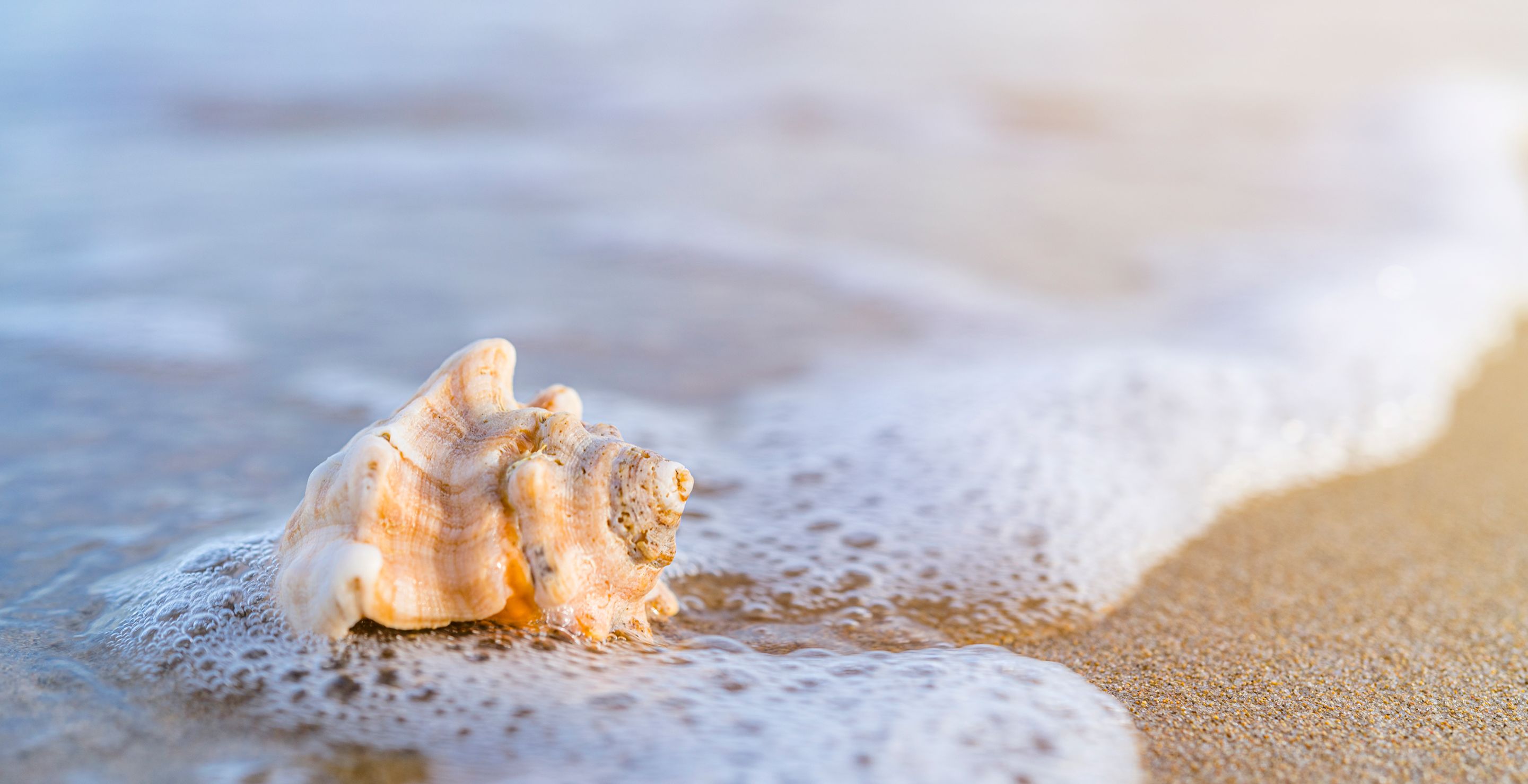
On the way to Mangadu village from Rameswaram, in the Kalam Sea Shell Mart, you begin to question your beginnings. Mounds of seashells galore throughout the campus. Hillocks of them gleam in the sun. Bags of them perch atop one another in tin sheds. It's like the whole sea had been trawled, molluscs collected and stowed away here.
On a recent day, the office manager, Sundaram, showed around the premises, of about four to five acres. This is a self-sufficient operation that starts with sourcing a mollusc, processing it, and turning it into a decorative item. In the back, which is off-limits, are hummocks of dead molluscs, their body tissue melted away by the sun during decomposition. The foul smell often rides the wind.
The owner of the enterprise, S. Abdul Kalam, comes in the forenoon. He says his journey has been a long one, starting in 1977 near Ramanathaswamy temple in Rameswaram, growing his business in Chennai and Mahabalipuram, and returning to Rameswaram. They source molluscs from the local fishermen, who get them as bycatch, from places like Thoothukudi and Thondi, among many coastal villages. While fishermen in Rameswaram catch shells as bycatch and segregate them when they return from the sea, some fishermen in places like Thoothukudi and Thondi catch shells exclusively. In these villages, fishermen set nets for carnivorous molluscs baited with fish, then collect the molluscs caught. These, too, end up in processing units like Kalam's. In addition, Kalam imports shells from Mexico, the U.S., and Africa, among others.
Bought from agents, the shells are dried in the open sun, soaked in water and hot water to remove the meat inside, cleaned with bleaching powder, dunked in hydrochloric acid, then dried in the sun and polished using hands and machines. The shell manufacturing units supply women in villages surrounding Rameswaram and other places with raw materials and collect hand-made products from them. According to a case study, the shell marts sell the finished products "at a gross margin of 75-100 per cent."
The finished products span a range of decorative items: bangles, key chains, wall clocks, chandeliers, hairpins, earrings, bracelets, pendants, and other items. Kalam says his turnover is Rs. 8 crore per annum. About 10 to 15 such units are there in Rameswaram.
Kalam says his business is brisk. His products mainly go to temple towns across India, such as Kashi and Mantralayam, among others. They also export them to Mexico, Florida in the U.S., Indonesia, the Philippines and other countries. "Religious devotion has increased, and a lot of people want these things. They want to keep them in their puja rooms," says Kalam.
Seeing the volume and profits in the trade, many entered it and folded within six months. "Without knowing how this works, many of them folded," Kalam says. "If I buy a shell, I know what to do with it."
Surrounding the temple in Rameswaram, there are about 200 shops selling these shell products to visitors, pilgrims and tourists. These shops source the products from shell units like Kalam's. One shop owner, Muniaswamy, says he sells Rs. 5,000 to 10,000 worth of shell products a day, and profits are at about 20 to 30 per cent. Or, more.
Asked if harvesting of this scale depletes the molluscs in the sea, Kalam says, "The sea is very big." He sees no problem continuing the business in the future.

Globally, there are 80,000 to 100,000 types of molluscs, of which 46,000 are known marine species. In India, there are 5,070 types, of which 3,371 are known marine species.
Kalam sees his enterprise as tiny compared to the sea and what it holds. As businessmen, people like him want to expand their shell trade, oblivious to the ramifications it sets off.
The sea is a living organism. Like cells in a human body, various elements of the sea water, salt, sea grasses, seaweeds, corals, fish and the whole enchilada function in tandem to make what it is.
Among many life forms, molluscs, ranging in size from particle-like seeds to berries, with shells made of calcium carbonate and structured as spirals, are the sentinels of the ocean's health. They are indicators of ocean acidification. Ocean acidification (OA), often referred to as the evil twin of climate change, is the ongoing decrease in ocean pH. As water absorbs more and more carbon dioxide, it turns the aquatic environment more acidic. The changing chemistry of the oceans affects sensitive marine organisms like foraminiferans, clams, oysters, scallops, and corals, as it makes it harder for them to obtain carbonate to build their calcium carbonate shells. As a result, their shells don't grow or are deformed in the acid bath and may even dissolve if the acidity increases.
Molluscs play an important ecological role. They provide food for other species in the food web. Secondly, they are among the most important ocean cleaners. Some of the molluscs graze on unwanted algal growth and keep a check on invading algae so that they don't affect the corals or sea grass beds. Thirdly, the bivalve molluscs, which are filter feeders, filter the pollutants from the environment. Molluscs such as cuttlefish, squids, and octopuses are active predators and feed on fish and crustaceans, such as crabs and shrimps, in the food web. Certain gastropod molluscs feed on dead and decaying matter and keep the seabed clean.
"They are scavengers; they are predators; they are filter feeders and algal grazers. They are helpful in maintaining the ecosystem's health," says Dr. Deepak Samuel, a marine ecologist at the National Centre for Sustainable Coastal Management (NCSCM), Chennai. If the population of molluscs dwindles, the ramifications are huge for pollution and the spread of invasive species.
Dr. Samuel says that mollusc populations are under severe stress in places around the Palk Bay and Gulf of Mannar. "Continuous harvesting of molluscs prevents juveniles from reaching adulthood, thereby reducing reproductive output and ultimately constraining population growth," he says.
Molluscs exhibit a characteristic free-swimming larval stage veliger indicating that larval recruitment may originate from sources beyond the local Rameswaram population. However, scientific observations indicate that molluscan populations are currently experiencing stress.
One species that is overexploited is the sacred chank, Turbinella pyrum. It has a big demand in coastal states such as Odisha and West Bengal. Bangles and earrings are made out of it.
Dr. Samuel says many years ago, there were plenty of numbers, but "now we see that even getting one live is difficult."
The chank's depletion is not a new story. The problem has been there for quite long. However, under British colonial rule, the chank fishery in the Gulf of Mannar was regulated only licensed divers and contractors alone could harvest, seasons were fixed, and rights were auctioned off to the highest bidder. It was a state monopoly, driven more by revenue than conservation. Size regulations existed but were loosely enforced. Even so, that system did what unregulated fishing today does not: it controlled who fished, when, and how much. It was among the earliest attempts at managed marine harvesting in the region and the sea was healthier for it.
At present, scientific studies on the biology and ecology are available only for a few species, including the sacred chank, but not for many others. "If we do not know the biology, if we do not know the growth factor, if we do not know their locations, then it is very difficult for us to prescribe any kind of management plan or what do's and don'ts should be there," the scientist explained.
Moreover, fishermen who harvest these molluscs may not make much money. It's the middlemen who make money, says Dr. Yosuva Mariasingarayan, a marine biologist at Centre for Marine Living Resources & Ecology (CMLRE), Cochin, Kerala. "Too much exploitation is leading to their population decline, disturbing the ecological cycle because they are filter-feeding organisms."
Studies show coral bleaching is an annual phenomenon in the Gulf of Mannar and Palk Bay. Both suffer from heavy metal contamination. Untreated sewage, effluents, invasives, human and climate change pressures, among many other factors, are so ecologically damaging the Bay that there are fears that the situation is going to be beyond repair soon.
The fishermen on the Rameswaram jetty say that they are not into fishing for shells. They say that it's their bycatch. However, the scale of the trade from India is staggering. According to the Observatory of Economic Complexity (OEC), in 2024 India exported $715 million in molluscs, making it the 5th-largest exporter in the world, driven by high demand in Spain, Italy, and Thailand. The industry focuses on squid, cuttlefish, and octopus.
After decades of research into wildlife trade, Professor Vincent Nijman says, "The main lesson is that the scale of the trade in shells is much larger than I thought. Larger volumes, more species, more intricate and more extensive trade networks, more parties involved… It is all bigger. And yet, no one seems to be paying attention." He leads the Oxford Wildlife Trade Research Group, Oxford Brookes University, Oxford, UK.
Nijman also contests the idea that shells are bycatch. "This is probably only partially true bycatch of what?" he questions. If you go out to sea to catch fish say tuna or even bottom-dwelling fish you do not suddenly end up with massive amounts of shells. That's not how it works, he adds.
He admits that at landing sites it is not all boats that bring in shells, but only a few, ones that specialise in it, that at least in part target this type of fishing granted this can be done alongside other activities as well. "But a large part of the fishing for shells is not accidental," he says.
India has two immediate problems with respect to molluscs. One is the religious and cultural significance of shells. Called sacred chank or chank shell Turbinella pyrum its stocks have already been depleted. It's costly too, going up to Rs. 15,000, depending on the size and type.
The way out would be to regulate its fishing so that a sufficient number can be collected every year without depleting stocks. To restore the mollusc population and keep the sea healthy, Nijman suggests: "The law is often a good starting point."
He sees hope for restoration in the community. "Talk to community leaders, talk to the main fishermen, talk to the sellers, talk to law enforcement agencies, get them involved, not in an attempt to shut down the trade in its entirety, but to regulate what can be legally traded and indeed stop the trade in those species that India has decided deserve legal protection."
While sacred chank's biology is studied, there are no studies on thousands of other species. Nobody knows how many or what kinds of species are out there. Without that knowledge, it's nearly impossible to have restoration plans.
Deepak Samuel reckons "we need ecologists, biologists and taxonomists working on these species."
Like surf receding from the shore, your life force ebbs away, seeing the mounds and mountains of shells that once were living beings. The clap and rumble of the sea sounds suspended.