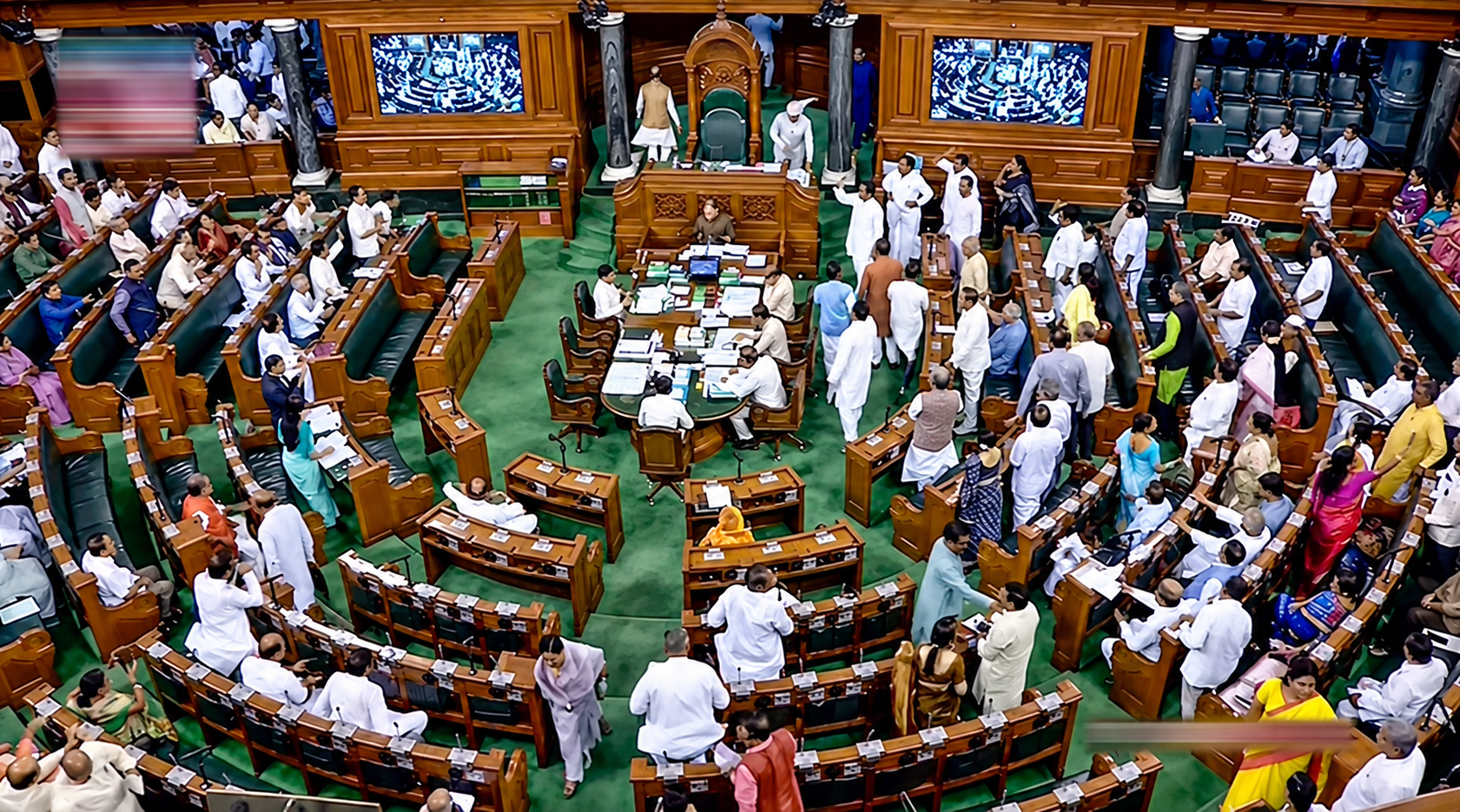
Recent standoffs between the ruling National Democratic Alliance (NDA) coalition and the Indian National Developmental Inclusive Alliance (INDIA) have slowed parliamentary business to a crawl. Partisan rancour rattles parliaments across the globe, but few face the dysfunction now plaguing India’s Lok Sabha (lower house) and Rajya Sabha (upper house).
PRS Legislative Research data show that in the Monsoon Session, held from July 20 to August 13, the Lok Sabha functioned for 15 per cent of its scheduled time and the Rajya Sabha for 33 per cent. Question Hour, the primary tool for holding the government of Prime Minister Narendra Modi to account, ran for one per cent of its allotted time in the Lok Sabha and 12 per cent in the Rajya Sabha. In the Lok Sabha, it lasted nine minutes, with two questions answered orally. Over the 17th Lok Sabha, which ended in 2024, Question Hour ran at 60 and 52 per cent respectively.
As a result, the government has less opportunity to answer questions on even the most pressing problems. The Election Commission of India (ECI) is in the middle of a trust crisis after removing about 133 million names from the national draft voter rolls through its Special Intensive Revision (SIR). Most of the names were marked as dead, shifted, absent or duplicate, and the ECI has ordered a special drive to re-enrol eligible voters who were left out. But the chance for legislators to respond to the controversy remains remote unless something approaching normal operations returns to Parliament.
“The opposition doesn't have any space,” Kirti Azad, a sitting Opposition parliamentarian, said in an exclusive interview with NWS. Azad noted that the Lok Sabha follows a model similar to the House of Commons in allowing minority parties certain days for debate. “If you look at the UK Parliament, you’ll find that there are certain days for the opposition where they can take up the topic and discuss it. But in our country,” added Azad, “although we follow that format, unfortunately the opposition doesn’t get a chance to speak.”
Azad’s comparison invites a test: is India’s paralysis part of a global pattern, or an outlier? NWS compared the legislatures of India, the United Kingdom and the United States on three measures: how often they sit, how much law they produce and how much scrutiny that law receives.
UK’s Westminster: protected Opposition time
Though no stranger to partisan conflict, the House of Commons still functions with some expedience. With two major parties and a sizeable third, it has 650 MPs drawn from a further 11 parties, a non-voting Speaker and a non-sitting party, a considerably smaller cohort than India’s 40-plus parties and 788 members across both houses.
The government controls most of the timetable, but the rules reserve part of the floor for the Opposition. Under Standing Order 14, each session sets aside 20 “opposition days”, on which opposition parties, not ministers, choose the topics: 17 for the official Opposition and three for the second-largest party. The motions are often not binding, but they force ministers to defend their record in public. That is the function Azad says is missing in India. The Speaker’s role reinforces it. The Commons Speaker gives up party affiliation on taking the chair, and the major parties, by convention, do not contest the Speaker’s seat. In India, the Speaker comes from the ruling alliance and typically remains a party member, and the Opposition accuses the chair of denying it time.
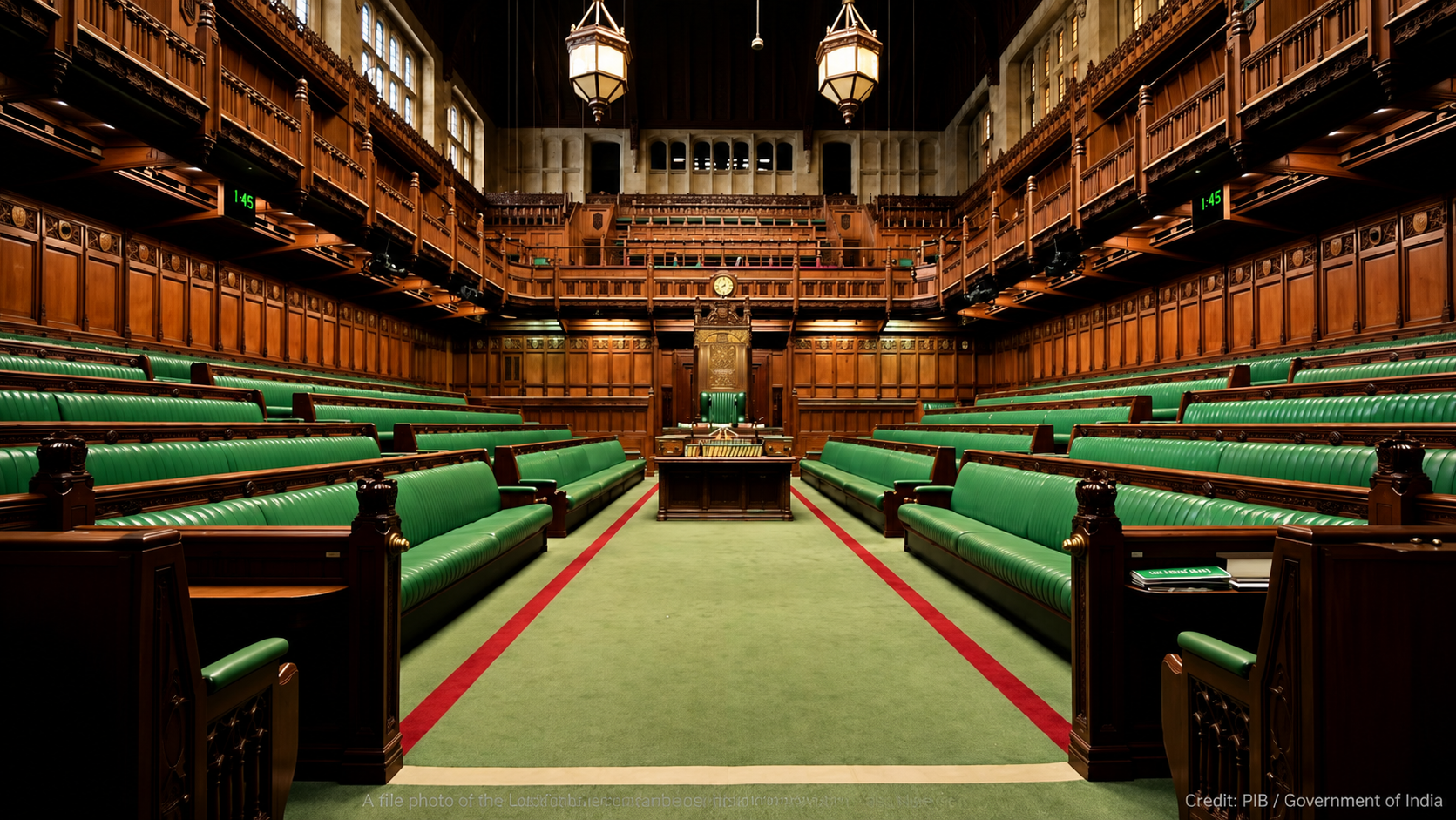
NWS analysis of House of Commons Library records shows that sitting days vary sharply but output does not. Since 2005-06, UK Parliaments have usually had between two and five sessions. The 58th Parliament had four sessions, lasting 209, 152, 213 and 101 sitting days respectively. This compares with an average of 165 sitting days per session over the past 20 years.
The biggest variation was seen in the 57th Parliament (2017-19), which had only two sessions. Its first session lasted 369 sitting days over 28 months, during the peak of the Brexit debate. The second session lasted just 23 days before Parliament was dissolved under Speaker Sir Lindsay Hoyle. Despite these differences, MPs have spent an average of seven to eight hours sitting each day over the past two decades.
On average, about 34 bills were introduced or carried over in each Commons session. The number was highest at 58 in 2005-06 and lowest at 23 in 2009-10. Of the bills dealing with public matters, an average of 88.9 per cent became law over the last 11 sessions across five Parliaments. The success rate ranged from 80 per cent at the lowest to 100 per cent in 2009-10, when all 23 such bills passed the Commons and received royal assent.
What differentiates the Commons from the Lok Sabha is that its rules guarantee the Opposition its share of the floor and an impartial chair. India’s Opposition says it has the format but not the practice.
Washington: a busy floor, thin results
At first, it may seem that the US Congress has remained fairly active. The 118th Congress (2023–24) met for 350 days over two sessions, more than the 20-year average of 315 days. The House also considered a large number of bills – 10,786 in total, according to the Brookings Institution. That was more than 3,000 above the 20-year average. However, only 777 bills were actually passed, below the usual average of 862.
Lawmakers also spent less time in session each day. They met for an average of 3.6 hours a day, compared with 5.3 hours over the previous 20 years. In the end, only 274 bills passed both the House and Senate and were signed into law by President Joe Biden.
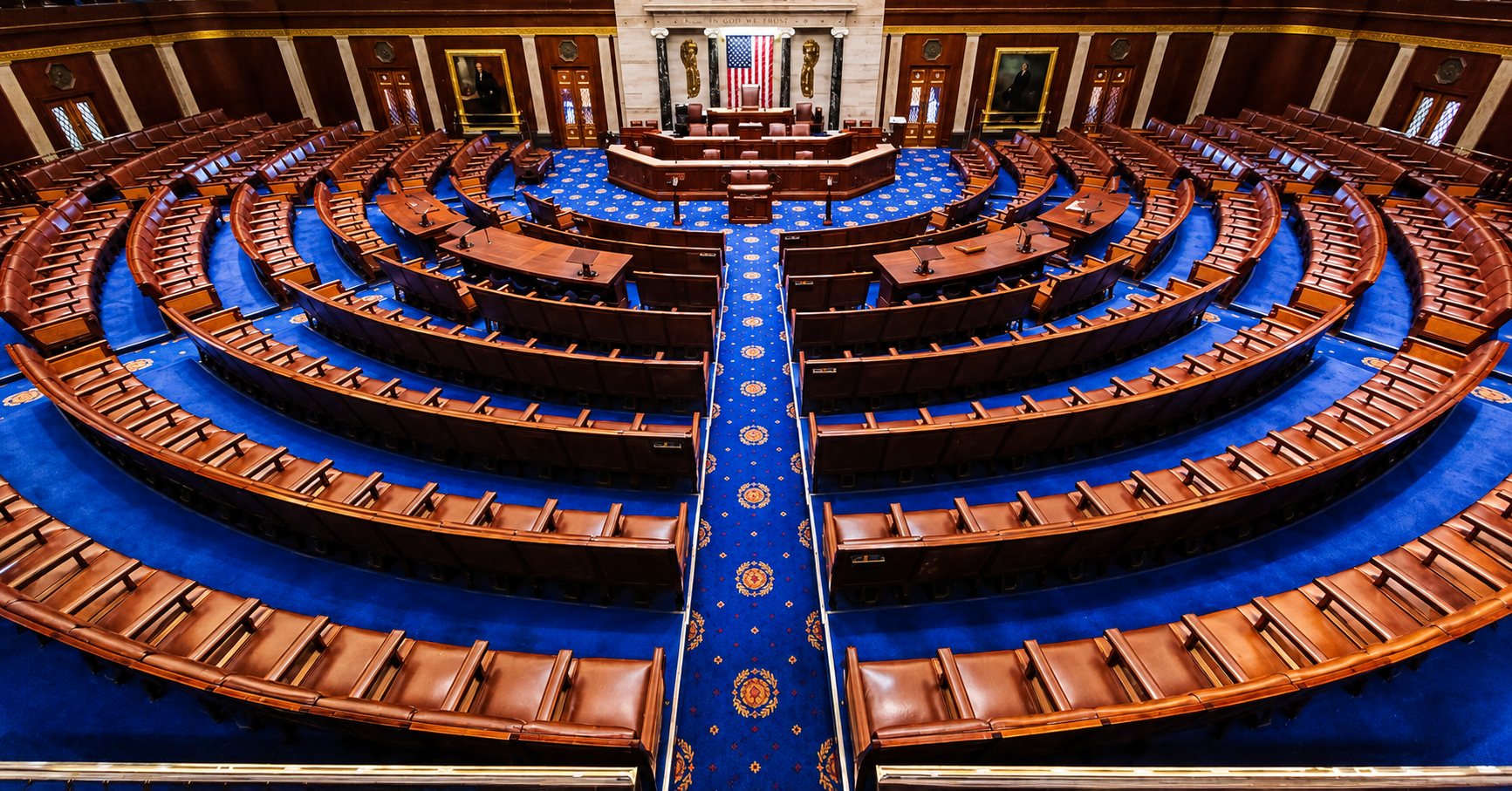
The American Enterprise Institute (AEI), another Washington think tank, found that this was fewer than in any Congress since the Civil War. Omnibus bills, which collect many often-unrelated measures into one, accounted for the bulk. AEI analyst Philip Wallach found that about 82.6 per cent of the Congress’s total output was packed into its 10 longest bills. Only the 117th Congress relied on them more. This, Wallach writes, points to “how hard it has become to move substantive legislation on its merits.” Leaders can steer a bill through by allowing omnibus packaging, but individual members cannot without their approval.
Partisan rancour may factor into Congress’s reduced efficiency, just as it may in India’s. The Congressional Management Foundation’s State of the Congress 2024 report found that senior Capitol staff consider civility and bipartisanship essential but hard to build or maintain. Of the 138 senior staff who responded, more than half had over 10 years on Capitol Hill. Only 31 per cent of Republicans and 12 per cent of Democrats said Congress functions as “a democratic legislature should”. Only 29 and 13 per cent, respectively, said it fosters effective debate on public issues. Heated rhetoric and fears for safety were driving many staffers to consider leaving.
Intra-party conflict also shapes lawmaking, as leaders must manage factions within their caucuses. In October 2023, Kevin McCarthy became the first speaker in House history to be ousted by a vote, after a motion from a fellow Republican. Only eight Republicans voted against him, but all 208 Democrats present joined them, carrying the motion 216 to 210 in the 435-member House. His successor, Mike Johnson, survived a similar attempt in May 2024. Wallach notes that such conflict may signal a shift of “power away from partisan leaders and toward the broader membership of the chamber”. It may also simply reflect strife within the Republican majority.
What this says about efficiency remains an open question. “Some of these indicators can give misleading answers,” said Charles Finocchiaro, professor and associate director of the Carl Albert Congressional Research and Studies Center at the University of Oklahoma. Congress was not designed for efficiency. “Congress is intended to take account of many opinions,” he told NWS, and a short bill can affect more constituents than a long one. “How much is the law changing?” he offered as a more useful question. “In relation to a thousand-page bill, I would argue that that one bill [that impacts many] is much more active.”
India: scrutiny itself has gone
If US debate is growing heated, it still seems sedate by Indian standards, where meaningful legislative discussion has fallen to new lows. PRS calculates that average annual sitting days in the Lok Sabha fell from 135 in the first Lok Sabha to 55 in the 17th, the fewest of any full-term Lok Sabha. The 17th also went its entire term without a Deputy Speaker. The Monsoon Session continued the trend: PRS reports that the Lok Sabha passed 11 bills, nine of them without any MP other than the minister speaking.
Even when bills are discussed, they pass without significant scrutiny. Of 179 non-finance bills passed in the 17th Lok Sabha, 35 per cent passed within an hour of discussion, 13 per cent within one to two hours, 22 per cent within two to three hours and 30 per cent after more than three hours. Some 58 per cent passed within two weeks of introduction, and only 16 per cent were referred to committees. Haste is also evident in how few bills lapsed: only four at the end of the 17th Lok Sabha, against 39, 68 and 46 after the 14th, 15th and 16th. The shutting down of discourse that Azad describes suggests an executive will to resist contrary views.
This erodes the purpose of the draft Constitution introduced on November 4, 1948, when Dr. B.R. Ambedkar, Chairman of the Drafting Committee, described a parliamentary system that supervises the executive and ensures accountability. Rushing laws through while denying the Opposition floor time signals not just a weaker Opposition voice but a threat of lost public trust in the government and the erosion of institutional memory.
Set side by side, the three legislatures show different problems. The Commons gives the government control of the timetable but protects Opposition time. Congress disperses power so widely that it struggles to pass laws. In India, the government’s control of the agenda means scrutiny is lost on the floor itself, where bills pass unspoken and questions go unasked.
MPs like Azad see these developments as dire. Until floor time is yielded to Opposition voices, and until voter rolls are restored and the damage done by the SIR undone, little can improve. “We put in questions, and they disallow,” said Azad. “They simply say that you can't ask these questions.” Azad sees this as a “complete … emergency kind of a situation that is prevalent in our country”, a reference to the 1975-77 Emergency, when civil liberties were suspended. “It’s a kind of democracy [just] by name.”