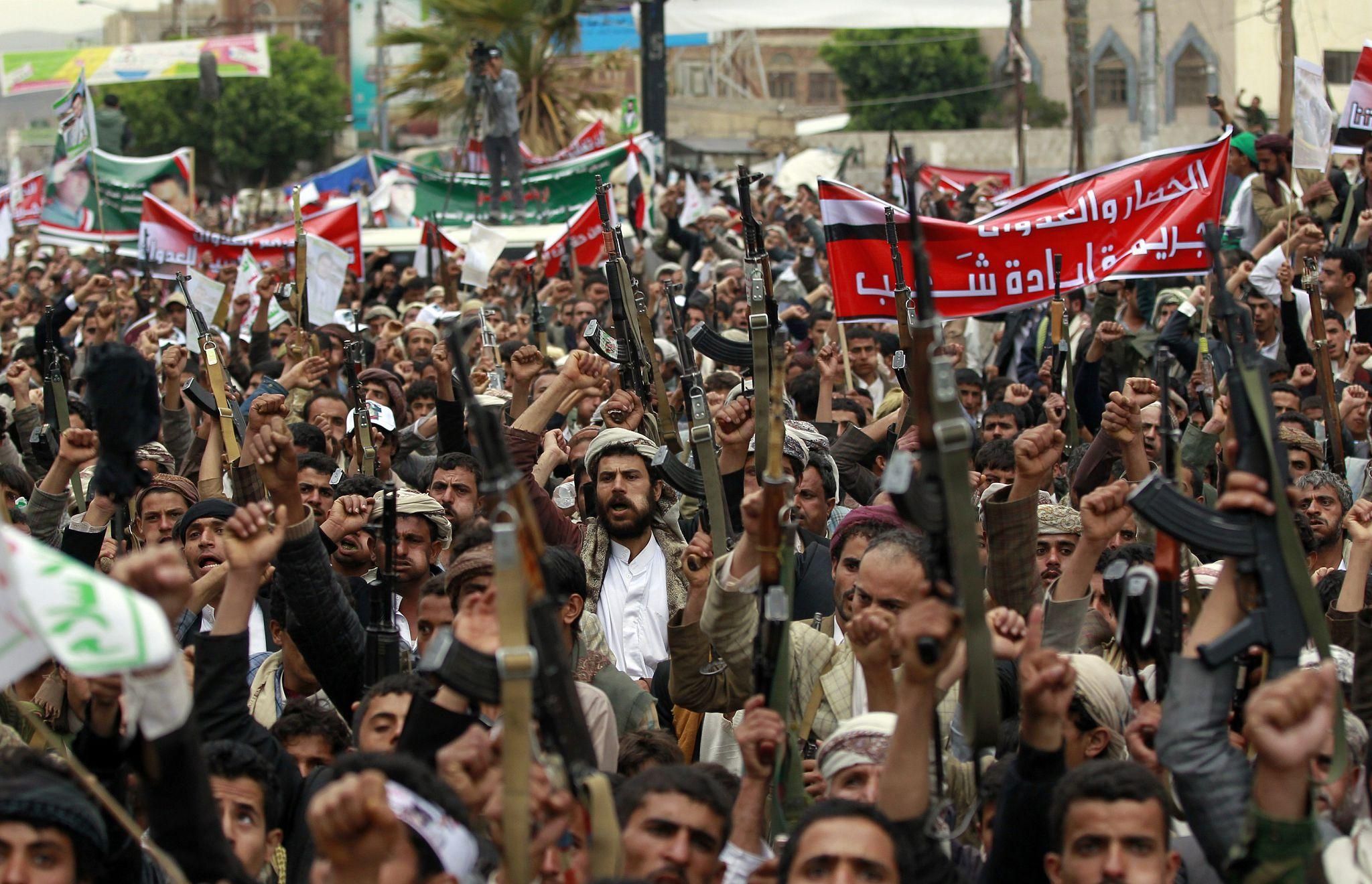
On Sunday (October 4), Yemen’s Saudi-backed Presidential Leadership Council (PLC) announced a military operation to recapture territory held by the Ansar Allah movement, commonly known as the Houthis. The announcement came at a difficult moment for the PLC, as the Houthis made a significant gain by cutting a vital supply route to the government-held city of Taiz. A government spokesman, Colonel Majed Abdullah al-Nazili, said that government and allied forces had carried out 257 “precision targeting operations” against Houthi positions on Saturday.
PLC chairman Rashad al-Alimi ordered all branches of the army to begin operations in a televised address, vowing to retake the country’s remaining territory and restore state authority. The announcement signals a shift from a largely defensive posture to a major military campaign against the Houthis, who control much of northern and western Yemen, including the capital, Sanaa. Regional and Western officials had earlier told Reuters that Saudi Arabia and its Yemeni allies were preparing a major assault. Under the reported plan, Saudi Arabia would provide air support while Yemeni forces conduct ground operations. A London-based defence analyst, Ibrahim Jalal, told Al Jazeera that the operation had brought the conflict into a “new phase”.
Houthi grip on Taiz
The offensive came as Houthi forces made a major move around Taiz, Yemen’s third-largest city and one of the most strategically important urban centres in the civil war. Security sources told AFP that the Houthis had effectively encircled the city after cutting the main supply route. They said that Houthi forces had seized the al-Safiya area, severing the main road between Taiz and Aden, the interim capital of the internationally-recognised government. A police source said the Houthis also took control of a local police station.
The development puts additional pressure on government forces and civilians inside the city. Taiz is home to hundreds of thousands of people and has remained divided and heavily militarised for years. The loss of the road to Aden is particularly significant because Taiz depends on routes through southern Yemen for the movement of people, food, fuel and military supplies. The fighting threatens to turn Taiz into a major battleground again after a lull of roughly five years. Despite Saudi backing, government forces have so far failed to repel the latest Houthi gains.
Fractured anti-Houthi camp
The PLC was established in April 2022 to bring Yemen’s principal anti-Houthi factions under a single political and military umbrella. Instead, competing regional and political interests have repeatedly weakened its cohesion. The most serious rupture came in December 2025, when the UAE-backed Southern Transitional Council (STC), itself a PLC member, seized large areas of Hadramawt and al-Mahra in southern Yemen. The advance alarmed Saudi Arabia because of the region’s proximity to its border and its strategic importance. Riyadh responded with airstrikes on December 30, including an attack on a suspected UAE-linked arms shipment at the port of Mukalla.
The confrontation exposed a deeper rivalry between Saudi Arabia and the UAE, the two principal Gulf powers that had backed different factions. The UAE announced that it would end its remaining military presence in Yemen. Saudi-backed forces then retook Hadramawt and al-Mahra in early January, and Aden fell to them on January 7. That day the PLC revoked the membership of STC leader Aidarous al-Zubaidi and accused him of high treason. He fled to the UAE via Somaliland. A delegation of STC members in Riyadh announced the group’s dissolution on January 9, though an STC official in Yemen disputed it.
The episode exposed the divisions within the coalition now expected to confront the Houthis. It also widened the rift between Riyadh and Abu Dhabi, whose competing interests have complicated efforts to build a unified anti-Houthi military structure. The International Crisis Group, a Brussels-based think tank, warned that Yemen’s current leadership enters the new phase with serious credibility and cohesion problems.
Houthi advances
The military operation followed a rapid Houthi expansion in September. The Houthis declared a naval blockade on Saudi Arabia in July, and early in September they launched drone and ballistic missile attacks on energy sites in southern Saudi Arabia. On September 10, Houthi forces captured the Red Sea port city of Mokha, less than 50 miles from the Bab al-Mandeb Strait. A senior government military official told the Associated Press that officials were stunned that Saudi aircraft did not strike the advancing Houthis. The next day, the Houthis pushed south to seize the rest of the Red Sea coast, Perim Island in the middle of the strait and the Hanish Islands.
Analysts said that control of Mokha could give Iran additional leverage in its confrontation with the United States and increase the Houthis’ ability to influence Red Sea shipping. Brent crude and West Texas Intermediate rose above $100 a barrel on the day Mokha fell.
The development is particularly significant because traffic through the Strait of Hormuz has also been severely restricted amid the wider US-Iran conflict. Control or disruption of Bab al-Mandeb would give Iran and its Houthi ally potential leverage over a second maritime chokepoint. Both waterways are critical to global energy and commercial shipping, so an escalation in Yemen could have consequences well beyond the country’s borders.
A new phase in Yemen’s war?
The PLC’s announcement could mark an important turning point, but its ability to turn the declaration into sustained gains remains uncertain. Saudi Arabia has substantial air power and resources, and the PLC and its allies have significant manpower. Yet the Houthis have shown they can exploit political divisions among their opponents and maintain pressure across multiple fronts.
The battle for Taiz could provide an early test. If the PLC can reopen the road to Aden and stabilise its forces around Taiz, it would show the coalition can mount a coordinated counteroffensive. If it fails, the Houthis could emerge with greater control over western Yemen, stronger leverage over the Red Sea and increased political bargaining power.
For civilians, however, the renewed fighting carries the most immediate risk. After more than a decade of war, Yemen remains divided among competing authorities and armed groups. A new offensive could bring further displacement, disrupt fragile supply routes and deepen a humanitarian crisis that has never truly ended. The immediate battle may be for Taiz, but the larger contest is over who controls Yemen’s territory, its ports and its position between the Red Sea and the Arabian Peninsula.