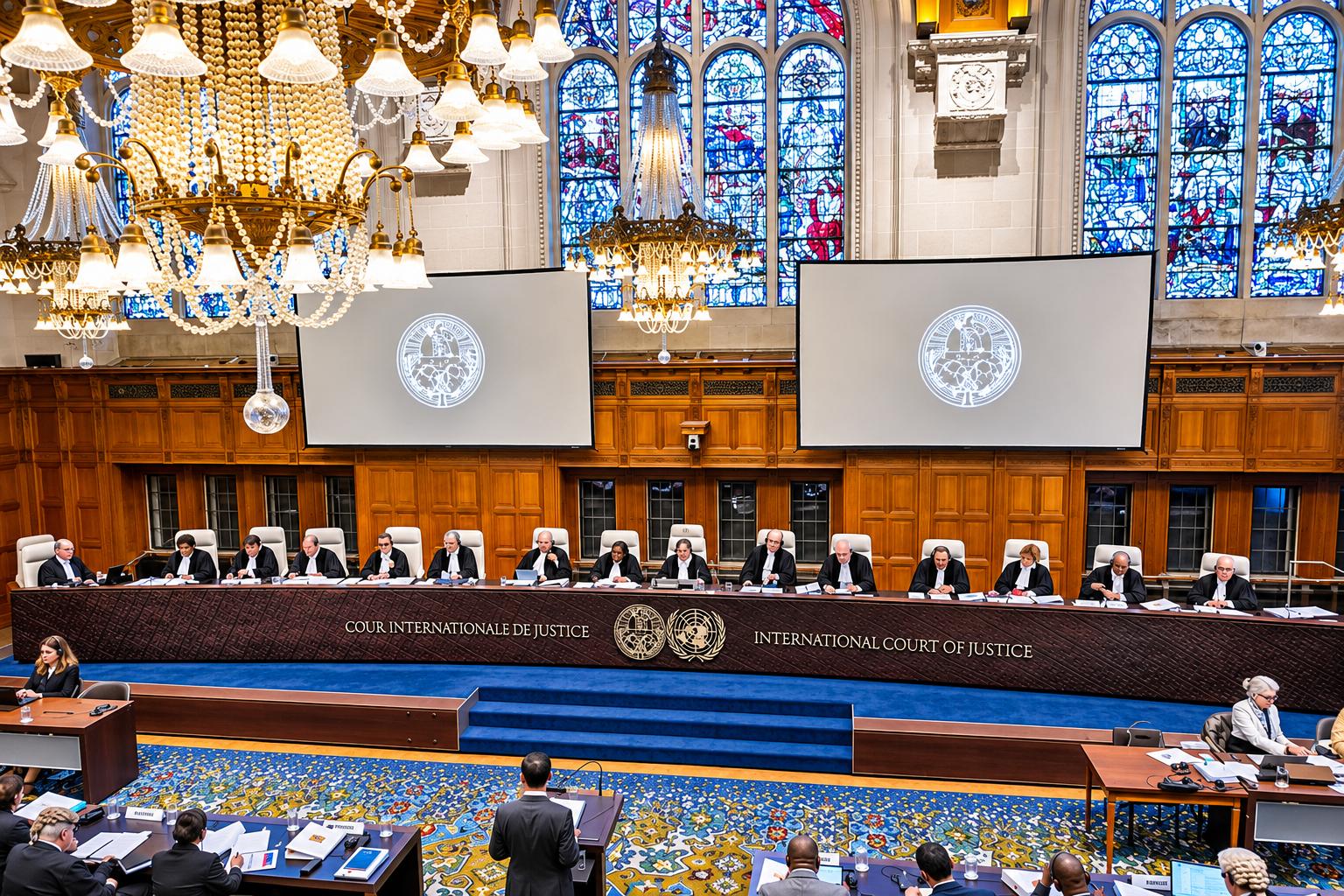
The International Court of Justice’s (ICJ) landmark judgment holding Myanmar responsible for genocide against the Rohingya could have significant implications for Israel’s defence against South Africa’s genocide case over Gaza. For the first time in its history, the world’s highest court has directly held a state responsible for committing genocide, setting out an important judicial reference point for other cases brought under the 1948 Genocide Convention.
Delivered on Thursday (November 19) by a 9-6 majority, the judgment found that Myanmar committed genocide against the Rohingya population in northern Rakhine State during its 2017 military operations. Beyond its historic significance, the ruling provides important clarification on how courts should assess genocidal intent when a state argues that its military actions were driven by security or counter-terrorism objectives.
That reasoning is likely to attract particular attention in Israel, which is facing a separate genocide case brought by South Africa over its military campaign in Gaza. Israel has consistently maintained that its operations were directed against Hamas following the October 7, 2023, attacks and were not intended to destroy Palestinians as a group.
The ICJ’s judgment does not establish Israel’s liability or determine the outcome of South Africa’s case. But it makes clear that a state’s stated military or security objectives cannot, by themselves, rule out genocidal intent. The court’s findings could give South Africa additional legal grounds to argue that Israel’s actions must be assessed through their cumulative impact and the wider pattern of conduct, rather than solely through its stated objectives.
The ruling also builds on the broader principle that security considerations and armed conflict do not displace a state’s obligations under the Genocide Convention.
Why the ruling matters for Israel
Myanmar had defended its military operations by arguing that they were directed against insurgents and security threats posed by the Arakan Rohingya Salvation Army (ARSA), which it characterised as a terrorist organisation. The court, however, held that this characterisation did not preclude the possibility that Myanmar had acted with genocidal intent.
In its judgment, the ICJ clarified that genocidal intent can coexist with other motives, provided those motives are not incompatible with an intention to destroy a protected group, in whole or in part.
Crucially, the court did not lower the established legal threshold for proving genocide. It retained the requirement that genocidal intent must be the “only reasonable inference” that can be drawn from a pattern of conduct. However, it clarified that this test requires courts to assess the totality of the evidence, rather than treat other possible motives as automatically excluding genocidal intent.
The distinction could prove consequential for Israel. Its argument that the military campaign in Gaza is directed against Hamas does not, by itself, settle whether genocidal intent existed. The ICJ would have to examine the evidence of Israel’s conduct, the circumstances surrounding its military operations and whether alternative explanations can reasonably account for the overall pattern.
South Africa’s case, filed on December 29, 2023, similarly seeks to establish genocidal intent through a broader pattern of conduct rather than relying solely on declarations of intent. The court’s reasoning could therefore provide South Africa with additional avenues to challenge Israel's defence, although the two cases involve different evidence, factual circumstances and legal assessments.
The conduct, not just the stated objective
The ICJ did not confine its assessment to Myanmar’s stated military objectives. It examined the nature, scale and pattern of military operations, alongside evidence of violence and persecution against the Rohingya. Executions of men and boys, mass rape, attacks on children and babies, and the systematic burning of villages were among the acts the court considered inconsistent with an intention to conduct counter-insurgency operations.
The judges also examined a wider pattern of conduct, including hate speech, discriminatory laws, forced displacement, destruction of property and widespread sexual violence.
The judgment noted that Myanmar’s security forces had failed to distinguish between civilians and alleged ARSA fighters. The court observed that the execution of Rohingya men and boys, widespread sexual violence, the targeting of children and babies, the methodical burning of villages and attacks on fleeing civilians were not consistent with an intention to conduct counter-insurgency operations.
The court concluded: “On this basis, the Court concludes that the intention of conducting genuine counter-insurgency operations does not constitute an alternative reasonable inference.” It also examined Myanmar’s argument that its objective was to forcibly displace the Rohingya population. The court found that this explanation did not account for the totality of the evidence.
The judgment further clarified that genocidal intent could coexist with an intention to punish a population, particularly in situations involving collective punishment. However, it found that the scale and nature of Myanmar’s actions went well beyond what would be required to punish the Rohingya.
Taking the evidence together, the court concluded that the “only reasonable inference” was an intention to destroy a substantial part of the Rohingya population in northern Rakhine State. The judgment, therefore, underscores a central principle in genocide litigation: a state’s declared military, security or counter-terrorism objectives do not necessarily determine whether genocidal intent exists. Courts may examine the totality of conduct and the surrounding circumstances to establish intent.
A historic first in international law
The ruling marks a watershed in international justice. Although the ICJ had previously examined allegations of genocide involving states, it had never before found a state directly responsible for committing genocide.
In its 2007 judgment in the Bosnia and Herzegovina vs Serbia and Montenegro case, the court found Serbia responsible for failing to prevent the Srebrenica genocide and failing to punish those responsible, but did not find that Serbia itself had committed genocide.
The Myanmar judgment goes further, directly establishing state responsibility for genocide under the Genocide Convention. It also found Myanmar in breach of its obligations to prevent genocide, punish those responsible and enact domestic legislation giving effect to the Convention.
The court ordered Myanmar to investigate those reasonably suspected of committing genocide and, where warranted, prosecute and punish them. It also directed the country to provide assurances and guarantees of non-repetition and adopt measures of restitution, including facilitating the safe, voluntary and dignified return of displaced Rohingya and the reunification of families.
Myanmar must also compensate the Rohingya population and its members for the damage caused. The court directed it to submit a report within two years detailing the restitution measures adopted and the amount and modalities of compensation. The judgment is binding and final, although the ICJ has no independent enforcement mechanism and cannot prosecute individual perpetrators.
What legal experts say about Israel
Israeli legal experts have acknowledged the ruling’s significance. Yuval Shany of Hebrew University said the judgment could enable judges in the Israel case to consider a broader range of contextual factors, potentially giving South Africa additional avenues to present its case.
Oxford academic Janina Dill said the ruling helped clarify some of the legal questions that could become central to the proceedings. Genocide scholar William Schabas told The Guardian that the judgment was “full of messages for Israel.”
Some media analyses also highlighted similarities in the evidence that could become relevant to the Gaza proceedings, including the targeting of children and the destruction and subsequent clearance of civilian areas. However, the evidence in the two cases will have to be assessed independently.
Philippe Sands, a leading human rights lawyer who was part of The Gambia’s legal team, described the judgment as one that brought the Genocide Convention to life. “I think it's a judgment that brings the genocide convention alive,” he told The Guardian. “It gives the convention practical, real meaning. And if the alternative view had been taken, the convention would essentially become a dead letter.”
‘Dangerous precedent’, says Israel
The judgment has also prompted concern among Israeli officials over its potential legal implications. Ynet reported that senior Israeli officials described the ruling as “a dangerous precedent”.
Israel’s position is that the Myanmar case cannot be mechanically applied to the Gaza proceedings. Alan Baker, a legal commentator quoted by Ynet, argued that Israel did not and does not intend to commit genocide against Palestinians in Gaza and that the findings against Myanmar therefore cannot be automatically transferred to Israel's case.
The distinction is legally important. The ICJ must assess each case on its own evidentiary record, and the Myanmar judgment does not establish Israel’s liability. However, the court’s reasoning may make it harder for Israel to rely on its stated military objectives alone as a decisive answer to allegations of genocidal intent.
Germany faces a separate case over support for Israel
The Myanmar judgment is also relevant to Nicaragua’s separate case against Germany, which concerns Berlin’s alleged violations of international law through its support for Israel, including arms supplies and funding decisions concerning the UN Relief and Works Agency for Palestine Refugees (UNRWA). Filed on March 1, 2024, Nicaragua’s case alleges that Germany facilitated violations of international law, including the Genocide Convention and the Geneva Conventions, in the Occupied Palestinian Territory. Nicaragua sought measures to halt German military assistance to Israel and prevent the use of weapons supplied by Germany in alleged violations of international law.
On April 30, 2024, the ICJ declined to order provisional measures but recalled states’ obligations concerning arms transfers and the risk that weapons could be used to violate the Genocide Convention and the Geneva Conventions. The court specifically addressed Germany’s arms supplies to Israel.
The order did not establish that Germany had violated the Genocide Convention or impose sanctions or binding provisional measures against Berlin. The case has since progressed to hearings on Germany's preliminary objections to the court's jurisdiction and the admissibility of Nicaragua’s claims. Those hearings concluded on September 10, 2026, and the court is yet to deliver its decision.
While Nicaragua’s proceedings concern Germany’s own alleged violations of international obligations, the Myanmar judgment may offer broader legal context on how the ICJ assesses allegations of genocide and the responsibilities of states in situations involving armed conflict.
No ‘binding precedent’, but the reasoning matters
The ICJ does not operate under a formal system of binding precedent comparable to that of some national courts. Its judgments in one case do not automatically bind it in another. However, the court has historically relied on and developed its reasoning across cases, making earlier judgments important legal reference points.
The Myanmar proceedings themselves illustrate this continuity. In 2020, when it imposed provisional measures in the Rohingya case, the ICJ made clear that the existence of an internal armed conflict did not exempt Myanmar from its obligations under the Genocide Convention. Myanmar, the court said, “remains under the obligations incumbent upon it.”
The November 19 judgment develops that reasoning by examining how a state’s military objectives, the surrounding circumstances and the pattern of its conduct should be assessed when determining genocidal intent. The six dissenting judges, however, disagreed with the majority’s findings, underscoring that the interpretation and assessment of evidence remain contested legal questions.
The majority’s reasoning will nevertheless be an important reference point when the court considers other cases involving allegations of genocide.
A long road to a final ruling on Gaza
South Africa’s case against Israel remains at the written pleadings stage, with the legal proceedings likely to continue for years. Under the ICJ’s timetable, South Africa’s reply is due on November 22, 2027, while Israel’s rejoinder is scheduled for May 22, 2029. Israel filed its formal counter-memorial in March 2026, but the contents of the submission have not been made public. The court has not yet set dates for subsequent proceedings or a final judgment, which is unlikely before 2030.
The Myanmar judgment does not settle the Gaza case. However, its historic significance and legal reasoning have sharpened one of the central questions facing Israel: whether the stated objective of fighting a militant organisation can, by itself, answer allegations of genocidal intent, or whether the court will find that the wider pattern of conduct points to something more.