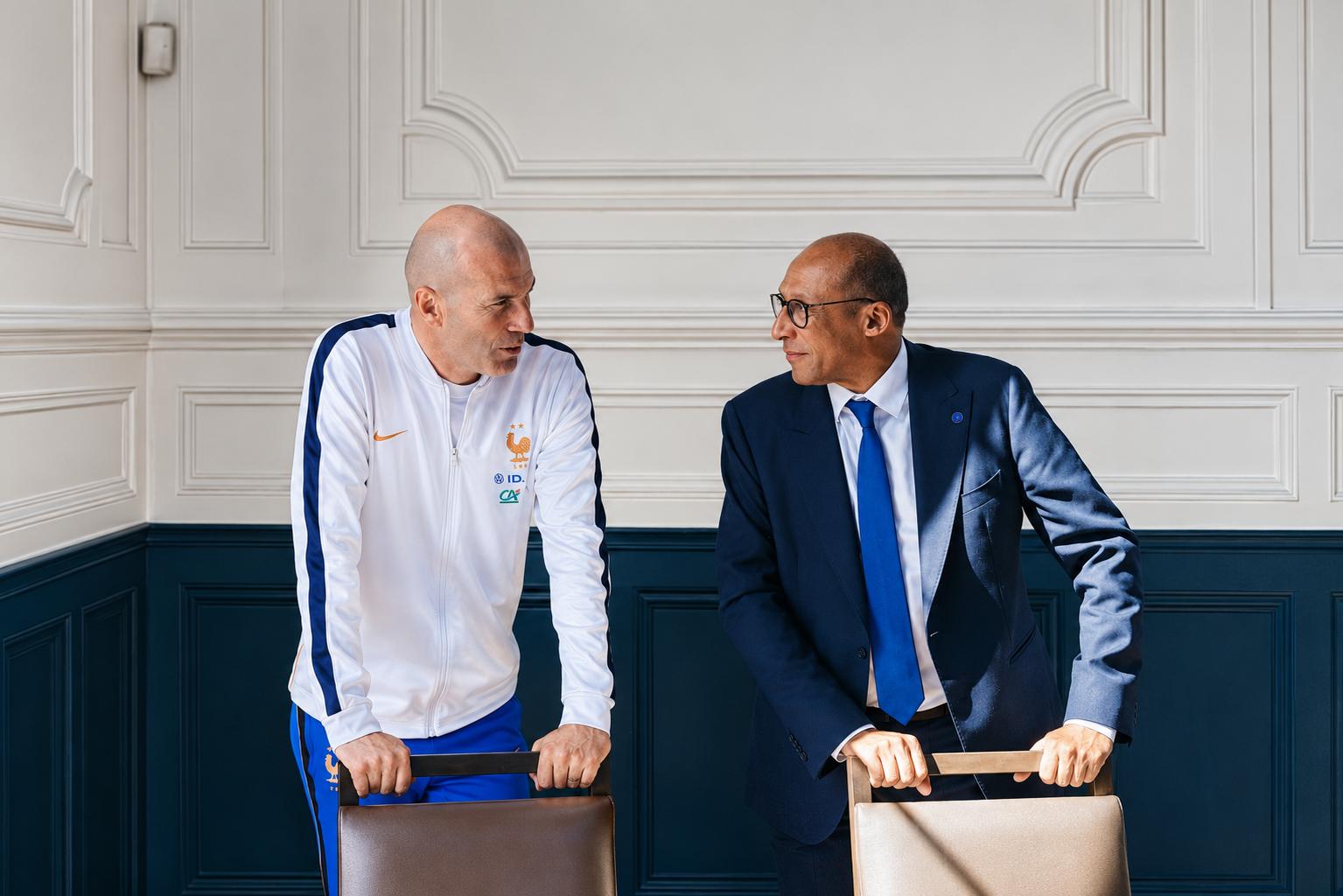
French Football Federation president Philippe Diallo has emerged as European football’s chosen challenger to FIFA president Gianni Infantino, securing UEFA’s backing in a contest in which the incumbent remains the clear favourite. The move signals a concerted European effort to challenge Infantino, whose leadership has come under mounting criticism but who retains considerable support across FIFA's continental confederations.
The Union of European Football Associations (UEFA) praised Diallo’s “extensive experience across all levels of the game”. His candidacy is due to be ratified by the French federation’s executive committee on Tuesday, with the election scheduled for March 18, 2027, in Rabat, Morocco. However, he is not the only candidate seeking to challenge Infantino, and none has yet demonstrated sufficient support to dislodge the incumbent.
Many missteps by Infantino
Infantino’s decisions have cost him support on several fronts. The biggest controversy centred on FIFA Forward Enterprise, his plan to bring private investors into a commercial entity holding rights linked to the World Cup and other FIFA competitions.
UEFA, the Asian Football Confederation (AFC) and the Confederation of North, Central America and Caribbean Association Football (CONCACAF) condemned the proposal in a joint letter in August, accusing Infantino of a “fundamental breach of trust”. The complaint was as much about the process as the money: critics said the plan had been developed without adequate consultation with the football community. Infantino subsequently abandoned the proposal and apologised for shortcomings in communication and consultation, but the damage to trust endured.
His handling of the World Cup also drew criticism after he was accused of exercising undue influence over a disciplinary decision involving US forward Folarin Balogun. US President Donald Trump acknowledged discussing the case with Infantino, after FIFA suspended Balogun’s automatic one-match ban, allowing him to play in the next match. Infantino had already faced criticism for creating a peace prize and awarding it to Trump.
UEFA has since escalated its challenge, seeking evidence through a US court proceeding in support of a possible criminal complaint in Switzerland alleging financial mismanagement at FIFA.
Divided opposition
Diallo says Infantino’s initiatives have “seriously damaged the image and the unity of football.” Although the FIFA president’s actions have drawn widespread criticism over the past year, global discontent has yet to translate into a united electoral challenge.
With several continental bodies continuing to back Infantino, his critics have struggled to find a candidate capable of mounting a credible challenge. Indeed, Diallo, 63, was not UEFA’s first choice. The body had tried to recruit a more recognisable figure from the playing or coaching world, but without success.
Diallo has, however, criticised Infantino since September, when the French federation withdrew its support for the president’s re-election bid. He said the FIFA president’s initiatives had “seriously damaged the image and the unity of football”.
Another obstacle is the absence of a united opposition. Diallo is not the only candidate seeking to challenge Infantino. Kozo Tashima, the Japan Football Association’s honorary president and a FIFA Council member, announced his intention to run earlier this month. The Guardian reported that it remained unclear whether former Tottenham Hotspur defender Ramon Vega, who had already declared his candidacy, would step aside.
Vega was the first to announce his intention to run, doing so in October. The former Switzerland international claims to have support across every continent but has not publicly identified the federations endorsing him. He has also tried to enter the race before. In 2019, he failed to secure the five national federation nominations required to qualify for the ballot.
Infantino’s electoral edge
The crowded field poses a problem for the opposition because of the electoral arithmetic. FIFA has 211 member associations, and Infantino needs a majority of votes cast to secure victory. Front Office Sports reports that Africa’s 54 associations, the Caribbean Football Union’s 25 and Oceania’s 11 are aligned behind him. The same outlet warns that Diallo, Tashima and Vega could split the opposition vote.
The sharpest blow to the anti-Infantino camp came in October. At the Asian confederation’s congress in Tokyo, president Sheikh Salman bin Ibrahim Al Khalifa pledged support for Infantino’s re-election, two months after joining UEFA and CONCACAF in criticising his commercial investment proposal. Infantino said he felt “great about the AFC’s support”.
That leaves Diallo’s best potential route through Africa, where UEFA hopes to secure votes from Francophone members of the continental confederation. The obstacle is that the Confederation of African Football (CAF) backed Infantino unanimously in April, and no formal change to that position has been announced.
There is, however, a possible sign of dissent. The Guardian reported in August that at least two African federation presidents had approached FIFA secretary general Mattias Grafström to sound out his interest in a rival presidential candidacy.
North America offers no ready-made ally either. CONCACAF has criticised Infantino but has been reluctant to endorse another candidate, with some federations reportedly preferring to boycott the election.
For now, Infantino continues to be the frontrunner.