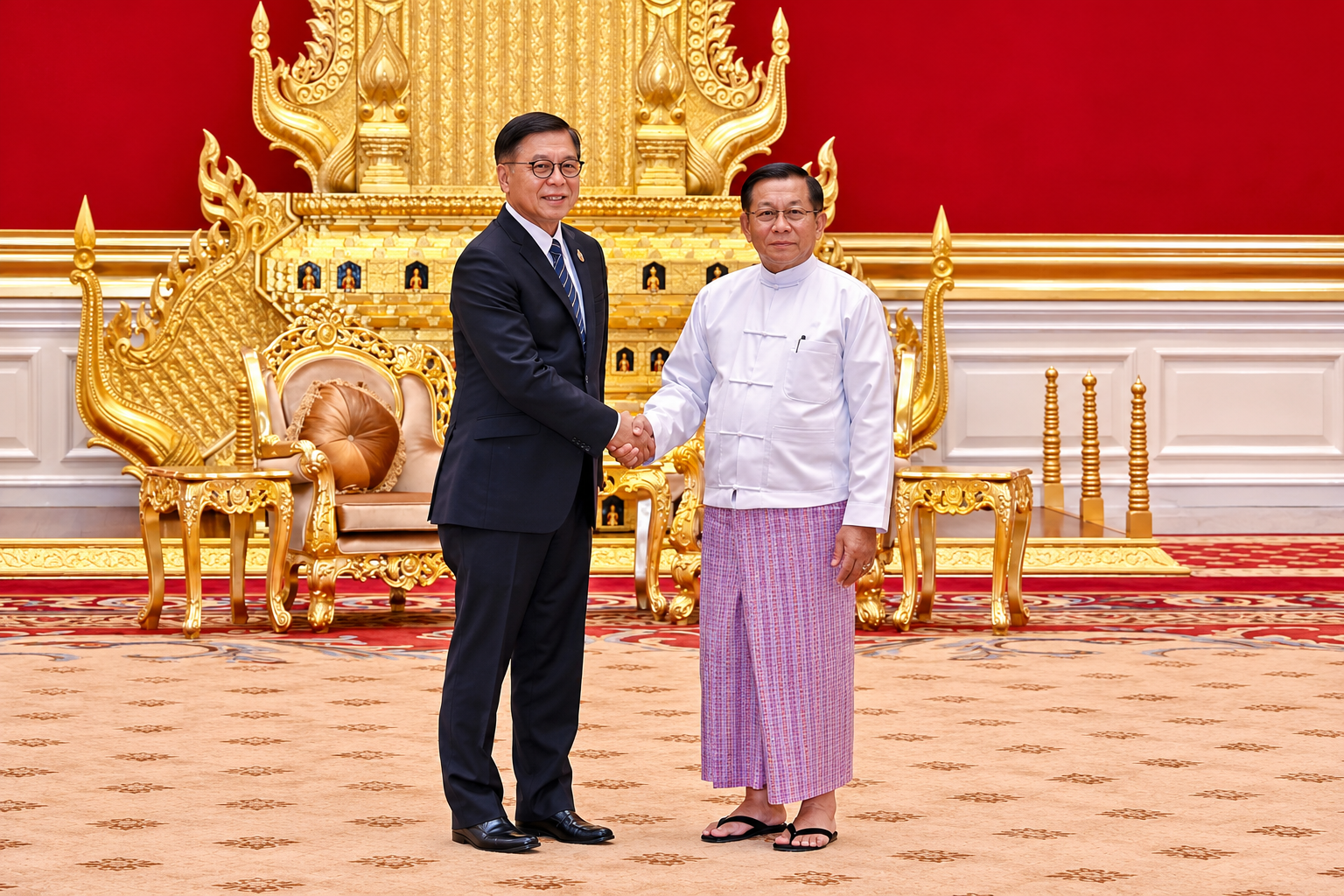
Thai Foreign Minister Sihasak Phuangketkeow travelled to Naypyidaw – Myanmar's remote, purpose-built capital located roughly 300 kilometres north of Yangon – and returned to Bangkok on the same day, in what officials described as the latest effort to keep dialogue open with the country’s ruling military council ahead of this weekend’s Association of Southeast Asian Nations summit in Manila, the Philippines.
Thailand said the stated purpose of the visit was to advance what Bangkok calls “calibrated re-engagement” – a carefully framed diplomatic posture aimed at maintaining communication channels with Myanmar’s junta without conferring outright political legitimacy upon a government that seized power in a coup on February 1, 2021, ousting the elected civilian government of Aung San Suu Kyi.
Why Naypyidaw – and why now?
Naypyidaw, which serves as Myanmar’s administrative capital and houses the country’s military headquarters, is rarely visited by foreign ministers of democratic governments. Thailand’s decision to send its top diplomat there comes days before an ASEAN summit signals Bangkok’s determination to position itself as a key interlocutor between the bloc and Myanmar's generals and to shape the terms of debate before leaders sit down in Manila.
The visit has drawn immediate criticism. Opponents of the junta and international human rights groups have argued that direct ministerial contact risks normalising a military government responsible for widespread atrocities against its own people. Thailand, however, has pushed back, maintaining that sustained engagement offers the most pragmatic path toward addressing the humanitarian emergency and cross-border security concerns that have worsened steadily since the coup.
A bloc struggling to respond
The ASEAN summit, expected to open in Manila between November 15 and 17 is set to place Myanmar at the centre of proceedings. The ten-member bloc has long struggled to mount a coherent response to the crisis, hamstrung by its foundational principle of non-interference in members’ internal affairs.
A five-point consensus agreed by ASEAN in April 2021 – calling for an immediate end to violence, inclusive dialogue among all parties, and the appointment of a special envoy – has largely stalled, leaving the grouping open to sustained criticism that it has failed to halt continuing bloodshed inside Myanmar.
Regional powers recalibrate
Thailand’s visit is part of a broader regional shift. Myanmar has seen a marked increase in high-profile diplomatic exchanges in recent weeks, with China, India, Malaysia, and other neighbouring countries all stepping up contact with Naypyidaw – a sign that regional powers are recalibrating their positions as the conflict grinds on and pressure mounts for some form of political resolution.
India's engagement is particularly significant. New Delhi, which shares a roughly 1,600-kilometre border with Myanmar, has maintained contact with the junta while simultaneously managing relationships with democratic partners and containing fears of instability spilling across its north-eastern frontier. Its continued participation in diplomatic exchanges alongside China and ASEAN member states suggests that the broader regional consensus is tilting toward managed engagement rather than isolation.
ASEAN divided over Thailand’s outreach
Thailand’s outreach has exposed growing differences within ASEAN over how to deal with Myanmar’s military-backed leadership. While Thailand, Malaysia, Cambodia, Vietnam and Laos have stepped up bilateral engagement with Naypyidaw, other members remain cautious about restoring the junta’s political standing within the regional bloc without tangible progress towards peace.
The Philippines, which holds ASEAN’s rotating chairmanship, has stressed that the bloc is not easing its position under the Five-Point Consensus, with its special envoy and Foreign Secretary Ma. Theresa Lazaro saying that proposals to allow Myanmar’s foreign minister to attend high-level ASEAN meetings remain under discussion and that no decision has been taken.
Thailand, meanwhile, wants Myanmar’s foreign minister readmitted to such meetings, arguing that direct engagement could help convey ASEAN’s concerns to the country’s decision-makers. The differing approaches have raised concerns among analysts that bilateral outreach could weaken the bloc’s collective leverage and allow Myanmar’s military-backed government to regain diplomatic legitimacy without making meaningful concessions.
Thailand’s complicated position
Of all ASEAN’s member states, Thailand occupies one of the most delicate positions in the Myanmar debate. Bangkok shares a long border with Myanmar and hosts a significant population of displaced persons who have fled the conflict – estimates suggest more than 100,000 people have sought refuge on Thai territory. That reality gives Thailand both a direct stake in stability and a vulnerability to any escalation.
By pressing ahead with ministerial-level contact days before the Manila summit, Bangkok appears to be signalling that it intends to play an active role in determining what framework, if any, emerges for managing ASEAN's relationship with Myanmar's military government going forward.
What happens in Manila
Whether Thailand’s approach of cautious, incremental engagement produces measurable progress, or whether it is seen by the junta as a signal that international pressure is easing, is a question the Manila summit will be forced to confront, even if it cannot definitively answer it. Some ASEAN member states are expected to push for firmer conditions attached to any normalisation of Myanmar’s standing within the bloc, while border states, including Thailand, have consistently prioritised stability and economic continuity.
What is clear is that four years after the coup, the region has yet to find a formula that works – and time, for the millions of civilians caught inside Myanmar’s conflict, is not a resource in plentiful supply.