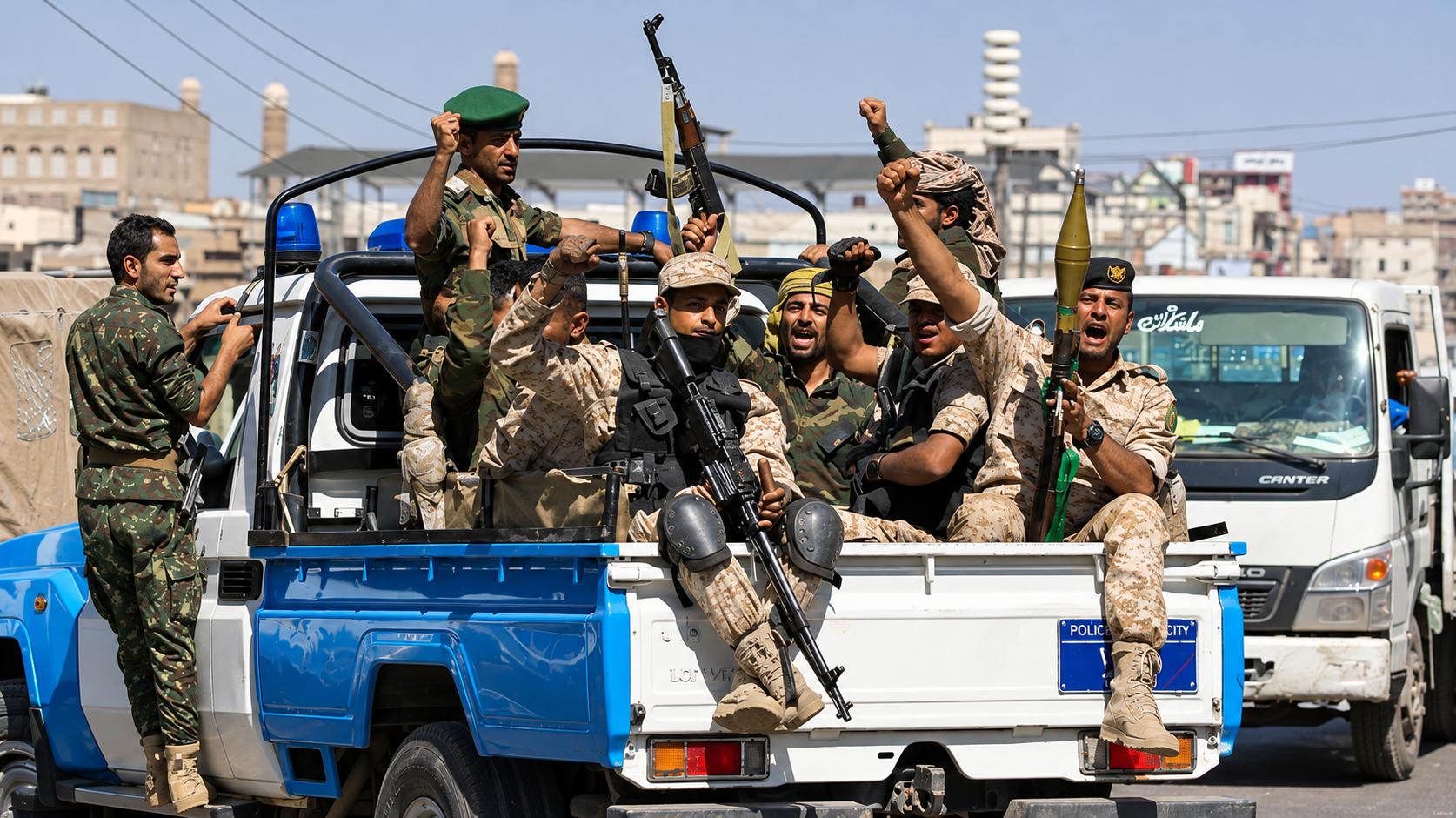
The Houthi forces, or the Ansar Allah movement, are pressing ahead in Yemen’s civil war, increasingly gaining ground by driving back the Saudi Arabia-backed Yemeni government forces. AFP reported that the Houthis are now 60 km from Aden, the seat of Yemen’s internationally recognised government, after seizing parts of Lahj province and taking over Red Sea territory that government-aligned troops vacated on Sunday (November 15).
Four military sources and two government sources told AFP that the Houthis had taken two districts in Lahj and were positioned at the Al-Kharaz camp in Al-Madariba. They have also taken the mountainous Al-Maqatirah area, through which the main road linking Aden to the besieged city of Taiz runs.
Announcing their retreat, the Saudi-backed Southern Armed Forces said they were repositioning away from the Bab el-Mandeb Strait to secure Aden and neighbouring governorates and strengthen the frontlines. They also said they aimed to end the siege of Taiz, Yemen’s third-largest city, with nearly two million people. This redeployment has allowed the Houthis to retake positions along more than 150 km of the Red Sea coastline, from Dhubab to near Khor Amira. Reuters, citing government military sources, reported that the troops fell back to Al-Sukya, about 150 km west of Aden, while analysts described the so-called “redeployment” as effectively a withdrawal.
How the coast was lost
The retreat of Yemeni government forces is the latest step in a collapse that began in September. The Houthis launched offensives along three axes from September 3 (western Taiz, southern Hodeidah and Mocha itself) and captured Mocha on September 10 after National Resistance Forces withdrew at dawn. The port was the last harbour fully under government control. By September 11, Houthi forces had also taken Dhubab and reached Perim Island in the strait. The Hanish archipelago followed after hundreds of government-allied troops pulled out, with the Houthi gains coming with seemingly little resistance.
The Houthis described the offensive to retake the Bab el-Mandeb Strait as a “national operation” to assert Yemeni sovereignty. The government framed it differently. Rashad al-Alimi, head of the Presidential Leadership Council, said the strait was a regional and international concern and must not become another Hormuz. The warning reflects the stakes: the Bab el-Mandeb links the Red Sea to the Gulf of Aden and carries a large share of trade between Asia and Europe. The fall of Perim Island was described as opening a new front in the wider 2026 Iran war.
A war in its second decade
The Yemen civil war began in 2014, when the Houthis, a Zaidi Shia movement from the northern highlands, took Sanaa and drove the government of President Abd Rabbu Mansour Hadi south to Aden. A Saudi-led coalition intervened in March 2015 to restore him. The Houthis’ early bid to capture Aden failed, but the coalition never dislodged them from the north, where most of Yemen’s population lives. Over the years, however, the Houthis have grown into a formidable force with their own arsenal of drones and ballistic missiles.
The war settled into a grinding stalemate and became one of the world’s worst humanitarian crises. The UN-brokered truce of April 2022 and the creation of the eight-member Presidential Leadership Council (PLC), which replaced Hadi, left the country as divided as before. The truce held in practice for years, although its formal terms lapsed, until it fell apart in July this year. The UN says more than 1,600 people have been killed and over 300,000 displaced since fighting resumed.
Why the government keeps losing
While the Houthis have grown stronger through the seven wars they have faced so far, government forces continue to weaken. Analysts point to a cluster of problems that predate this offensive and reinforce one another.
There is no single army. The Presidential Leadership Council (PLC) was meant to unite the anti-Houthi camp, but it remains a coalition of armed factions with separate patrons, paymasters and agendas. Tareq Saleh’s western-coast forces, for example, operate separately from other government units. Yasmine al-Eryani of the Sana’a Centre for Strategic Studies said the government had remained largely on the defensive before Mocha fell. Without a central command capable of moving units, sharing intelligence or ordering a stand, each faction tends to guard its own turf, and a pullback by one exposes its neighbours.
The Saudi-UAE rupture broke the coalition’s spine. In early December 2025, the UAE-backed Southern Transitional Council (STC), a separatist group represented on the PLC, moved to seize large parts of Hadramawt, Yemen’s largest governorate and home to significant oil resources. The STC said it was responding to a Saudi-backed tribal alliance taking control of an oil field there. Analysts say the real aim was the province’s oil, which its leaders see as essential for a viable breakaway southern state. The Sana’a Centre adds that the STC would not have challenged Saudi Arabia without strong Emirati backing.
Following this sudden move, Saudi Arabia struck STC-linked forces at Mukalla port on December 30. The UAE immediately announced its withdrawal from Yemen, and the STC announced its dissolution on January 9. STC chairman Aidarous al-Zubaidi was expelled from the PLC and charged with treason. Riyadh won the contest, but the cost was high. The UAE had armed, trained and paid some of the best-organised southern units. An STC representative argues that the UAE’s exit broke the deterrence that had held the Houthis back. The STC has since relaunched under a new name, while the PLC remains deeply fractured. A southern movement whose fighters see the government as a rival cannot be counted on to fight and die for it.
The ranks are hollow. Mohammed al-Basha of the US-based advisory firm Basha Report told AFP that fragmented command, factional rivalry and “ghost soldiers” (names on payrolls, but not on the battlefield) have left the government unable to open new fronts or regain the initiative. This pattern was evident at Mocha. According to reports, the Houthis found government units depleted and padded with ghost soldiers, while forces that asked Saudi Arabia for air support received none. Payroll padding is a symptom of a deeper problem. Commanders who draw salaries and supplies for phantom soldiers have little incentive to risk losing them, while soldiers who are unpaid or underpaid have little reason to stay at their posts. The government has also been starved of revenue since Houthi drone attacks on oil terminals halted crude exports in 2022.
Motivation is lopsided. The Houthis are ideologically driven, centrally led and fighting on home ground. They also have the advantage of numbers. In September, large numbers of fighters were moved from Sanaa and central Yemen towards the coast. Their opponents, meanwhile, are a patchwork of factions with competing visions. Some want a united Yemen, others an independent south, while still others seek to protect a particular province or militia. Many defenders of the coast are southerners or Tihama locals with little stake in preserving the Aden-based government’s authority.
The patron is distracted and cautious. Saudi Arabia wants the Houthis contained and its own territory and oil facilities protected, but has been reluctant to commit ground forces or push for an outright victory. Meanwhile, the Houthis continue to launch attacks on Saudi territory. A government that depends on Riyadh for money, air cover and political direction is only as resolute as its backer. Officials acknowledge the damage. PLC member Sultan al-Arada called the collapse of forces at Mocha and elsewhere on the west coast “painful and regrettable”.
What comes next
Though the Houthis have recorded victories against fractured and corrupt government forces with relative ease, capturing Aden may prove difficult. It is a city of more than a million people, with sandbag defences and tunnels being built around it, and is the last major prize the government holds. The Houthis tried and failed to take it in 2015, and an advance on a large urban area would stretch their supply lines.
However, the government will need a unified command, loyal troops and a willing Saudi air force to hold Aden, and as of this week, none of the three is guaranteed. Despite making tall claims, government forces have so far failed to advance or defend their territory effectively and continue to lose territory to Houthis.