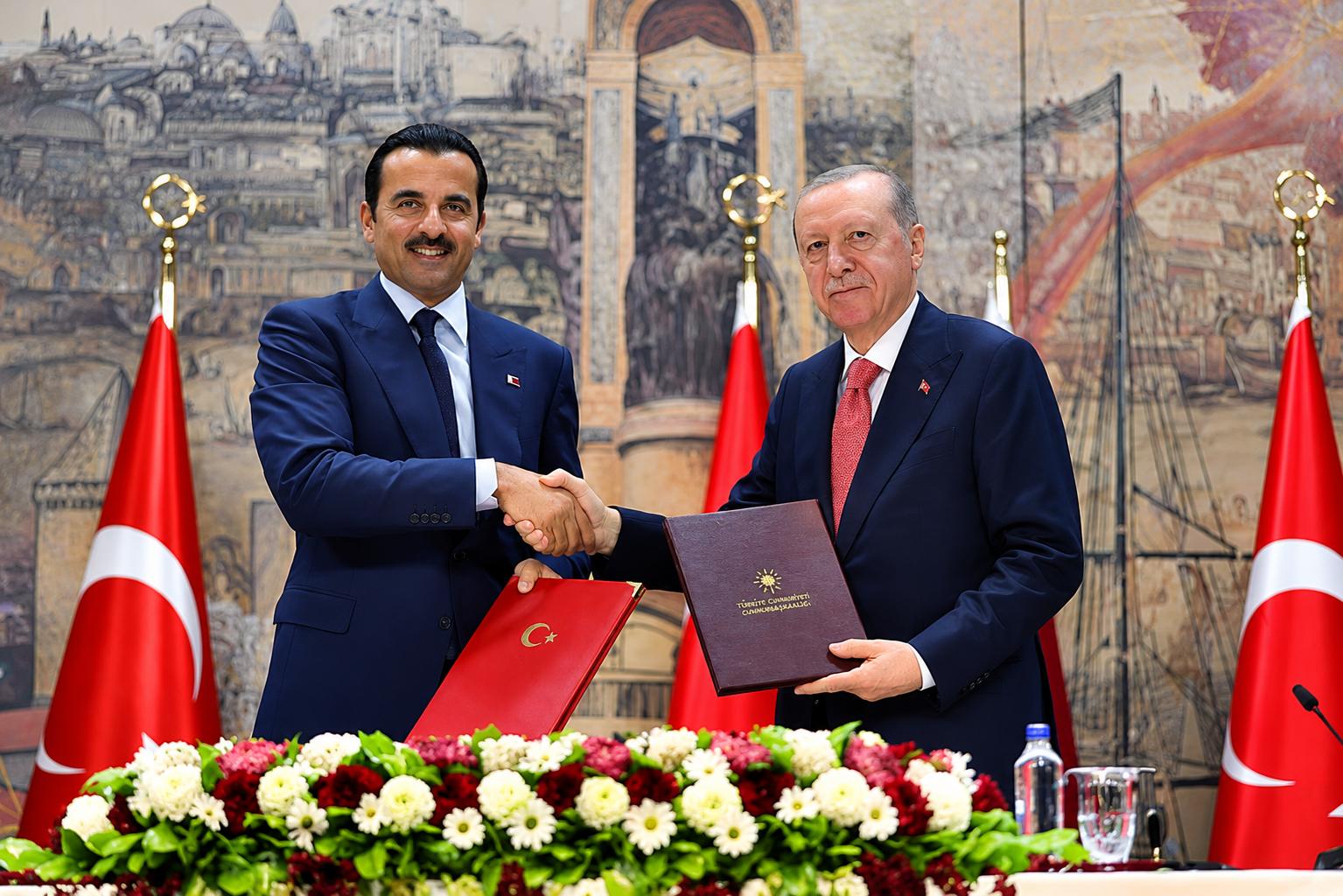
Turkey and Qatar signed a mutual defence agreement on Friday (November 13), pledging a unified stance against any external armed attack on either country. The two countries agreed to consult on threats to their security, regional and global security issues, defence policy, and to expand cooperation through joint military exercises, defence-industry projects and training exchanges for personnel. President Recep Tayyip Erdogan and Emir Sheikh Tamim bin Hamad Al Thani signed the agreement in Istanbul.
The deal comes as the Iran war enters its ninth month, after a Saudi-Pakistan-Turkey Mecca Defence Pact in August and a four-nation Badr defence-industry accord in October. Neither side has disclosed the details of the pact. The pact was one of five agreements signed at the 12th meeting of the Turkey-Qatar Supreme Strategic Committee, held at Istanbul’s Dolmabahce Presidential Office. Turkey’s official Anadolu news agency says the pact covers trade, education, diplomacy and defence. The Emir travelled to Istanbul after attending the COP31 climate summit in southern Turkey.
What “mutual defence” means
Both countries issued a joint communique on the occasion. The public language in the agreement calls for a “unified position” against external attack. It does not explicitly say whether an attack on one country would trigger an automatic military response. The text of the agreement has not been released, so that question is open. The communique said the security deal aims to strengthen collective defence, promote regional security and establish a common position against external armed attacks targeting either or both countries.
Analysts told Al Jazeera the pact is about deterrence. Abdulla Banndar Al-Etaibi of Qatar University said the goal is not an alliance against any particular country but to raise the cost of aggression so others are deterred. He said cooperation already rests on a Turkish military presence, joint training and defence manufacturing, and is moving to a more advanced level. Security analyst Yusuf Alabarda told Al Jazeera that Gulf states, and Qatar in particular, have concluded their US security guarantees are not working properly. He said Turkish weapons and air defences could be deployed to Qatar in the near term, and that the pact would help advance those military deals.
Why defence manufacturing matters
The communique also welcomed the Badr memorandum, describing it as a step towards collective defence by developing indigenous capabilities, including joint production, technology development, information sharing, and stronger supply chains. Badr memorandum is an agreement between Turkey, Qatar, Pakistan and Indonesia.
Al-Etaibi said disruption to navigation in Hormuz has made foreign military supply chains harder to rely on, so producing weapons locally and securing spare parts is now a strategic necessity. Mahjoob Zweiri, a Middle East policy expert, said joint manufacturing marks an advanced strategic stage, but requires billions of dollars in investment and mutual trust over technology transfer.
A relationship already on a war footing
Turkish troops are already in Qatar. Turkey first deployed forces there in 2017 under a 2015 pact. In March, the Turkish Defence Ministry confirmed its soldiers operate in Qatar under the Qatar-Turkey Joint Forces Command. The new pact formalises a partnership that was already close. The urgency comes from the war. Iran attacked Al Udeid Air Base, the biggest US base in the Middle East, during the war that erupted on February 28. Iran has struck it several times since.
Turkey and Qatar have set up the Supreme Strategic Committee under an agreement signed on December 19, 2014. Turkish contractors have carried out 206 projects in Qatar worth $20.8 billion, the communique said. The two sides reiterated a $5 billion bilateral trade target and pledged closer energy cooperation, particularly on liquefied natural gas. They also pledged to counter terrorism in all its forms. Zweiri said the pact reflects a high level of trust built through political and security tests since 2014.
The other two pacts
Friday’s deal is the third defence arrangement involving Turkey and Muslim-majority partners since August.
Mecca pact: On August 7, Saudi Arabia, Turkey and Pakistan signed the Mecca Joint Defence Agreement, under which an armed attack on one is treated as an attack on all three. AP described it as mirroring NATO’s Article 5. No signatory may withdraw during the first 10 years after it takes effect. In October, Turkey and Pakistan agreed to deploy troops to Saudi Arabia under the pact.
Badr accord: On October 21, Pakistan, Qatar, Turkey and Indonesia signed the Badr memorandum in Doha, aimed at cooperation in military production, capabilities, technical training and research and development. Unlike the Mecca Agreement, Badr does not establish a mutual-defence commitment.
What could come next?
Ankara and Doha say the way forward on the war is diplomacy. Their communique said the war on Iran and its regional repercussions must be resolved through dialogue and diplomacy and called for the swift and full resumption of safe, unimpeded passage through the Strait of Hormuz. The Turkish presidency said Erdogan told the Emir the two countries would keep working to prevent a resurgence of war in the Gulf and lay the basis for dialogue and peace. He added that the two sides were working to develop and diversify their energy partnership, and that defence-industry cooperation would continue to grow.
On the defence side, the partnership could widen. Ozcan Tikit, a foreign affairs analyst at Anadolu, the Turkish official news agency, expects cooperation to expand to missile defence systems, drones and armoured vehicles, with Qatar possibly joining advanced Turkish air defence projects. He said some manufacturing projects could extend to Saudi Arabia and Pakistan, but stressed these are future possibilities, not projects announced in the agreement.
However, none of these amounts to a break with Washington. Ankara has said the Mecca pact is not aimed at any other country. After the Iranian strikes, Qatar said it wanted deeper security cooperation with the US. One Al Jazeera analysis argues the US will likely remain the Gulf’s most important security partner while Gulf states build overlapping partnerships with Turkey, Britain, France and others.