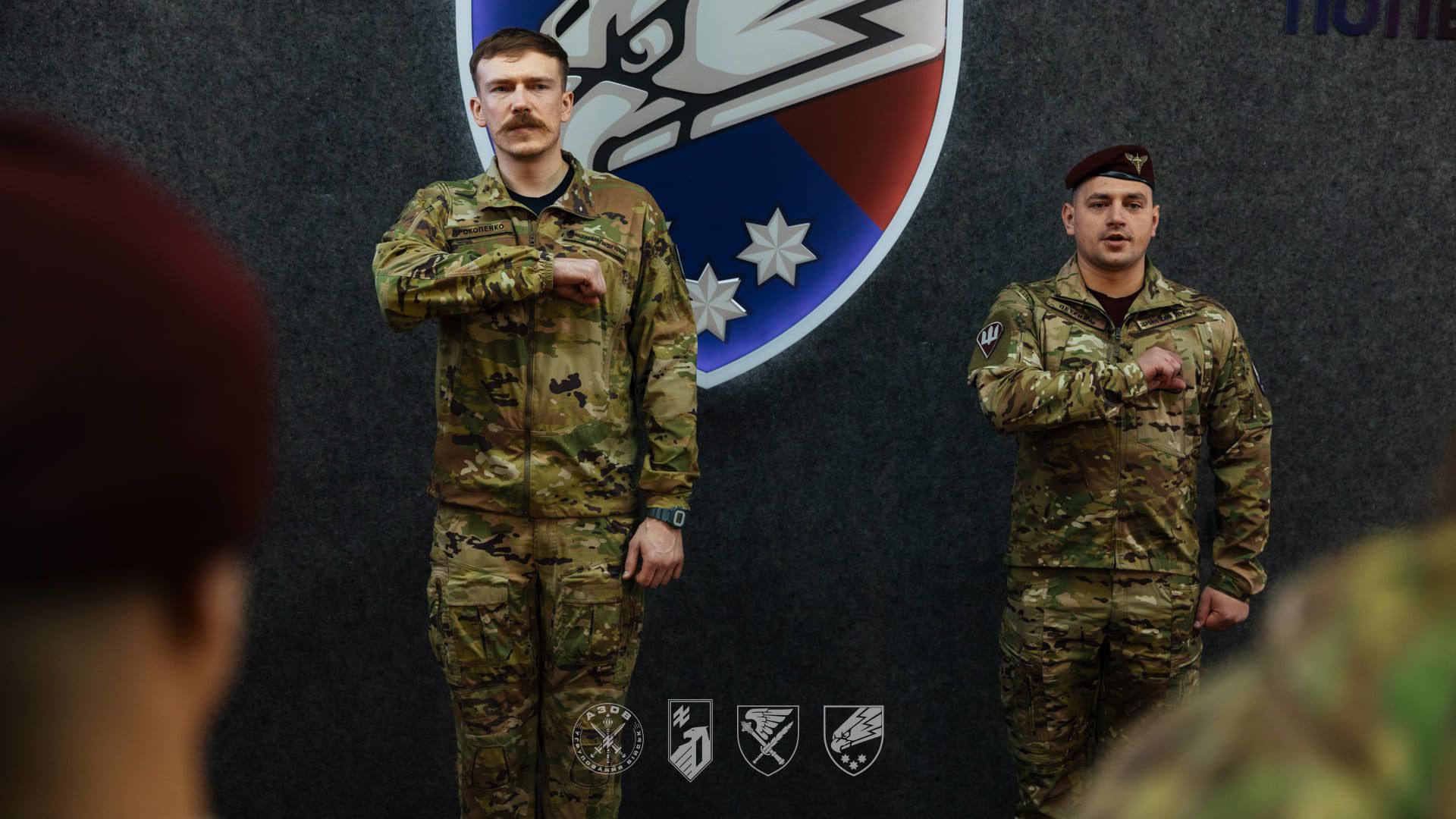
Ukraine's anti-corruption campaign has taken an unusual turn, with two of its leading anti-graft institutions partnering with the country's controversial Azov military formation to mobilise assistance for troops fighting Russia. The National Anti-Corruption Bureau of Ukraine (NABU) and the Specialised Anti-Corruption Prosecutor's Office (SAPO) announced the agreement on November 17, joining the National Guard's 1st Corps Azov and its fundraising organisation, AZOV.ONE, under an initiative called 'Sword of Damocles'.
Under the initiative, NABU and SAPO will mobilise resources for Azov troops deployed on the front lines. The announcement did not specify the funding arrangements, equipment to be supplied or scale of assistance. SAPO described the programme as a reminder that "responsibility is inevitable", linking the pursuit of corruption with support for Ukraine's armed forces. The partnership has attracted attention because of Azov's origins in Ukraine's far-right nationalist movement and the controversy surrounding its early members and ideology. It also comes amid high-profile corruption investigations involving senior Ukrainian officials, law-enforcement personnel and individuals linked to President Volodymyr Zelenskyy's political establishment.
From anti-corruption investigations to military assistance
The memorandum brings together institutions with markedly different responsibilities. NABU investigates high-level corruption, while SAPO oversees prosecutions in cases the bureau handles. Azov is a military formation within Ukraine's National Guard, whose 1st Corps comprises several operational brigades. AZOV.ONE is a fundraising organisation associated with the formation. The arrangement is significant because it brings anti-corruption institutions into a formal partnership with a military fundraising network as Ukraine struggles to sustain its war effort while confronting allegations of corruption within its own state machinery.
A controversial military legacy
Azov's history dates to 2014, when it emerged as a volunteer battalion amid the conflict in eastern Ukraine following the overthrow of President Viktor Yanukovych. Its early membership included far-right nationalists, some associated with organisations that openly embraced ultranationalist and neo-Nazi ideologies and symbols. The formation subsequently became part of Ukraine's National Guard, a military force with law-enforcement responsibilities.
Azov gained international prominence during the 2022 defence of Mariupol, particularly the resistance at the Azovstal steelworks, where Ukrainian fighters held out against Russian forces. It has since undergone significant expansion. In March 2025, Ukraine established the 1st Corps Azov, with the 12th Special Forces Brigade Azov serving as its foundation.
The formation now encompasses multiple National Guard brigades and is considerably larger than the original volunteer battalion. Its origins, however, remain politically contentious. Russia has repeatedly invoked Azov's early far-right associations to portray the Ukrainian government as being controlled by neo-Nazis, using the claim to justify its invasion.
But far-right elements in Azov's early history are documented and cannot simply be dismissed as Russian propaganda. Despite the controversy, the US State Department has agreed to assist by exempting certain human rights-compliance requirements.
A precedent involving a nationalist fundraiser
The Azov agreement follows another partnership between NABU, SAPO and prominent Ukrainian nationalist activist Serhiy Sternenko. Earlier in November, the two anti-corruption institutions signed a memorandum with the Serhiy Sternenko Community Foundation, which raises funds for military equipment.
Sternenko is a well-known activist and military fundraiser who has maintained links with senior Ukrainian officials. He previously served as an adviser to Mykhailo Fedorov, who has held several ministerial portfolios.
Under the arrangement, resources linked to criminal proceedings are being directed through the foundation to military assistance. The foundation reported receiving 56.89 million hryvnias under these arrangements. It said the money helped finance the purchase and delivery of 2,060 FPV drones, 25 interceptor drones designed to counter Russian Shahed-type unmanned aerial vehicles and an unmanned aerial vehicle system. The foundation disclosed these figures, which have not been independently audited in the public announcement.
The arrangement has also raised questions about the precedent it could establish. Critics have questioned whether allowing defendants to make charitable contributions to military organisations as part of negotiated settlements could create the perception that wealthy suspects can secure favourable treatment by financing the war effort.
Corruption investigations put pressure on Zelenskyy's government
The partnerships come as NABU and SAPO pursue investigations exposing alleged corruption across Ukraine's political, energy and law-enforcement establishments.
One major investigation, Operation Midas, concerns alleged corruption involving Energoatom, the state-owned nuclear power company. The case has drawn attention to suspected financial networks involving individuals close to the country's political establishment.
Other investigations have targeted serving and former officials, including individuals linked to the Presidential Office and security institutions. In another case, investigators exposed an alleged criminal network involving compromised Ukrainian officials and organised crime figures. The suspected activities included scam-call centres, drug trafficking, racketeering, abductions and other criminal operations.
The investigations have highlighted the difficulties facing Ukraine's anti-corruption institutions as they pursue powerful individuals and networks during wartime. NABU has previously accused the Security Service of Ukraine (SBU) of illegally wiretapping its detectives and obstructing investigations. The agencies have also clashed over the custody of suspects. Against this backdrop, the new partnership with Azov adds another dimension to Ukraine's increasingly complicated institutional landscape.
The accountability question
Mobilising additional resources for Ukraine's armed forces is an urgent priority. Private fundraising organisations have played an important role in procuring drones, communications equipment and other military supplies. But involving anti-corruption institutions in military fundraising raises questions about transparency, oversight, and the separation of institutional responsibilities.
The Sword of Damocles initiative may provide additional resources to Ukrainian troops. Its longer-term significance, however, will depend on how transparently it operates and whether it maintains the distinction between prosecuting corruption and financing military operations. For institutions established to strengthen the rule of law, the challenge is not merely to help Ukraine win the war. It is also to ensure that pursuing that objective does not compromise the accountability standards they were created to defend.