Germany's longstanding support for Israel’s oppression of Palestinians is finally facing pressure, with growing public opposition to its military campaign in Gaza, protests against arms exports, dissent within the governing coalition and confrontations at public rallies increasingly exposing the divisions. Nearly half of Germans now believe Israel's killings in Gaza amount to genocide, according to a government-commissioned study by the University of Konstanz.
The annual report, published on October 7, found that 49 per cent of Germans held this view, compared with 28 per cent in 2023. The shift is particularly pronounced among younger Germans. Among students, the proportion who believe Israel's killings amount to genocide rose to 65 per cent, from 37 per cent in 2023. Support for boycotting Israeli products among young people also rose to 41 per cent, up from 26 per cent in 2023.
Yet the growing criticism of Israel has not necessarily translated into an environment where people feel free to express their views. More than 63 per cent of young Germans said they feared being branded antisemitic for speaking out against Israel, according to an El País report. The findings point to a widening gap between Germany's established political position on Israel and the attitudes of sections of its population, particularly younger people, as the war in Gaza continues to shape domestic political debate.
Palestinian flag on Reichstag
The changing mood has increasingly manifested itself in public protests and confrontational political actions. On November 8, a 22-year-old man removed the German flag outside the Reichstag in Berlin and replaced it with a Palestinian flag, while two fellow activists filmed the action. The activist group Peacefully Against Genocide claimed responsibility for the protest, which was streamed on TikTok. Police detained the man and two others. The man, a student from Heidelberg, later told Al Jazeera that he wanted to send a direct message to lawmakers over Germany's position on the war in Gaza.
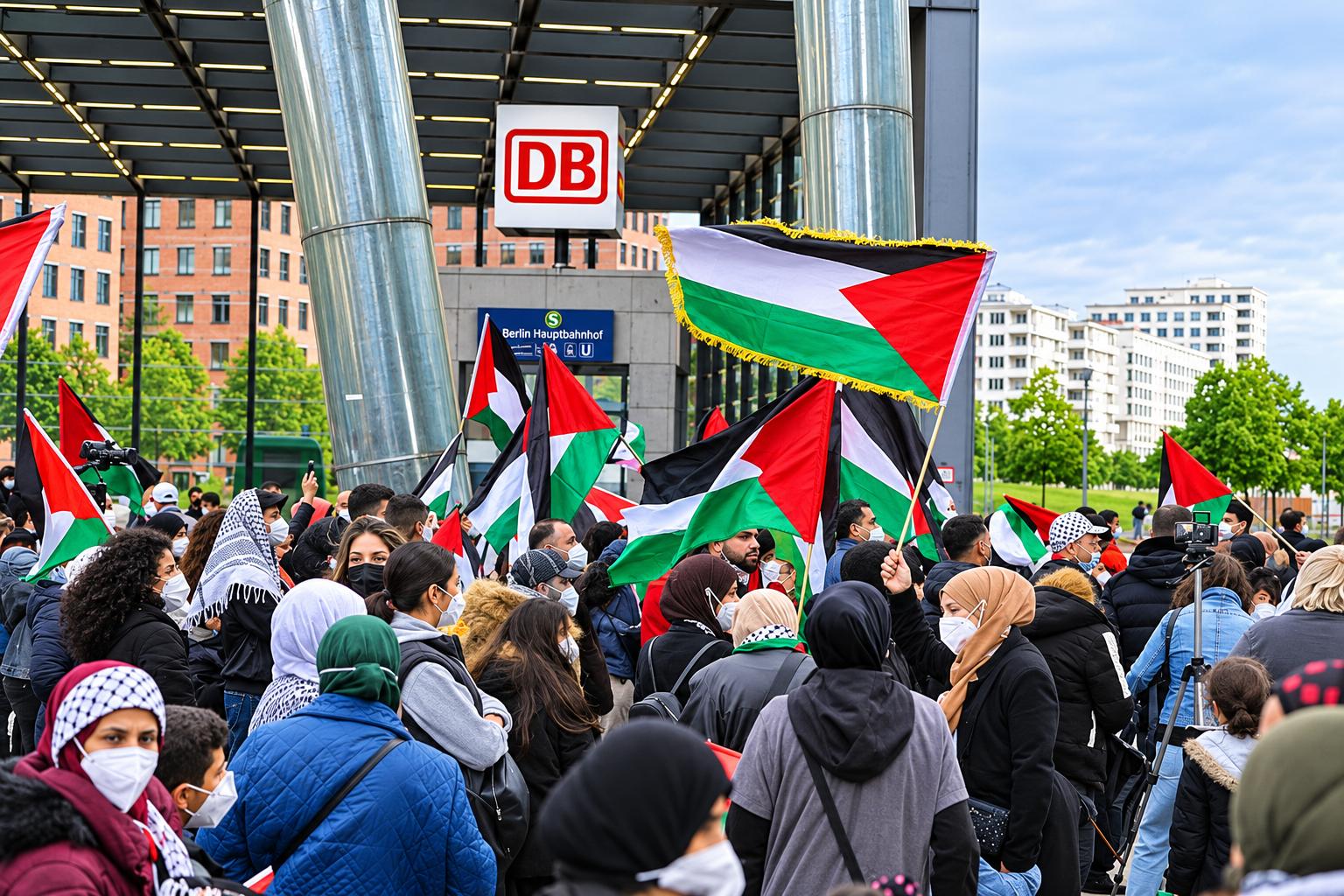
The action triggered condemnation from senior political figures. Bundestag President Julia Klöckner of the Christian Democratic Union (CDU) demanded better protection for parliament and described the perpetrators as "Palestine chaos-makers". Berlin Mayor Kai Wegner said the act demonstrated contempt for democracy. Klöckner subsequently expressed anger that the incident had generated so little public outrage, reflecting a wider concern among some pro-Israel politicians that Germany's political and social climate is changing in ways that are increasingly unfavourable to their position. The flag protest came amid a series of demonstrations against Germany's support for Israel. A day earlier, hundreds of demonstrators marched in Berlin against German arms supplies to Israel, under a heavy police presence, Anadolu reported.
Dissent within Merz's coalition
The pressure is also coming from within the governing coalition, where disagreements over how Germany should respond to Israeli actions have become more visible. Adis Ahmetovic, foreign policy spokesman for the Social Democratic Party (SPD), the junior partner in the coalition government led by Chancellor Friedrich Merz's CDU, said in October that Germany must consistently defend human rights. He called for sanctions against those responsible for settler violence in the West Bank and argued that German weapons must not be used in violations of human rights.
The SPD has accused the CDU of obstructing a common European approach that would exert greater pressure on Israel, El País reported. The disagreement highlights the growing tension between Germany's longstanding commitment to Israel and calls within sections of the governing political establishment for a more critical approach. The divisions have also surfaced at the European Union level, where Berlin has resisted efforts to impose greater economic pressure on Israel.
In April, Germany and Italy blocked an initiative by Spain, Slovenia and Ireland to suspend the EU's trade agreement with Israel. In July, Amnesty International said a majority of EU member states, led by Germany and Italy, continued to oppose suspending the agreement. Berlin has argued that strong sanctions could provoke a significant backlash from Israel. Germany has also emphasised its humanitarian assistance to Palestinians, with the Foreign Ministry saying it has provided €375 million in aid to the Palestinian territories, more than any other country. The dispute over the trade agreement has become one of the clearest examples of Germany's influence in preventing a stronger EU response to Israel, even as several European governments seek to reconsider their relations with Tel Aviv.
Pro-Israel voices face resistance
The changing political atmosphere has also unsettled prominent supporters of Israel within Germany’s political establishment. Michael Roth, who chaired the Bundestag Foreign Affairs Committee until 2025, told Israeli newspaper Maariv that defending Israel had become increasingly difficult within the SPD, even for senior politicians who continued to support Israel privately. Roth attributed the shift to what he described as a postcolonial worldview that increasingly portrays Israel as an oppressor, images from Gaza that Hamas had exploited, and politicians’ calculations about electoral pressures.
He argued that German supporters of Israel must win the debate within their own country rather than expecting Israel to persuade German public opinion. Roth also urged Israel to take action against settler violence in the West Bank, while insisting that Israel still had more supporters in Germany than the increasingly heated public debates might suggest. His remarks reflect concerns among pro-Israel politicians that the challenge is no longer confined to demonstrations or criticism from opposition parties but is increasingly affecting political discourse within established parties that have traditionally supported Israel.
Greens face heckling
The political tensions have extended beyond the SPD and the CDU to the Green Party, which has also faced confrontations over its position on Israel. Party leader Felix Banaszak was heckled by masked protesters at a Berlin 'Gen Z Decides' rally on November 21 and was forced to leave the gathering, Die Welt reported. Police estimated that about 4,000 people attended the rally. The initiative’s main demands focused on education funding, climate action and opposition to conscription. However, the protest also became a platform to criticise established political parties for their positions on Gaza. Protesters accused the Social Democrats of betrayal and the Greens of complicity, while chanting "Viva Palestine". The presence of Palestine-related slogans and accusations at a rally primarily focused on domestic policy also underscores how the issue has moved beyond foreign-policy discussions and into wider political activism.
Germany officials line still intact
Despite the growing criticism, Germany's political establishment continues to defend its strong support for Israel, rooted in the country's responsibility for the Holocaust and the commitment to ensuring Israel's security. Supporters of the government's approach argue that Germany's relationship with Israel is not simply a policy choice but a fundamental element of its post-war political identity. Kurt Wansner, a veteran Berlin CDU lawmaker, told El País that many pro-Palestinian demonstrations were driven largely by foreigners reacting against Germany's historical responsibility.
Stefan Evers, the CDU's Berlin leader, told the city’s parliament on November 12 that Israel's existence was the German state's raison d'être. The argument has, however, increasingly been challenged by politicians and activists who say Germany’s historical responsibility should also entail defending universal human rights and applying the same standards to Israel as to other states. Rouzbeh Taheri of the Left party argued that most young Germans no longer share what he described as the unconditional solidarity with Israel exhibited by many politicians and media organisations.
The disagreement is increasingly about how Germany should interpret its historical responsibility: whether it primarily requires unwavering support for Israel's security or whether it also demands a stronger response to the humanitarian consequences of Israel's military operations and actions in the occupied territories.
Pro-Israel policy under growing scrutiny
Germany's support for Israel since the Hamas attack of October 7, 2023, has remained substantial, even as public debate has become more polarised. In November 2023, then Air Force chief Lt Gen Ingo Gerhartz visited Israel. In an interview, he told the Jerusalem Post that Israel's air force was among the “most professional and precise in the world”.
Germany has also taken a restrictive approach to certain slogans associated with the Palestinian movement. Authorities in several parts of the country have banned the phrase "From the river to the sea" at demonstrations, citing concerns about its association with calls to eliminate Israel. The legality of the slogan, however, has been contested in German courts. Courts in Münster and Cologne ruled in 2023 that its use was lawful in certain contexts, while the Düsseldorf Administrative Court upheld a ban, reflecting the continuing legal and political debate over how Germany balances freedom of expression with the protection of public order and its obligations to combat antisemitism.
The growing criticism of Israel does not mean that Germans have abandoned support for Israel's existence. A majority still consider it important that Germany supports Israel's right to exist, even as attitudes towards the Israeli government's military conduct, the war in Gaza and Germany's arms exports are increasingly divided. Germany’s Israel policy is therefore facing a more complicated domestic landscape than it did in the immediate aftermath of October 7, 2023. The country’s historical commitment to Israel remains deeply embedded in its political establishment, but growing public opposition, generational differences, protests and disagreements within the governing coalition are increasingly challenging how that commitment is translated into policy.