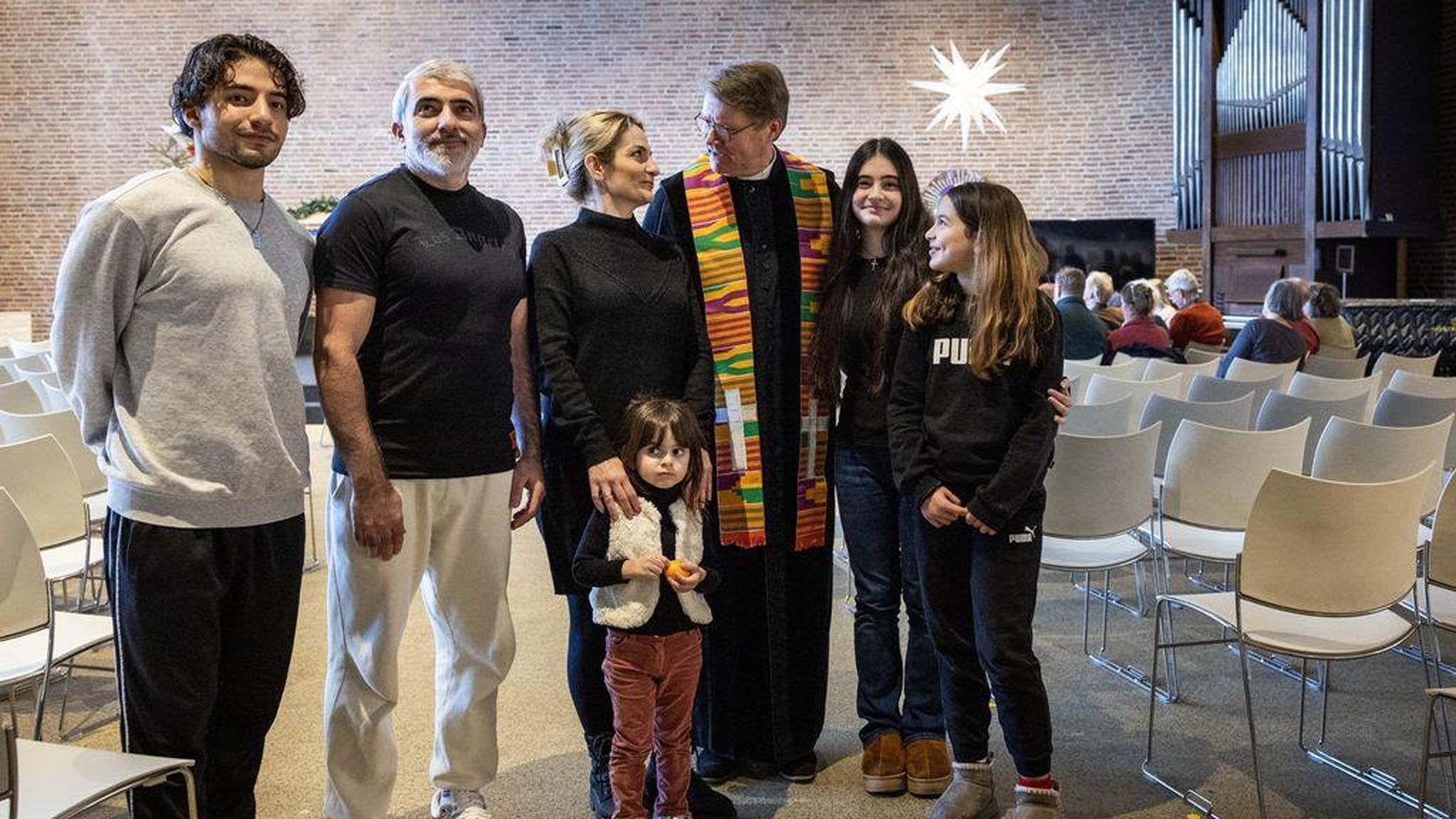
When the Babayants family sought refuge at the Open Hof church in Kampen on November 21, 2024, the congregation was working on a project centred on warm-heartedness. Herman Stomphorst, the church asylum coordinator, later recalled that their arrival coincided with discussions about setting up a refugee working group of the Dutch Council of Churches. No one anticipated how long the church’s commitment to refugees would be tested. Two years on, the test continues. The service that began that day has not stopped, and the family has not left the church building since.
The continuous service is for the Babayants family, a Christian family of six from Uzbekistan. Alexandr, his wife, their son Aram, 22, and daughters Ariana, 16, Amelia, 12, and Aleksa, 5, have lived in the Netherlands for 13 years. They applied for asylum in 2014, saying Alexandr feared persecution in Uzbekistan, but their applications have been repeatedly rejected. The two youngest girls were born in the Netherlands, and Ariana says she has no memories of Uzbekistan.
The arrangement rests on a provision of Dutch law that prevents authorities from entering a place of worship while a religious service is under way. The service at Open Hof has therefore continued around the clock, with prayers, sermons and hymns. More than 2,000 volunteers, both religious and non-religious, have filled the schedule, some travelling from abroad. Each two-hour block requires at least three people, adding up to about 50 volunteers a day. A December 2025 account by a German Protestant outlet described participants praying, singing, reading scripture and writing new songs at all hours.
A family of six confined
The Babayants family has lived in the Netherlands for 13 years. Before taking refuge at Open Hof, they moved between refugee centres. The days in the church tend to look alike, Ariana told Al Jazeera. Volunteer teachers arrive every weekday to conduct high school classes. But she misses the classroom, her friends and running outdoors in nature. To stay connected with people her age, she and Amelia opened a TikTok account and posted dance videos. They are locked up, she said, despite having done nothing wrong.
“We have traded our freedom for safety,” Aram Babayants, 22, said. The family’s only son has a modest wish: a letter from the tax office that would allow them to remain in the Netherlands. He and Ariana want to close this chapter and begin a free life, but cannot fully participate in the society in which they grew up.
The call
The church asylum episode began on October 28, 2024, when pastor Kasper Jager received a phone call asking whether his church could host the family. He agreed, knowing what he had to do. After seeking approval from the other parishes in Kampen and the Dutch church council, he found overwhelming support. Three weeks later, the family moved in.
Some other churches condemned the move as excessive activism. Jager, however, points to the example of Jesus, whom he describes as an activist who stood up for the most vulnerable. He has also stressed that the family’s Christian faith is incidental: the church, he said, would have done the same for a Muslim family. The motivation, in his view, is justice and humanity, not creed.
Beyond one family
Through the continuous service, the church has sought to highlight the inadequate recognition of children’s rights in Dutch immigration law. Asylum coordinator Stomphorst says the effort is focused on children’s rights, not the asylum procedure itself. He said that children who have grown up in the Netherlands and speak Dutch should not face deportation. While children’s rights are well represented in family and criminal law, he said, they are not an integral part of Dutch immigration law. Although he agrees that it is not a church’s role to engage in politics, he argues that something must be done when policy falls short of basic human dignity.
The church and its volunteers want the rights of all children enshrined in Dutch law. The latest government figures show that about 420 children have been waiting more than five years for an asylum decision. The campaign has drawn support well beyond the church community. The Dutch public broadcaster NOS reported that more than 800 churches rang their bells in support of the Babayants family.
The campaign has unfolded against a backdrop of rising anti-immigration sentiment in the Netherlands. Recent months have seen far-right demonstrators chant racist slogans, throw fireworks at authorities and attack refugee accommodation centres.
Waiting on politics and the courts
Politics has offered little relief. A minority government led by Prime Minister Rob Jetten took office in February 2026, replacing what is described as the most right-wing government in the country’s history. Open Hof pastor Jager said there had been hope that the new government would protect so-called “rooted children” – those who have spent most of their lives in the country or were born there – but little progress has been made.
There is, however, a glimmer of hope. In July, the Netherlands’ highest administrative court, the Council of State, ruled that three families should receive residence permits, giving greater weight to children’s rights and their long-standing ties to the country over the government’s aim of limiting migration. Jager was cautiously optimistic that the ruling could set a precedent, but warned that it could still take years before the Babayants family can safely leave the church.
How long can it go on?
When the church asylum began, Dutch media reported that the family could remain safely for at least several weeks. An earlier case in The Hague, in which Jager was involved, lasted 96 days. The Open Hof service has now run for more than seven times that long.
Stomphorst acknowledges that the service cannot continue indefinitely. How long it lasts, he said, depends on the congregation, the volunteers and, above all, the family itself. As long as the family can keep going, so can the church. In the meantime, a new two-hour block begins every two hours, as the next volunteers take their places.