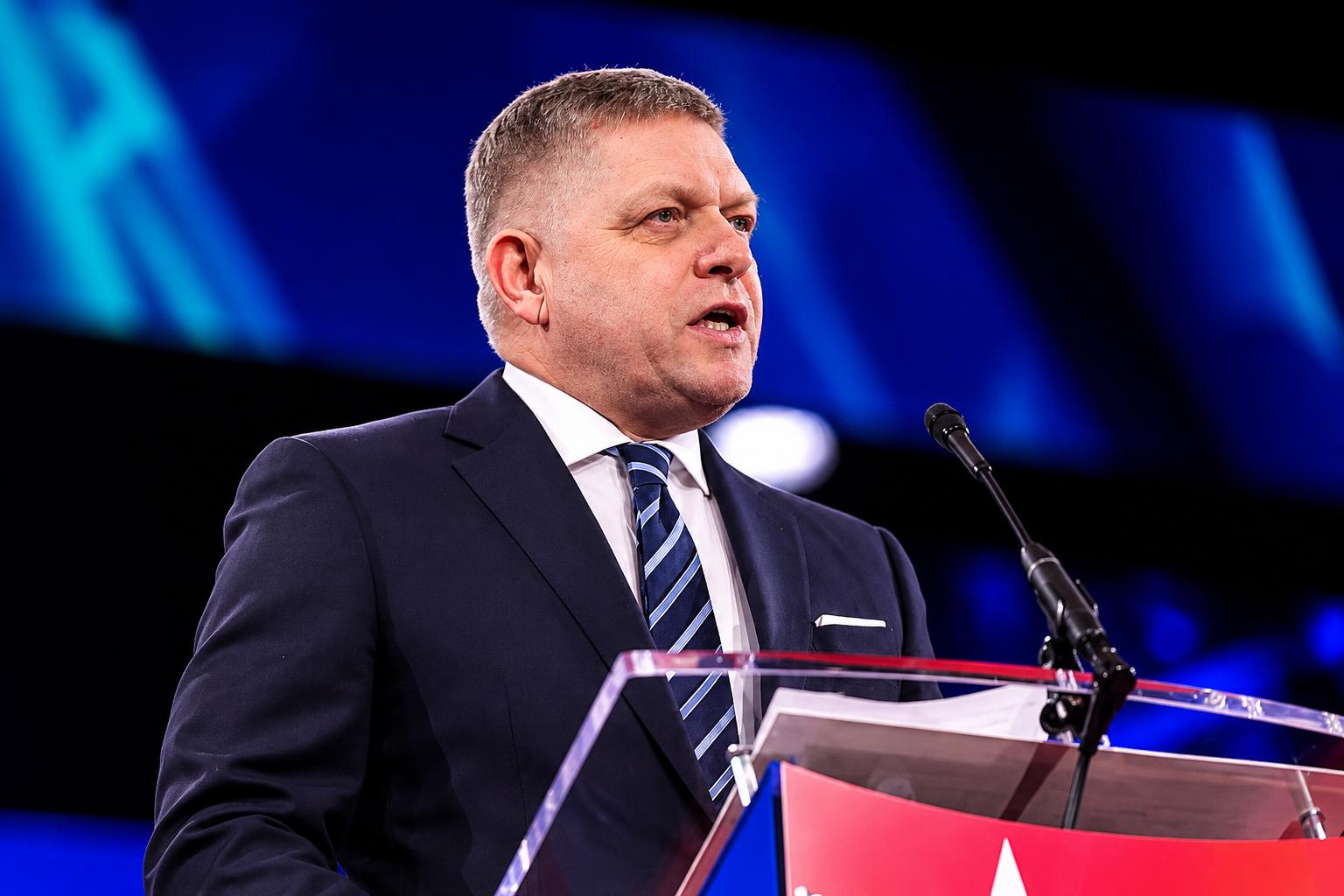
Slovak Prime Minister Robert Fico has refused to participate in a proposed €45 billion European Union loan for Ukraine, accusing Brussels of political blackmail and arguing that the financing amounts to gifts that Kyiv is unlikely ever to repay. His refusal has sharpened divisions within the EU over how to finance Ukraine’s continuing military and economic needs. While German Chancellor Friedrich Merz is pushing for all EU members to participate in Ukraine financing, Slovakia, Bulgaria, Hungary and the Czech Republic have resisted the proposed package. Merz has warned that he could block the EU's seven-year budget if member states fail to share the financial burden of supporting Ukraine.
Politico reported that Merz is seeking to make Ukraine aid Le Pen-proof, ensuring that funding remains secure even if far-right French leader Marine Le Pen comes to power following next year's elections. With the EU's next seven-year budget set to be discussed at the Brussels summit on November 26 and 27, the financing dispute is likely to feature prominently in negotiations.
The European Commission proposed the additional €45 billion loan on November 18 to help cover part of Ukraine's projected €70 billion financing gap for 2027. The package envisages €25 billion for military assistance and another €20 billion for budget support. Fico, in a video address posted on social media on Saturday, said Slovakia would not participate in the proposed financing, reiterating its decision to stay out of the earlier €90 billion Ukraine loan.
“As you know, Slovakia did not participate in the first €90 billion loan, and we want to do the same now, although we are being politically blackmailed by linking this loan to the EU budget,” Fico said. His remarks came ahead of talks among Eastern European leaders in Bratislava on Monday, November 23, and an extraordinary EU summit in Brussels later this week, where Ukraine financing and the bloc's long-term budget are expected to feature prominently.
Merz wants every country to pay
The dispute has intensified after Merz reportedly threatened to obstruct the EU's 2028–2034 budget unless all member states contribute to financing Ukraine. In a letter to European Council President Antonio Costa, the German chancellor argued that the burden of supporting Kyiv was unevenly distributed and called for all EU members to participate. Berlin's position aims to prevent a handful of countries from opting out of financing commitments while continuing to benefit from the broader EU budget and its programmes.
Fico, however, has rejected the linkage, arguing that Slovakia should not be pressured into financing Ukraine through negotiations over the bloc's wider budget. The confrontation pits Germany's push for collective responsibility against governments opposed to additional financial commitments to Kyiv, particularly military assistance. Fico also said the issue would be discussed at a Visegrád Group meeting in Bratislava on November 23. The group comprises Poland, the Czech Republic, Slovakia and Hungary. The Kyiv Post reported that Austria's prime minister would also attend the meeting.
Slovakia questions repayment possibility
Fico has also questioned the EU's decision to pursue additional financing while peace negotiations between Russia and Ukraine are taking shape. “At a time when peace talks are taking shape, the European Union wants to borrow €45 billion on international financial markets to support the war in Ukraine, knowing that Ukraine will not repay a single cent of this loan, just as it will not repay the €90 billion,” he said, adding that “Let's be honest, these are not loans, they are gifts.”
Under the Commission's proposal, Ukraine would repay the principal only after receiving war reparations from Russia, making repayment dependent on a future settlement and the payment of reparations. The financing would also be conditional on reforms, including measures to combat corruption and strengthen the rule of law. The proposed package would add to the substantial assistance already provided to Ukraine. According to the European Commission, the EU and its member states have provided nearly €238 billion in assistance since 2022.
Four countries resist participation
Slovakia is not alone in opposing participation in the proposed loan. Hungary, the Czech Republic and Bulgaria have also resisted, complicating the Commission's efforts to secure broad agreement. The four countries have differing political and financial concerns. Still, their opposition raises questions about whether Brussels can secure agreement from all 27 member states or will have to rely on an alternative financing arrangement.
The EU has already faced a similar challenge with its earlier €90 billion Ukraine loan, under which Slovakia, Hungary and the Czech Republic opted out. At the same time, the participating countries assumed the financial obligations under a special arrangement. That precedent offers Brussels a possible route forward if negotiations fail to secure wider participation. However, the new proposal and its connection to the EU's long-term budget could complicate matters.
The Commission has reportedly explored ways to separate civilian and military financing, potentially allowing countries reluctant to fund military assistance to participate in the civilian component. The proposal could offer a compromise, although no agreement has been reached.
Three compromise ideas
The dispute is now testing the EU's ability to maintain a common approach to Ukraine while accommodating governments opposed to further financial or military support. Merz's insistence that all members share the burden is also tied to negotiations over the next long-term EU budget, giving the financing dispute a broader political dimension. If the four countries continue to resist, Brussels could seek a compromise involving differentiated participation, financial guarantees or another arrangement allowing willing member states to proceed.
One possibility is differentiated participation, allowing countries reluctant to finance military assistance to contribute to the civilian component of the proposed loan. Under this approach, the €20 billion earmarked for budget support could be separated from the €25 billion military component, enabling governments to avoid directly financing military aid while participating in the broader funding framework.
A second option is to repeat the arrangement used for the earlier €90 billion loan, under which Slovakia, Hungary and the Czech Republic opted out, while participating countries assumed the financial obligations under a special arrangement. This could allow the EU to proceed without requiring all member states to contribute.
A third possibility is to restructure the financing through alternative guarantees or a coalition of willing countries, potentially bringing in other European partners such as the UK to help finance Ukraine if agreement among all EU members proves difficult.
Analysts believe Merz may ultimately refrain from exercising his budget veto. Meanwhile, the European Commission could seek to persuade the dissenting countries to accept differentiated participation, allowing them to contribute to civilian support while staying out of military financing.
EoM-------------------