About 100 students, parents, faculty members and alumni packed a Cornell University auditorium last week for a hearing that quickly became less about one alleged assault than about the institution’s response to it. Some wept as participants described their own experiences of sexual violence. Sophomore Jane Wang said that reading the allegations felt like reading “my own personal testimony”, telling the hearing she was “also speaking as Jane Doe”.
The case concerns a woman identified as Jane Doe, who said that, at 20, she was sexually assaulted by seven members of the Chi Phi fraternity for hours in October 2024. Her lawsuit, filed in mid-September, alleges that the incident involved alcohol and the drug ketamine, and that Cornell failed to protect her or adequately punish the men involved. The allegations have yet to be proven. Four of the fraternity members acknowledged sexual contact but said it was consensual, while a lawyer for one of the accused men argued that her original sworn statement described the conduct as voluntary. None of the claims has been tested in court.
What has made the case a national story is not only the allegations, but what followed. Cornell says its internal process resulted in two men being expelled, two suspended for at least two semesters, one graduating before any punishment could be imposed and two found not responsible. No one was arrested. The lawsuit brought those outcomes into public view, while coverage by the Cornell Daily Sun intensified scrutiny. A local prosecutor reopened the criminal investigation; Governor Kathy Hochul, who said she was “deeply disturbed”, handed a review to Attorney General Letitia James; and Senator Chuck Schumer demanded an independent inquiry into “how this case was handled”.
Cornell president Michael Kotlikoff eventually broke his silence in an eight-minute video, calling the allegations “deeply disturbing” and “a defining moment” for Cornell. The university, he said, “must do better”, backing the outside investigations and calling for a “serious look” at fraternities and sororities.
The reaction is fuelled by a larger concern. Cornell’s 2025 survey found that 35 per cent of undergraduate women reported experiencing non-consensual sexual contact during their time at the university. At Harvard, a student columnist wrote that they were “not surprised that this happened at an Ivy League institution”, recalling that after reporting an assault to Harvard’s Title IX office they were offered three options: a formal complaint, an informal complaint or nothing.
For Lisa Wade, an associate professor at Tulane University and author of American Hookup: The New Culture of Sex on Campus, that familiarity is crucial. “There are so many people in America who find this so familiar,” she said.
The question now extends beyond what happened inside one fraternity house. It is whether universities have built systems that students can trust to investigate sexual violence transparently, hold powerful organisations accountable and protect those who report it.
Students are demanding accountability
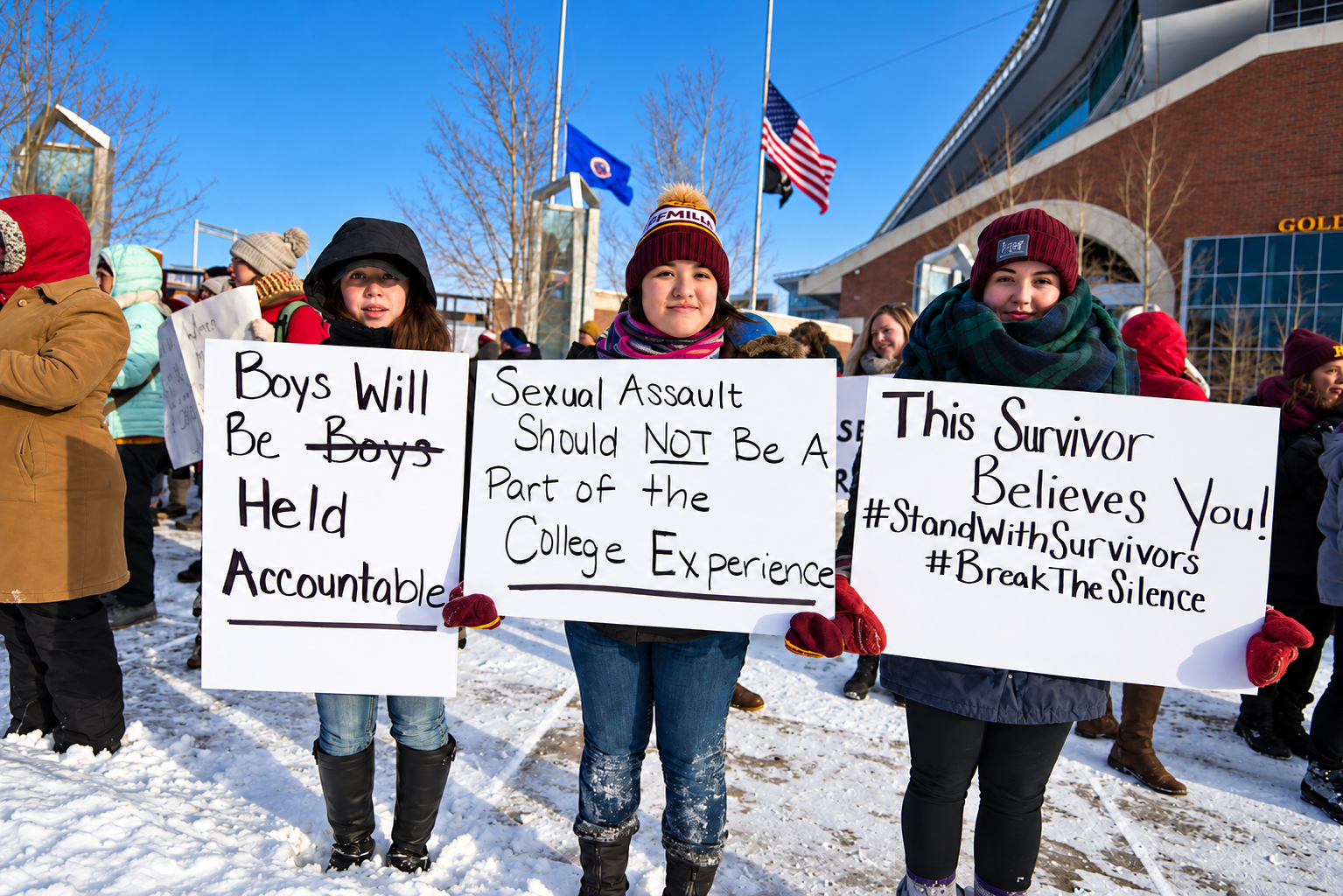
At Cornell’s hearing, students voted unanimously for three resolutions calling for a review of how the university coordinates with law enforcement, stronger protections for people who report assaults and an undergraduate task force. One speaker demanded “transparency from Cornell administration” through a detailed, multi-step plan.
Student leader Adriana Vink said students feel Cornell is “complicit in rape culture”, while junior Sim told the hearing that Cornell “has failed our community”. Student groups planned a campus protest, while Congresswoman Alexandria Ocasio-Cortez, speaking at a Cornell town hall, said of Jane Doe’s treatment: “never again”.
The phrase “rape culture” is contested, and one case cannot establish that an entire university has such a culture. But it reflects a broader argument: sexual violence cannot be addressed only through disciplinary procedures after an incident. Universities must also examine the social environments and power structures in which students live.
That is particularly relevant to fraternities, which can occupy an unusually powerful position in American university life. Many fraternity houses are privately owned, while alumni networks can give them considerable financial and social influence. Nick Syrett, a University of Wisconsin-Madison professor and author of a history of white college fraternities, said the criticism of fraternities “seems pretty warranted”.
Elizabeth Allan, a professor of higher education at the University of Maine and director of its Hazing Prevention Research Lab, says the persistence of such problems points to the limits of incremental reform. “It’s a horrifying but familiar story on many campuses,” Allan said, arguing that the failure of successive reforms shows “how entrenched some of the behaviours are and that we need to take an approach that’s transformative”.
Cornell philosophy professor Kate Manne has similarly argued that the problem cannot be understood simply as individual misconduct. Writing about an event at which sexual-assault survivor and author Chanel Miller spoke to Cornell fraternity members, Manne described seeing some students “scroll, bored, on their phones”.
“There’s a prevailing sense that campus culture is rape culture, especially in fraternity houses: it’s a deeply embedded feature of life here that is widely known but rarely protested,” Manne wrote.
The underlying issue is therefore not simply whether universities have rules. Most do. It is whether those rules are applied transparently, whether students trust the people administering them and whether institutions are prepared to scrutinise powerful groups within their own communities.
A global accountability problem
The Cornell case is part of a much wider reckoning. The details differ between countries, but the pattern is familiar: an individual case or a large-scale survey exposes a problem; students protest; the institution promises reform; and questions remain over whether the structures that produced the problem have actually changed.
In Australia, a 2017 national inquiry documented sexual assault and harassment at universities. A 2021 follow-up found that 4.5 per cent of students had been sexually assaulted since starting university, while just 29.7 per cent of those who reported an incident were satisfied with the process.
In Britain, the Everyone’s Invited website received 1,035 testimonies naming 86 universities in a single week in 2021. In India, the alleged gang rape of a first-year student at South Calcutta Law College in June 2025 closed the campus for more than a week. Police later filed a 650-page chargesheet against four people. The accused had ties to a powerful campus institution — in this case, a ruling party’s student wing — prompting accusations that political influence could shield perpetrators.
The circumstances differ, but the question is strikingly similar: who investigates the institution when the institution itself is part of the power structure surrounding the alleged misconduct?
That question is becoming harder for universities to avoid.
The politics of self-regulation
The Cornell protests are unfolding at an especially awkward moment for American universities. Since 2025, elite institutions have been fighting the Trump administration over federal funding, antisemitism, diversity policies and the interpretation of civil rights law.
Cornell is a case in point. The administration froze more than $1bn in funding, and in November 2025 Cornell agreed to pay $60m to restore more than $250m in research funding. It also accepted the administration’s interpretation of civil rights law and agreed to report admissions data to the government through 2028.
The irony is difficult to miss. Universities have spent the past two years arguing that they need autonomy to govern themselves and protect academic freedom. Their students are now asking a complementary but uncomfortable question: if universities govern themselves, who holds them accountable – and whether a university can protect the rights of an accused student while being transparent about its procedures, decisions and institutional responsibilities.
The pressure at Cornell has come largely from below. Students organised the hearing, demanded transparency and pushed for changes in how the university handles sexual violence. Similar pressure has emerged elsewhere through student protests, survivor testimonies, campus journalism and national inquiries.
A reporting mechanism is not enough if students do not trust it. A disciplinary system is not enough if its decisions are opaque. A task force is not enough if its recommendations do not change institutional behaviour. And a university statement promising to “do better” means little if students cannot see what has changed.
That is why the Cornell hearing matters beyond Cornell. The allegations at its centre will have to be tested through the appropriate legal and institutional processes. But the student response has already raised a much larger question, one that extends from Ithaca to Harvard, Melbourne, London, New Delhi and Kolkata: what does accountability look like inside an institution powerful enough to investigate itself?
For years, universities around the world have responded to sexual violence with policies, committees, reporting procedures and training. The growing student protests indicate that the next phase of the reckoning is about something harder to institutionalise: accountability itself.
And that may be the one thing universities can no longer simply put in a policy document.