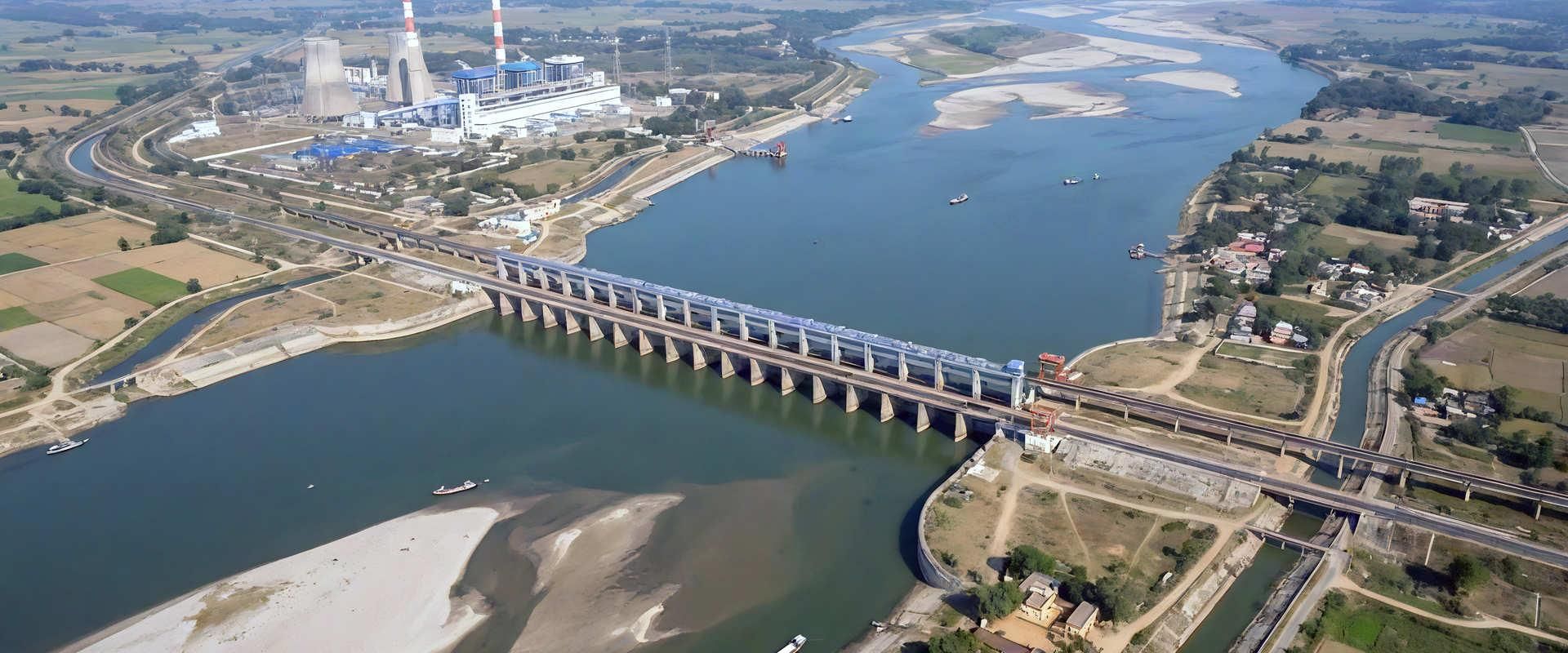
When the 1996 Ganga Water Treaty expires on December 12, it will not simply mark the end of a technical arrangement governing how much river water flows past the Farakka Barrage into Bangladesh each dry season. It will also mark the moment when two separate but connected tests converge on Prime Minister Narendra Modi’s government: one diplomatic, playing out in an already-frosty relationship with Dhaka, and one political, playing out inside his own coalition in Bihar.
Bangladesh’s water resources minister, Shahid Uddin Chowdhury Anee, has told The Print in an exclusive interview that Dhaka wants a renewed treaty to reinstate a “guarantee clause” assuring it a fixed minimum flow of water during the river’s leanest fortnight, from April 21 to May 31. The clause, he pointed out, existed in a 1977 agreement between the two countries but was dropped when the current treaty was signed in 1996. “It’s a high priority for us,” Anee said, adding that the renegotiated pact must reflect both countries’ interests. He also credited the government of Prime Minister Tarique Rahman – sworn in only in February, after Bangladesh’s first elected government since the 2024 uprising – with placing “the people's interest” at the centre of the upcoming negotiations, contrasting that with what he meant as the 17 years of Sheikh Hasina-led rule that preceded it.
That confidence from Dhaka, however, is up against a rebellion brewing much closer to Modi.
Bihar draws a line
Long before India and Bangladesh have formally sat down to renegotiate, the Janata Dal (United) – Chief Minister Nitish Kumar’s party and a pillar of the ruling National Democratic Alliance both in Bihar and at the Centre – has mounted an increasingly vocal campaign against renewing the treaty at all. JD(U) national working president and Rajya Sabha MP Sanjay Kumar Jha has argued that “the treaty should not be renewed”, blaming it for silting upstream of the Farakka barrage and for a lean-season formula that, he claims, obliges India to release far more water than actually reaches Bihar at Buxar.
This isn’t a fringe protest. In early September, the JD(U) formally launched a state-wide outreach drive titled “Nitish Samvad on Farakka Water Treaty” from Bihar’s Buxar – the point where the Ganga enters Bihar – to carry the issue “to Bihar’s doorsteps” ahead of the December deadline. Jha has demanded that Bihar’s water needs be assessed all the way to 2050 and that the state be given a seat at the negotiating table, and has written on X that India “should allow it to lapse and negotiate afresh based on the scientifically assessed water needs of Bihar and other basin states.” He has also called the pact “one-sided” and told reporters, “This treaty should be terminated. It should not be renewed.”
The JD(U) is the second-largest party in the NDA’s landslide win in the November 2025 Bihar Assembly election. Its objections, therefore, carry real political weight, not least because they revive a decades-old regional grievance: successive Bihar governments have long argued that the Farakka arrangement, engineered chiefly to serve Kolkata port and West Bengal’s interests, causes upstream flooding and siltation that Bihar is left to absorb.
A test that stretches beyond the Ganga
For the BJP, this poses a delicate balancing act on two fronts simultaneously.
First, there is the alliance-management problem. The JD(U) has broken with the BJP before – most notably in 2013, when it ended a 17-year partnership over Narendra Modi’s elevation within the party – and both Bihar’s coalition and Modi’s national government’s arithmetic remain delicately poised even after November’s emphatic win. Having a key ally publicly campaign against a foreign-policy commitment the Centre may eventually have to defend forces the BJP to either tacitly endorse Bihar’s grievances, at the risk of complicating negotiations with Dhaka, or push back against its own coalition partner’s signature campaign, at the risk of reopening old alliance wounds barely a year into a fresh term.
Notably, Jha has continued to insist that his advocacy is not politically motivated even as he has met Union ministers Nirmala Sitharaman and S. Jaishankar alongside Bihar’s BJP leadership to press the case – a sign that the Centre is already being drawn into managing the optics.
Second, there is the foreign-policy problem, and it could hardly have arrived at a worse moment for New Delhi. Ties with Dhaka have remained cold since Tarique Rahman’s government took charge in February. A planned state visit by Rahman to India was cancelled at the last minute in August — complicated further by a press briefing given by the India-based, ousted former premier Sheikh Hasina on August 5. Rahman also skipped the BRICS Leaders’ Summit in New Delhi despite an invitation extended to him as chair of BIMSTEC, and Dhaka sent no representative at all. India, for its part, was also seen delaying the approval of Bangladesh’s nominee as its next High Commissioner to New Delhi, weeks after the request was made. Against that backdrop, a treaty renegotiation snagged by domestic Indian politics is precisely the kind of friction Delhi can ill afford if it wants to demonstrate, as it has tried to through gestures such as upgrading its own High Commissioner to Dhaka to Cabinet rank, that it still values the relationship.
The weight of history
The dispute over a guaranteed minimum flow is not new – it is, in many ways, the ghost that has haunted Ganga water-sharing since the Farakka Barrage first began diverting river flow in 1975 to flush silt from Kolkata port. Bangladesh took its objections to the United Nations that year, which eventually produced a five-year agreement in 1977 that did contain a guarantee clause, assuring Dhaka at least 80 per cent of its allotted share regardless of circumstances.
When that agreement lapsed in 1982, India declined to renew it in the same form; two subsequent memoranda of understanding, signed through the 1980s, dropped the guarantee clause altogether, and between 1989 and 1996 there was no water-sharing arrangement at all – a vacuum that soured relations for years. The 1996 treaty, signed by then Prime Minister H.D. Deve Gowda and Hasina, restored a formula-based sharing mechanism but stopped short of any guaranteed minimum, providing instead that the two sides would hold “immediate consultations” if flow at Farakka fell below 50,000 cusecs.
That unresolved question – a fixed guarantee versus an emergency-consultation clause – is exactly what Dhaka now wants reopened, and exactly the kind of concession that would need to be weighed against Bihar’s demand that any new formula first account for the state’s own water needs.
Delhi’s narrowing room
A parliamentary standing committee on external affairs, chaired by Congress MP Shashi Tharoor, has already flagged the risk of delay, urging the government to begin bilateral talks “at the earliest” to avoid a vacuum after December, while also recommending that both West Bengal and Bihar be consulted to keep state-and national-level interests aligned. The Indo-Bangladesh Joint Rivers Commission last met for technical discussions in Kolkata in May, and minister Anee has indicated it will reconvene soon, but formal renegotiation is yet to begin in earnest with barely two months left on the clock.
That leaves the Modi government threading a needle from both ends: reassure a wary, newly elected government in Dhaka that India remains a reliable water-sharing partner – one it needs on connectivity, trade and internal security matters too — while placating a coalition partner in Patna that has turned a hydrological grievance into a full-blown public campaign. How Delhi resolves that tension over the next ten weeks may say as much about the durability of the ruling BJP-led National Democratic Alliance at home as it does about the future of India’s most consequential river relationship with its eastern neighbour.