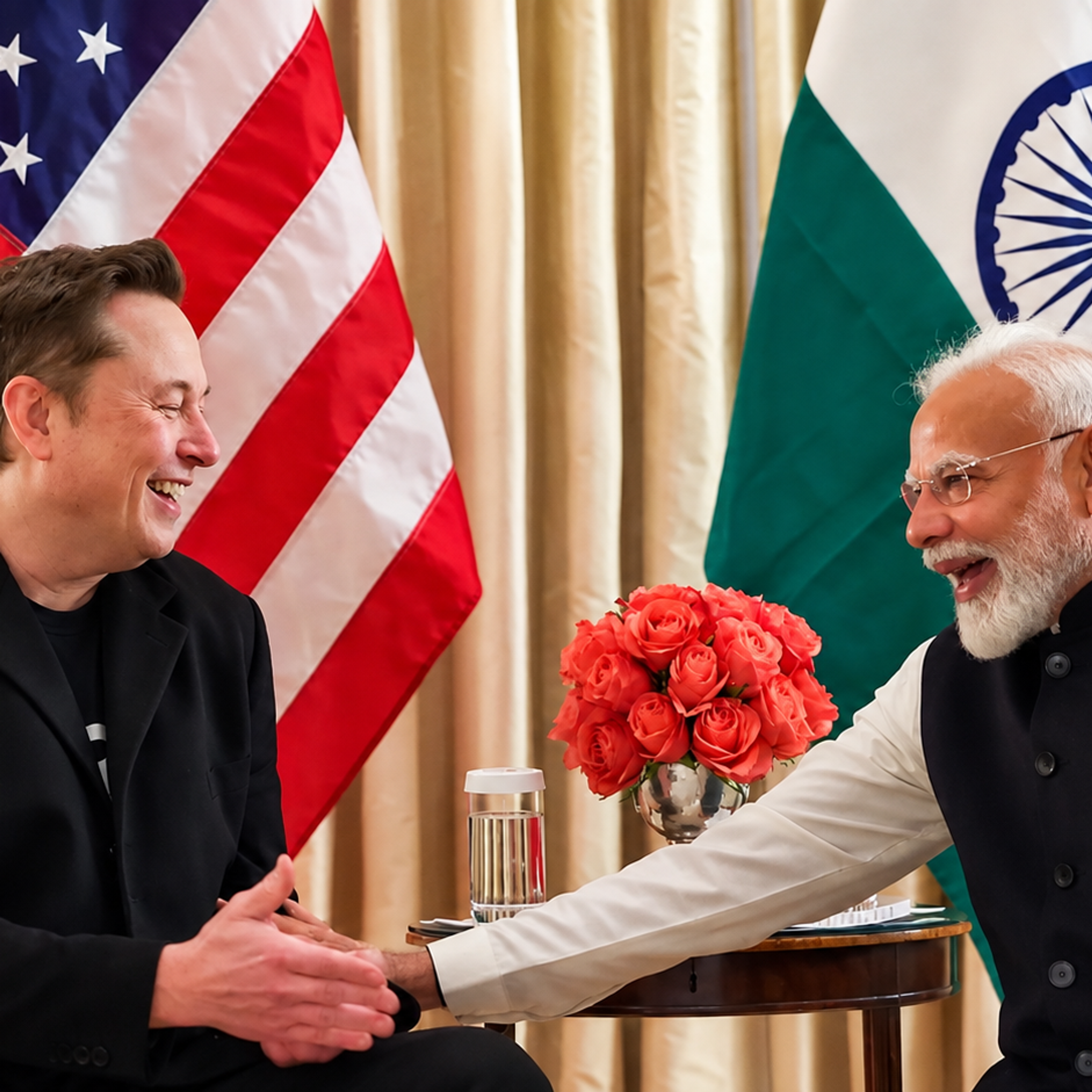
Escalating his public attacks on the Indian government, Elon Musk sarcastically addressed Reliance Industries chairman Mukesh Ambani as “Prime Minister Ambani” in an X post on October 9, continuing a three-day public attack over Starlink’s delayed entry into India. The government says security clearance and unfinished spectrum rules apply to every satellite operator and are holding up the launch.
In his X post, Musk said, “Please accept my humble apologies for not realising that you are the real boss of India. Naturally, you would prefer to maintain your monopolistic exploitation of the great people of India, but would you nonetheless consider allowing Starlink to compete?” Though Musk did not name Prime Minister Narendra Modi in his post, it was clear he was taking a veiled dig at the PM. Reliance and Jio have not commented, and Akash Ambani declined to comment when asked at the India Mobile Congress, Indian media portal ThePrint reported.
Social media reactions were mostly negative, with many questioning Musk's right to dictate terms to a government. Some users suggested Musk was trolling for fun, since public attacks rarely pressure the Indian government into granting licences. Others asked whether the US would let China’s BYD challenge Tesla, implying every country has its own security concerns.
Continuous attacks
Musk has posted eight times on the subject since October 7, the same day Starlink’s vice president, Lauren Dreyer, told the India Mobile Congress the company was ready to serve India when the country is ready. That evening Musk alleged that Starlink was being blocked in India by “certain oligarchs” and called it a crime against Indians. Opposition leader Rahul Gandhi joined in, saying Musk should “wait till you discover the other guy,” without naming anyone. The opposition’s intervention shows how quickly a licensing question has become a domestic political fight, which is the outcome a regulatory process is meant to avoid.
However, the Indian Ministry of Communications called the suggestion that its framework is unfair “baseless and misconceived.” The ministry said all three satellite licensees were at “broadly the same regulatory stage.” That is a point about process: a framework applied to three companies at the same stage cannot easily be unfair to one of them. Sunil Bharti Mittal suggested the same thing. His Eutelsat OneWeb is awaiting approvals, and so is Reliance Jio’s Jio-SES venture. Musk replied that Starlink is licensed in over 165 countries and has spent five years complying with Indian law. That is useful context, but being licensed in 165 countries doesn’t automatically grant a licence in the 166th, especially in a major economy like India.
Indian government’s concerns
Indian Communications Minister Jyotiraditya Scindia rejected Musk’s claims. He said India does not permit monopolies in any sector. “Now let me be very clear, India does not allow monopoly in any sector… even as satcom is concerned, there is not a single licensee that has been chosen. Licences have been given to everyone who wants to provide these licences,” he explained. He said three companies hold licences (Starlink, Jio Satellite Communications and Bharti-backed Eutelsat OneWeb). Each can start once it clears security and the government assigns spectrum after fixing the revenue-based charge. Minister of State for Telecom Chandra Sekhar Pemmasani added that the file was with the Home Ministry and had nothing to do with one company. The ministers’ message is consistent: no one has been picked, and no one has been shut out.
Though not said in so many words, the government has been weighing security concerns. Reported recoveries of Starlink equipment in the Indian state of Manipur and the Andaman and Nicobar Islands have raised the alarm. The government insists it should monitor and control traffic from Indian users within the country. Licence conditions include lawful interception, data localisation and the ability to restrict service in specific areas or for specific users in an emergency. Each gateway site needs separate security clearance. Starlink must also provide call data records to agencies on request and, in a crisis, switch off services. These are not exotic demands. They are what a state with sensitive borders would ask of any network operating over its territory.
Indian officials say Starlink’s design complicates national compliance. Its satellite constellations are not country-specific, and they relay data through inter-satellite laser links, so authorities examined whether Indian traffic could bypass domestic gateways. The government has also sought assurances that it can control the Starlink network in an emergency or conflict, a concern partly tied to Starlink’s use in Ukraine. This is the heart of the matter: the worry is less about Starlink as a company than about a network built to ignore borders. Bloomberg reported that Home Ministry agencies declined to issue operating permits, citing doubts about controlling a US-based operator amid geopolitical tensions. It separately reported in June that clearance was held back after Starlink terminals were used in Iran. Starlink denied that.
Musk denied this week that a Manipur kit was used by militants, saying Starlink’s beams are turned off over India. India is entitled to verify that claim rather than take it on trust.
What else is pending
Starlink Satellite Communications is a wholly owned SpaceX subsidiary, and its FDI proposal was still pending on October 8, with officials having raised questions in May about its structure. The Digital Communications Commission approved a 5 per cent spectrum charge on adjusted gross revenue on September 3, and it awaits Cabinet approval. None of these approvals sits with a business rival.
Starlink says it is prepared. Its vice-president Lauren Dreyer said it has 20 gateway sites with hundreds of antennas in India and India-specific controls to keep user data in the country. It has also been onboarded by Unique Identification Authority of India (UIDAI) for Aadhaar-based customer verification. Preparation is to Starlink’s credit, but readiness is not the same as clearance.
Everybody is waiting
Despite his high-profile attacks, Musk’s suggestion that Starlink is being singled out does not match the facts. It is not just Starlink: the other two players are also waiting for clearances from the Indian government, at different stages. Bharti-backed Eutelsat OneWeb said this week that it has cleared all licensing hurdles and awaits only final security approvals. Ambani’s Jio venture with Luxembourg-based SES, Orbit Connect India, also holds licences. Amazon’s Kuiper, now Amazon Leo, is still awaiting its licence. Ambani’s own satellite venture is in the same queue as Musk’s.
Jio has also shifted from Starlink partner to competitor. It signed a deal in March 2025 to bring Starlink to its customers. It is now reportedly weighing its own constellation of 1,600 to 1,650 satellites, estimated to cost $10 billion to $15 billion. Jio’s interest as a rival is real and deserves scrutiny, but a motive is not proof of influence. Ambani argued in late 2024 for auctioning satellite spectrum. India instead chose administrative allocation, the route Musk had backed. On the one point where the two men’s interests clearly diverged, the state sided against Ambani.
A long wait
Starlink’s difficulties began in 2021, when the government told it to stop pre-selling service without a licence. It received its GMPCS licence in June 2025, IN-SPACe authorisation in July 2025 and trial spectrum that September. It is a long wait, but a timeline set by sequential approvals is not the same as a blockade. When Jio and Airtel signed their Starlink deals in 2025, the Congress alleged the prime minister orchestrated them to buy goodwill with Donald Trump through Musk. Now, for whatever reason, Musk has publicly objected to India's approval process. The Indian government may not take this easily, given its security concerns tied to its geography.