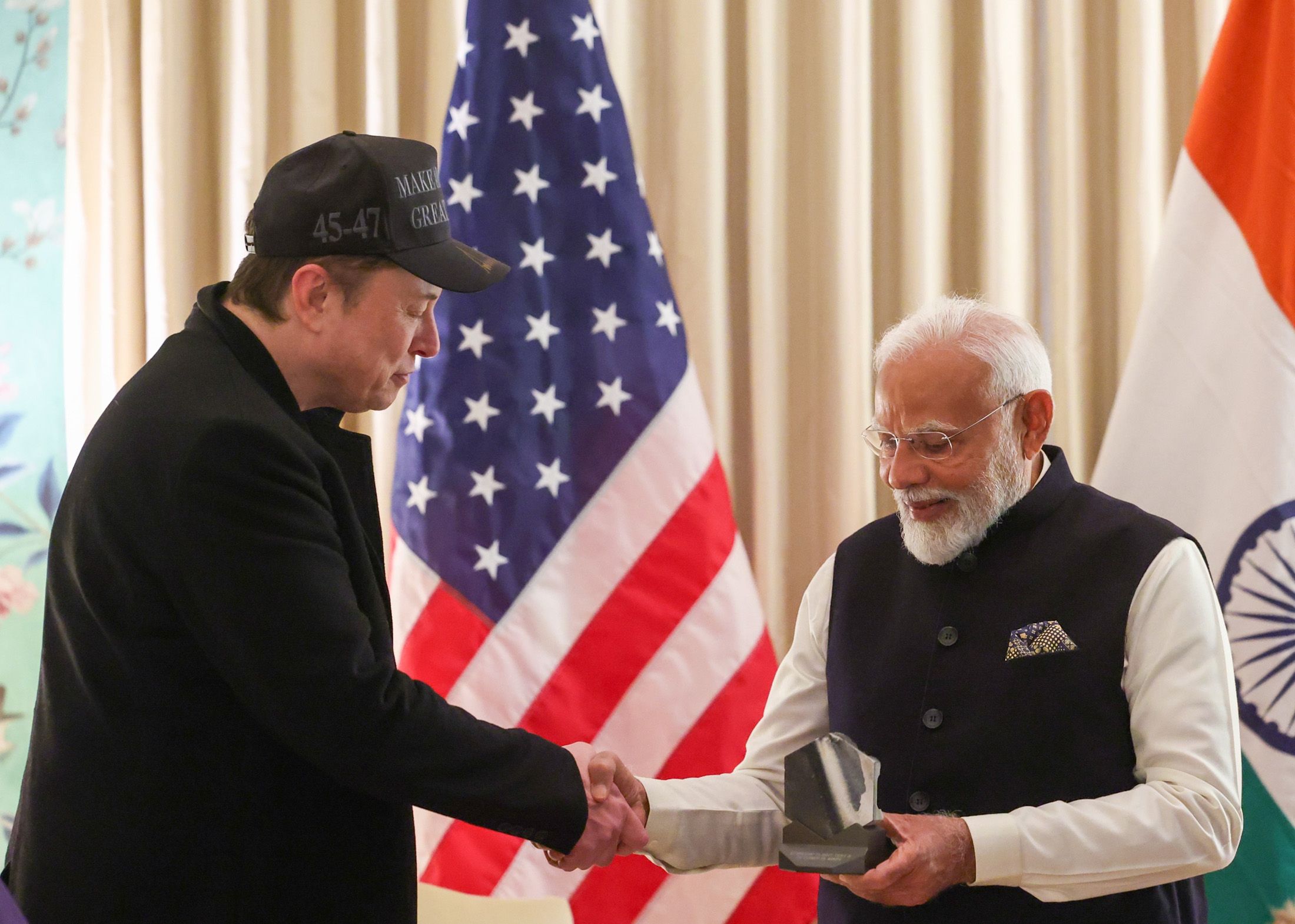
For five years, Starlink has tried to sell satellite broadband in India, where over 11,200 villages still have no 4G signal and two operators, Reliance Jio and Bharti Airtel, serve more than 80 per cent of broadband users. On October 7, Elon Musk blamed the delay on “certain oligarchs” protecting a “monopolistic chokehold”, calling it “a crime against the people of India”. He named no one and offered no evidence, but the remark was widely read as aimed at Mukesh Ambani of Reliance and Sunil Bharti Mittal of Bharti Airtel. New Delhi responded that its regulatory framework for satellite services is fair.
Musk was replying to a post arguing that satellite broadband could reach villages, schools and clinics beyond the range of fibre and mobile networks. “You can guess who they are,” he wrote. In a separate post, he said Starlink would “enable high-speed, affordable internet connectivity for those who cannot afford current prices”. At India Mobile Congress in New Delhi the same day, Lauren Dreyer, Starlink’s vice-president of business operations, said: “We are standing ready to serve India once India is ready.”
A long wait
Starlink has been trying to operate in India since 2021, when the government advised people not to subscribe without a licence and told the company to stop taking bookings and ordered it to halt services.
Progress has since come in stages. The Department of Telecommunications (DoT) granted Starlink a GMPCS (global mobile personal communication by satellite) licence in June 2025, the key requirement for commercial satellite operations. Space regulator IN-SPACe authorised its first-generation constellation the following month. Starlink became the third operator, after Eutelsat OneWeb and the Reliance Jio-SES venture, to clear these hurdles.
Commercial service, however, still remains out of reach. Starlink, OneWeb and Jio Satellite all need spectrum and second-stage security clearance, according to reports on the government’s latest spectrum decision. Starlink, which is wholly foreign-owned, also needs foreign-investment approval, which OneWeb and Jio Satellite do not.
What is Starlink?
Starlink is the satellite internet service of SpaceX, which Musk founded in 2002. Thousands of small satellites in low-Earth orbit deliver high-speed broadband to areas that fibre and mobile networks do not reach. Commercial service began in 2021, and the network now has about 11,000 satellites serving users in more than 170 countries. In India, Starlink has built 20 gateway sites and is seeking approval for nearly 30,000 second-generation (Gen 2) satellites.
Why it matters to India
Of India’s 1.093 billion internet subscriptions in March 2026, only 440.87 million were rural. Rural subscription density was 48.31 per 100 people, against 126.80 in urban areas. Fibre has not closed the gap: BharatNet has made about 221,000 Gram Panchayats (village councils) service-ready, but only 80,472 points of presence were operational in June 2026. Wired connections account for just 4.26 per cent of subscriptions. The government itself cites difficult terrain, low commercial viability and infrastructure constraints.
Starlink’s satellites can reach villages, mountains and islands where extending fibre or mobile networks is difficult. Dreyer told the conference that better links could let rural schools offer online learning, clinics hold remote consultations and small businesses reach more customers. Portable terminals could give emergency teams backup connectivity when floods, earthquakes or storms damage ground networks, and Direct to Cell could connect ordinary 4G phones beyond tower coverage, subject to approvals. “With Starlink, people can get connected within minutes, not years,” Dreyer said.
Why has approval taken so long?
The delay is not only a matter of paperwork. Operators must comply with rules on national security, sovereignty and local participation. These include routing satellite traffic through India-based data centres and points of presence, which raises costs for foreign firms, and integrating the indigenous NavIC navigation system, which adds technical complexity.
Security agencies have also been wary since a Starlink device turned up in a raid in India’s conflict-ridden province Manipur in December 2024. Musk, however, responded that Starlink beams were turned off over India. In June, Bloomberg reported that Home Affairs Ministry agencies had withheld final clearances, partly over the use of Starlink terminals in the Iran war. Starlink called the report misleading and said its talks with the government were “active and productive”. The union government has separately warned the company over signing agreements with state governments before securing a nationwide licence.
Spectrum, the radio frequencies on which satellites operate, is the most contentious issue. The Digital Communications Commission, the DoT’s apex decision-making body, has approved a spectrum usage charge of five per cent of annual adjusted gross revenue (AGR), or four per cent in rural and remote areas, with a five-year tenure extendable by two. Starlink and Amazon’s Kuiper (now Amazon Leo) had sought a charge below one per cent. The government has yet to decide how administratively assigned spectrum will be priced.
The ‘oligarchs’ and their stake
Reliance and Bharti have spent years building satellite ventures, through Jio Satellite Communications and Eutelsat OneWeb, whose parent group Mittal co-chairs. OneWeb received IN-SPACe authorisation in November 2023 and is still awaiting spectrum. A well-funded foreign rival entering the same market is a clear commercial threat to both groups.
Their influence on policy has been most visible in the spectrum debate. Reliance Jio argued that satellite spectrum should be auctioned, as mobile spectrum is, to protect operators that paid for airwaves and built towers. Mittal backed the bidding in October 2024, and at a regulatory hearing Jio and Airtel pressed for the same terms and pricing for satellite and terrestrial services, prompting Musk to call the auction demand “unprecedented”.
On that point, the incumbents lost. Telecoms minister Jyotiraditya Scindia said spectrum would be assigned administratively, as is the global norm, and the commission’s September decision confirmed there would be no auction. The DoT also dropped a proposed per-subscriber levy on urban users. The rules that fall hardest on Starlink, such as foreign-investment approval and local data routing, are set by the government, and no evidence has been published that either businessman shaped them.
SpaceX had earlier announced partnerships with Jio and Airtel to distribute Starlink in India but service has not started.
What happens next?
Starlink has reapplied to IN-SPACe for its Gen 2 constellation, which would operate at 340-615 km and add capabilities including direct-to-device connectivity. IN-SPACe had earlier rejected a 30,000-satellite application because some features and spectrum bands did not conform to Indian requirements.
Starlink is not the first Musk venture to find India’s approval process slow. Tesla first teased an Indian launch in April 2016, but it took nine years to open its first showroom, in Mumbai in July 2025. Earlier plans were shelved over import duties and policy hurdles, and talks about building a factory in the country fell through. Musk called India’s duties among the “highest in the world”, while New Delhi offered lower rates only to carmakers that committed to investing hundreds of millions of dollars and manufacturing locally. Tesla opted to import instead, and its cars still face duties that can exceed 100 per cent, which put the Model Y at about US $70,000, nearly double its US price. As with Starlink, the sticking points lay largely in government policy, though Tesla’s dispute centred on tariffs rather than on any domestic rival.
Musk’s latest public attack may complicate matters for Starlink, since the Narendra Modi government has rarely welcomed foreign executives accusing domestic business groups of misconduct. Yet India’s stated aim of bringing affordable internet to hundreds of millions of unconnected citizens gives Starlink a genuine public-interest argument. India is also a crucial prize for a company that remains shut out of China.